Uttar Pradesh adopts multi layered approach for river conservation
Source:The Hindu ↗
Why It Matters
Crucial for understanding environmental governance, river conservation initiatives, and technological deployment (like drones) for pollution control in Uttar Pradesh, aligning with state-specific administrative measures frequently tested in UPPSC PCS.
Summary
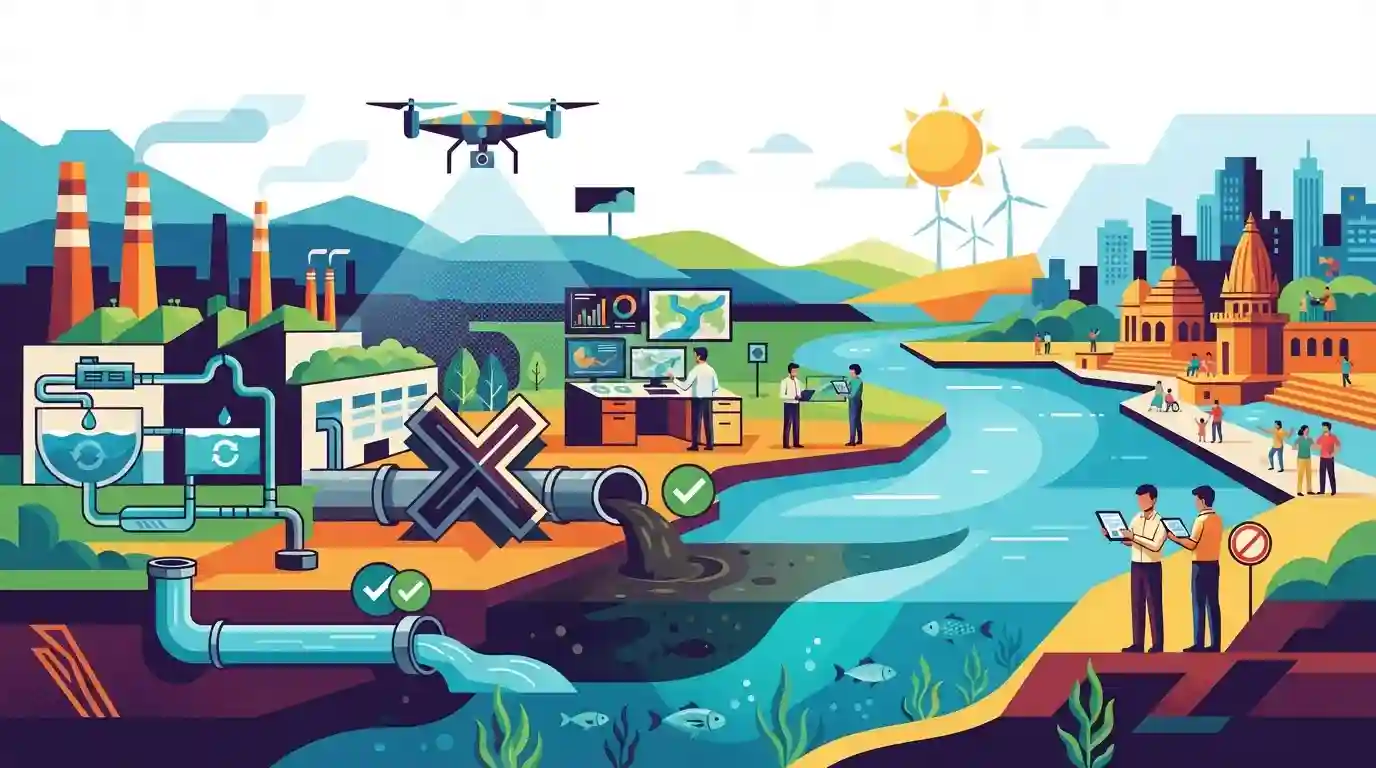
The Uttar Pradesh government has adopted a multi-layered approach, including drone surveys, to monitor and enforce zero discharge into rivers, aiming to curb water pollution in key water bodies such as the Ganga and Yamuna.
Key Points
- Uttar Pradesh implements a multi-layered approach to ensure zero discharge of untreated waste into rivers.
- The strategy includes the use of drone surveys for monitoring drainage systems and pollution hotspots.
- Focus is placed on improving water quality, sewage treatment plants (STPs), and industrial effluent monitoring across the state's major river basins like the Ganga and Yamuna.
Important Terms
National Green Tribunal

An apex judicial body established under the National Green Tribunal Act, 2010, for effective and expeditious disposal of cases relating to environmental protection and conservation of forests and other natural resources.
UPSC context
Important for UPPSC GS Paper III (Environment, Pollution & Judicial Bodies). Tests knowledge of environmental jurisprudence and compliance enforcement.
Namami Gange
An integrated conservation mission approved as a flagship program by the Union Government in June 2014 to accomplish the twin objectives of abatement of pollution and conservation of the National River Ganga.
UPSC context
Vital for UPPSC GS Paper I & III (Government Schemes, River Rejuvenation, Pollution Control). Tests understanding of national conservation initiatives.
Ganga Action Plan
An early major river cleaning project launched in 1985 by the Ministry of Environment and Forests to intercept, divert, and treat domestic sewage flowing into the Ganga river.
UPSC context
Relevant for UPPSC GS Paper III (Environmental History and Evolution of River Conservation Policies in India). Tests background knowledge of pollution control.
Prelims Trap
Zero discharge into rivers implies absolute cessation of all industrial and municipal water extraction from river basins.
Aspirants often assume 'zero discharge' means complete elimination of all water usage, whereas policy-wise it refers strictly to treating and recycling 100% of industrial effluent and municipal sewage back into processes or safe reuse.
Static Concepts Connected
What are the major institutional bodies and frameworks governing river pollution in India?
- Statutory Base: Central Pollution Control Board (CPCB) operates under the Water (Prevention and Control of Pollution) Act, 1974.
- Judicial Body: National Green Tribunal (NGT) established in 2010 under the NGT Act for effective disposal of environmental cases.
- Flagship Scheme: Namami Gange Programme is an integrated conservation mission approved as a flagship program by the Union Government in 2014.
Cross-Topic Patterns
E-Governance in Environmental Regulation
Uttar Pradesh's use of drones and AI-based surveillance for river pollution merges environmental governance (GS-3) with modern e-governance and administrative transparency initiatives (GS-2).
Wastewater Reuse & Agricultural Sustainability
The Safe Reuse of Treated Water Policy directly links wastewater recycling targets to micro-irrigation expansion and agricultural sustainability under state agrarian policy.

UP specific river pollution control policies, drone surveillance integration, and targets like the Safe Reuse of Treated Water Policy are high-yield for UPPSC Prelims/Mains.
Linked PYQs · 2
Linked PYQs · 2
- 2018UPPSC_PRELIMSGS1
Which of the following rivers of Uttar Pradesh has been declared a 'Biological Disaster' due to environmental pollution?
- 2022UPPSC_PRELIMSGS1
The main purpose of 'Ganga Action Plan' project, launched in 1985, was
