UP Implements Drone Survey Initiative to Ensure Zero River Discharge
Source:The Hindu ↗
Why It Matters
This article details a direct real-world application of advanced technologies (GIS, LiDAR, AI-drones) in governance and environmental management (SDG 6). It provides a strong template for mains answers on river rejuvenation and UP-specific environmental initiatives, while highlighting geographic elements and river basins relevant to Prelims.
Summary
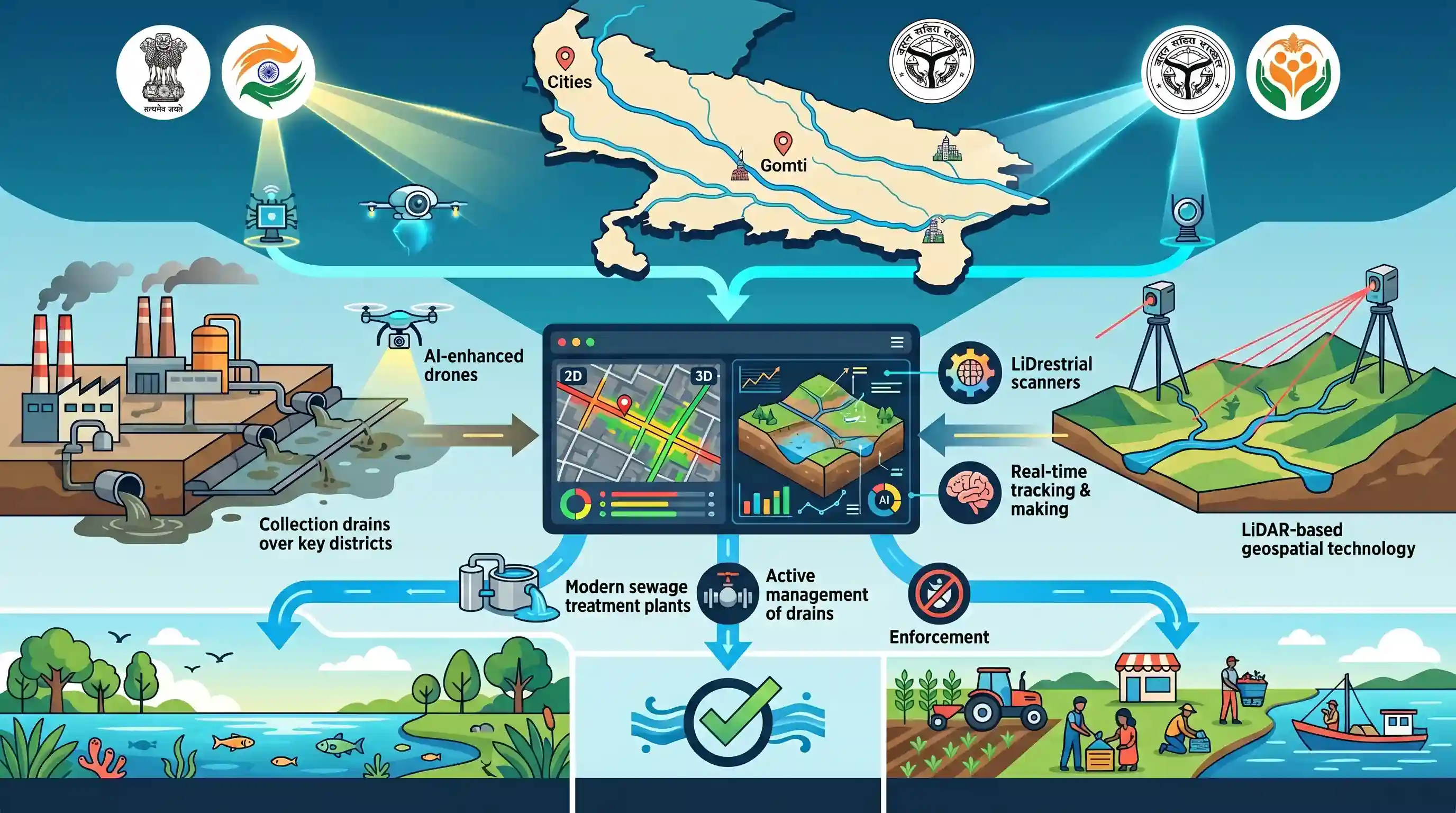
The Uttar Pradesh government is implementing a highly advanced, multi-layered scientific approach to ensure 'zero discharge' of pollutants and untreated wastewater into major state rivers, including the Ganga, Yamuna, Gomti, Varuna, and Pandu. Supported by the National Mission for Clean Ganga (NMCG) and led by the State Mission for Clean Ganga (SMCG), the project utilizes AI-enhanced drone surveys and LiDAR-based geospatial technology to monitor over 400 km of drains across eight key districts. This critical environment data will be integrated into a live, GIS-based 'Drain Dashboard' with 2D and 3D visualization capabilities to enable real-time tracking, environmental conservation, and local livelihood development.
Key Points
- The Uttar Pradesh government has embarked on a multi-layered, technology-driven action plan to achieve 'zero discharge' into major state rivers, including Ganga, Yamuna, Gomti, Varuna, and Pandu.
- The project includes conducting drone surveys covering more than 400 km of river stretches and drains across key districts like Lucknow, Prayagraj, Varanasi, Kanpur, Hardoi, Ballia, Meerut, and Mirzapur.
- High-tech tools such as LiDAR-based geospatial data, AI-enhanced digitally stabilized drones, and visual imaging will be employed to map and trace pollution discharge points.
- The visual and scientific data will be integrated into a live, GIS-based 'Drain Dashboard' featuring 2D and 3D visualization capabilities for real-time monitoring and swift redressal.
- The project is being spearheaded by the State Mission for Clean Ganga (SMCG) in coordination with the National Mission for Clean Ganga (NMCG).
- This initiative aims at river rejuvenation, promoting environmental sustainability, and aligning with the socio-economic and employment goals of the state.
Important Terms
Namami Gange Programme

A flagship conservation initiative launched in 2014 under the Ministry of Jal Shakti to effectively abate pollution and rejuvenate the national river Ganga and its tributaries through basin-level, multi-sectoral interventions.
UPSC context
Relevant for GS Paper III (Environment and Conservation), testing critical understanding of comprehensive river rejuvenation strategies.
National Mission for Clean Ganga (NMCG)
A registered society established in 2011 that serves as the central executive and implementing arm of the National Ganga Council to execute river rejuvenation and pollution control projects under the Ministry of Jal Shakti.
UPSC context
Relevant for GS Paper II (Institutional Governance), evaluating structural and policy execution mechanisms of central environmental bodies.
State Mission for Clean Ganga (SMCG)
The state-level implementing arm (or State Project Management Group) of the National Mission for Clean Ganga, responsible for coordinating, planning, and executing river conservation and pollution abatement projects within respective basin states.
UPSC context
Relevant for GS Paper II (Federalism), testing cooperative federalism and coordination between central agencies and state-level institutions.
Prelims Trap
The Gomti River is a glacier-fed, Himalayan tributary of the Ganga.
Unlike glacier-fed rivers, the Gomti is an alluvial, groundwater-and-monsoon-fed river originating from Gomat Taal (Fulhar Jheel) in the flat plains of Pilibhit, UP.
Static Concepts Connected
What are the key Ganga tributaries in UP and their origins?
- Left-Bank Tributaries: Includes Ramganga (joins at Kannauj), Gomti (joins near Ghazipur), and Varuna (joins at Varanasi).
- Right-Bank Tributaries: Chiefly the Yamuna (joins at Prayagraj), along with the Tons and Son rivers further downstream.
- Plains-origin exception: While Ramganga and Yamuna are glacier-fed, the Gomti and Varuna originate from groundwater-fed lakes in the alluvial plains.
What is Zero Liquid Discharge (ZLD) technology?
- Basic principle: An industrial wastewater treatment setup designed to completely eliminate liquid discharge by recycling all process water.
- Key stages: Employs reverse osmosis (RO) to concentrate pollutants, followed by thermal evaporation and crystallization to extract dry solid salts.
- Policy mandate: Enforced by CPCB and NMCG specifically targeting highly polluting industrial sectors along the Ganga basin.
Cross-Topic Patterns
AI & LiDAR in Environmental Governance
Blends Science & Tech with environmental conservation, shifting pollution monitoring from reactive manual sampling to real-time, GIS-based predictive tracking.
Inland Waterways vs Riverine Ecology
Achieving zero discharge on Ganga tributaries reduces heavy sludge, preventing critical siltation that threatens navigation draft on National Waterway-1.

Geographical profiles of plains-origin Ganga tributaries (Gomti, Varuna) will likely be paired with GIS/LiDAR monitoring in Prelims 2026.
Linked PYQs · 4
Linked PYQs · 4
- 2022UPPSC_PRELIMSGS1
The main purpose of 'Ganga Action Plan' project, launched in 1985, was
- 2018UPPSC_PRELIMSGS1
Which of the following rivers of Uttar Pradesh has been declared a 'Biological Disaster' due to environmental pollution?
- 2023UPPSC_PRELIMSGS1
Biological Oxygen Demand (BOD) is a standard criteria for -
- 2023UPPSC_PRELIMSGS1
Which of the following statement is correct? (1) Ram Ganga river joins the Ganga at Kannauj. (2) River Betwa joins the Yamuna near Prayagraj. Select the correct answer using the code given below –
