Supreme Court Appeal on National Security Act Detention
Source:Indian Express ↗
Why It Matters
It underscores the constitutional checks and balances involving preventive detention laws like the NSA, illustrating the tension between executive-driven state security measures and judicial protection of personal liberty under Article 21.
Summary
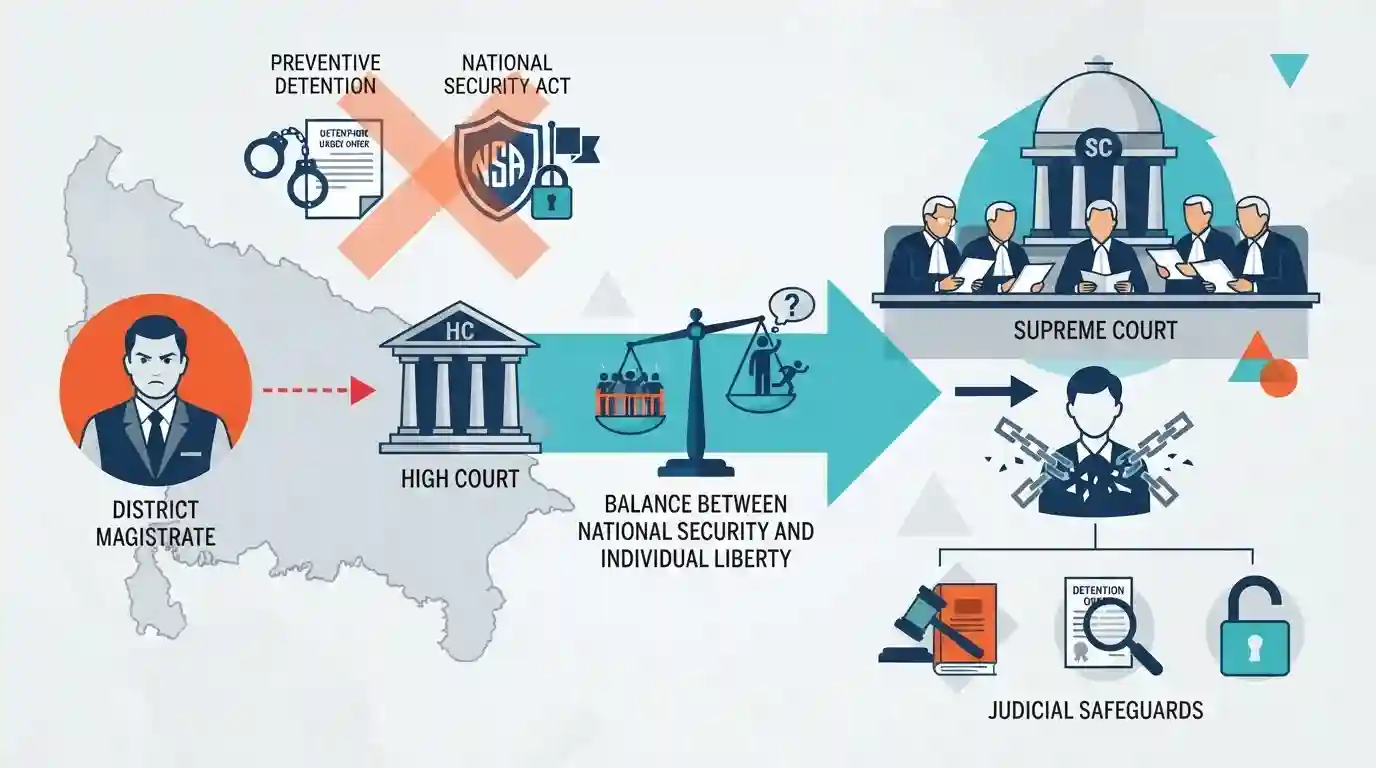
The District Magistrate of a district in Uttar Pradesh has approached the Supreme Court against a High Court order quashing the preventive detention of a student under the stringent National Security Act (NSA). This case highlights the ongoing debate over the balance between national security/public order and individual liberty, highlighting the judicial safeguards surrounding preventive detention in India.
Key Points
- A District Magistrate (DM) in Uttar Pradesh has moved the Supreme Court challenging the quashing of a student's detention under the National Security Act (NSA).
- The case brings to light the friction between state executive powers of preventive detention and judicial oversight regarding fundamental rights (Article 21 and 22).
- Preventive detention laws like the NSA have often faced judicial scrutiny over procedural safeguards and potential state overreach.
Important Terms
National Security Act (NSA)

A stringent Indian statute empowering central and state governments to detain individuals without trial for up to 12 months to prevent actions prejudicial to national security or public order.
UPSC context
GS Paper II (Polity and Governance): Tests understanding of executive powers, preventive detention laws, and civil liberties safeguards.
Article 21
Constitutional provision guaranteeing protection of life and personal liberty, which can only be deprived according to the procedure established by law.
UPSC context
GS Paper II (Fundamental Rights): Core to judicial review, balancing state security with individual rights and personal liberty.
Article 22
Constitutional provision offering protection against arbitrary arrest and detention, including specific safeguards and procedural requirements for preventive detention laws.
UPSC context
GS Paper II (Indian Constitution): Essential for examining executive detention powers and constitutional safeguards against abuse.
Supreme Court
The apex judicial body of India responsible for constitutional interpretation, safeguarding fundamental rights, and exercising judicial review over state executive and legislative actions.
UPSC context
GS Paper II (Judiciary): Evaluates the role of the apex court in protecting civil liberties against arbitrary state action.
Static Concepts Connected
What are the constitutional and statutory safeguards regarding preventive detention under Indian law?
- Constitutional Safeguards: Article 22(4)-(7) prescribes constitutional safeguards, ensuring no person is detained beyond three months without an Advisory Board's approval.
- Statutory Authority: Under Section 3 of the NSA 1980, State Governments and DMs can order detention based on subjective satisfaction, subject to judicial review.
- Grounds & Representation: Detenues have the right to be informed of the grounds of detention as soon as possible and afforded the earliest opportunity to make a representation.
Cross-Topic Patterns
Preventive Detention vs Executive Overreach
Judicial review under Article 32/226 bridges executive preventive detention powers with fundamental rights enforcement, forming a core testing area for arbitrary state action.

Expect a conceptual statement question on Article 22 safeguards and the mandatory role of Advisory Boards in preventive detention cases.
Linked PYQs · 3
Linked PYQs · 3
- 2024MainsGS2
Right to privacy is intrinsic to life and personal liberty and is inherently protected under Article 21 of the constitution. Explain. In this reference discuss the law relating to D.N.A. testing of child in the womb to establish its paternity.
- 2024PrelimsGS1
Under which of the following Articles of the Constitution of India, has the Supreme Court of India placed the Right to Privacy ?
- 2025PrelimsGS1
Consider the following pairs : Provision in the Constitution of India Stated under I. Separation of Judiciary from the Executive in the public services of the State : The Directive Principles of the State Policy II. Valuing and preserving of the rich heritage of our composite culture : The Fundamental Duties III. Prohibition of employment of children below the age of 14 years in factories : The Fundamental Rights How many of the above pairs are correctly matched?
