Kanwar Yatra Administration and Cultural Significance in Uttar Pradesh
Source:The Hindu ↗
Why It Matters
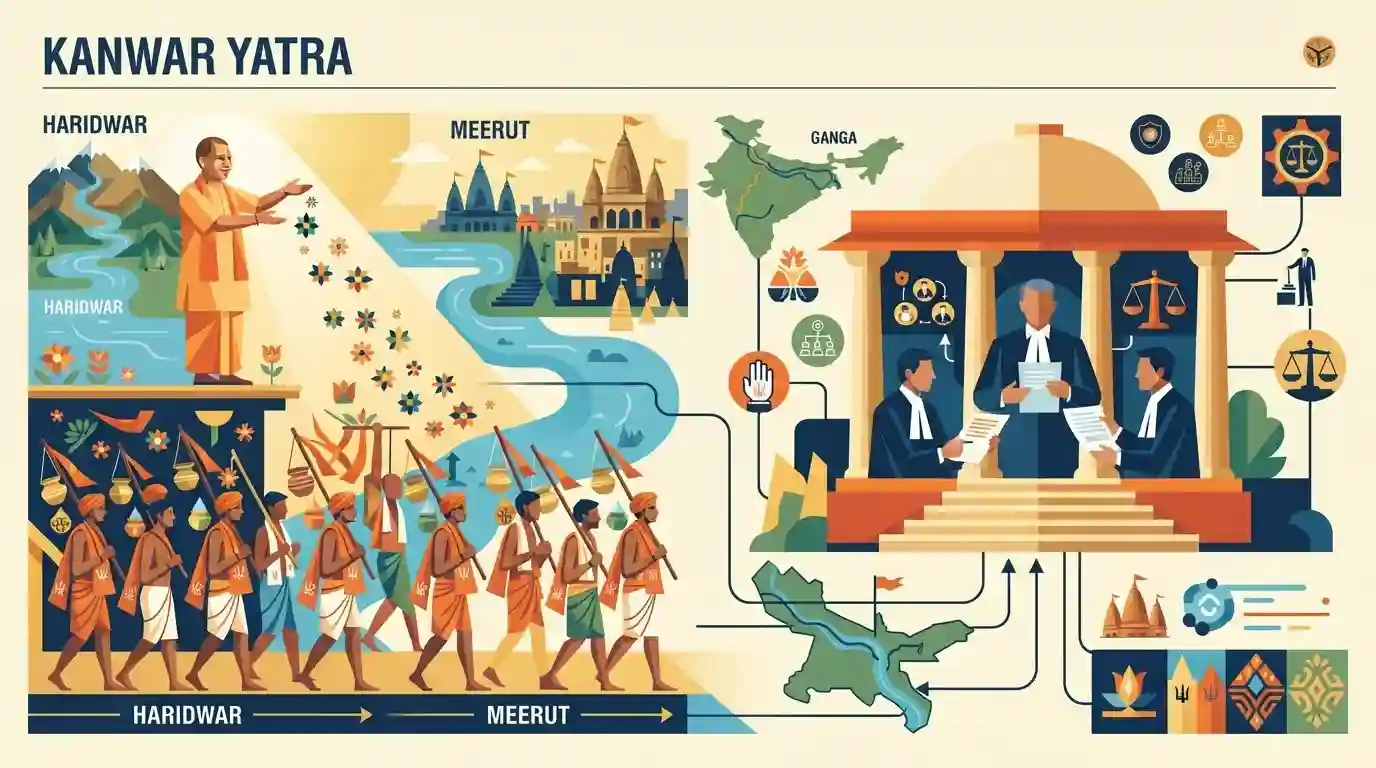
The Kanwar Yatra is a massive socio-religious pilgrimage with significant administrative, geographical, and cultural dimensions in North India. It touches upon the geography of the Ganga river, Shaivite traditions, and the challenges of crowd management and law-and-order, which recently drew the Supreme Court's attention for safety protocols.
Summary
Uttar Pradesh Chief Minister Yogi Adityanath showered flowers on Kanwariyas in Meerut, lauding the Kanwar Yatra as an unparalleled example of devotion and national unity. The annual pilgrimage takes place during the holy month of Shravan, with devotees collecting Ganga water from Haridwar to perform Jalabhishek at Shiva temples. In parallel, the Supreme Court is examining the need for formal protocols to ensure the safe and orderly conduct of the massive religious gathering.
Key Points
- Uttar Pradesh CM Yogi Adityanath welcomed Kanwariyas in Meerut by showering them with flowers.
- He praised the Kanwar Yatra as a profound symbol of devotion, dedication, and national unity.
- The pilgrimage occurs during the month of Shravan, where devotees collect water from the Ganga in Haridwar for the Jalabhishek of Lord Shiva.
- The Supreme Court has requested a response from the Centre regarding a protocol to ensure the safe conduct of the Kanwar Yatra.
Important Terms
Kanwar Yatra

An annual Hindu pilgrimage during the monsoon month of Shravan. Devotees, known as Kanwariyas, fetch holy water from the Ganga River and carry it long distances to offer at various Shiva temples and Jyotirlingas.
UPSC context
Relevant for GS Paper 1 (Art and Culture), testing knowledge of regional Indian traditions, pilgrimage systems, and religious practices.
Supreme Court
The apex judicial body in India. It frequently interprets fundamental rights, balancing the freedom to practice religion (Article 25) against public order, morality, and health, particularly during massive religious gatherings.
UPSC context
Essential for GS Paper 2 (Polity), focusing on judicial review, fundamental rights, and state regulation of religious practices.
Shravan
The fifth month of the Hindu lunar calendar, typically falling between July and August. It holds immense spiritual significance in Hinduism, marked by monsoon festivals, fasting, and dedicated worship of Lord Shiva.
UPSC context
Important for GS Paper 1 (Art and Culture) to understand traditional Indian lunar calendars and their socio-cultural significance.
Prelims Trap
The right to freely practice religion under Article 25 cannot be restricted by the State for crowd control.
Article 25 is explicitly subject to "public order, morality and health." The State and Judiciary can legally regulate religious processions for public safety.
Static Concepts Connected
What are the specific constitutional limitations on religious freedom under Article 25?
- Public Order: The State can restrict religious practices to prevent riots, manage traffic, or ensure safe crowd control during massive gatherings.
- Morality & Health: Practices cannot violate accepted public morals or endanger public health and sanitation.
- Secular Regulation: The State retains the power to regulate any economic, financial, political, or other secular activity associated with a religious practice.
How is the main stream of the Ganga river officially formed?
- Devprayag Confluence: The Ganga officially gets its name at Devprayag, which is the crucial confluence point where the Alaknanda and Bhagirathi rivers merge.
- Panch Prayag: Devprayag is the final confluence in the sacred Panch Prayag system of the Garhwal Himalayas, making it a critical geographical and cultural site.
Cross-Topic Patterns
Kanwar & Tamil Kavadi Parallels
North India's Kanwar Yatra for Lord Shiva conceptually mirrors Tamil Nadu's Kavadi Aattam for Lord Muruga, showcasing a pan-Indian ritualistic unity of carrying votive burdens to shrines.
Article 25 vs Public Order
The SC examining Kanwar protocols tests the constitutional limits where individual religious practice intersects with the State's responsibility for public order, health, and disaster management.

Expect a comparative question linking North Indian and South Indian ritualistic traditions (like Kanwar & Kavadi) with Article 25 caveats.
Linked PYQs · 3
Linked PYQs · 3
- 2022UPPSC_PRELIMSGS1
Match List - I with List - II and select the correct answer from the code given below the lists. List-I (God): (A) Shiva (B) Vishnu (C) Ganesh (D) Saraswati List-II (Symbol): 1. Chakra 2. Trident 3. Veena 4. Rope or noose
- 2023UPPSC_PRELIMSGS1
Which one of the following place is the confluence of the river Alakhnanda and the Bhagirathi?
- 2023UPPSC_PRELIMSGS1
Which of the following statement is correct? (1) Ram Ganga river joins the Ganga at Kannauj. (2) River Betwa joins the Yamuna near Prayagraj. Select the correct answer using the code given below –
