Uttar Pradesh Sets Target for Additional Data Center Capacity
Source:the-statesman ↗
Why It Matters
With UP striving to become a $1 trillion economy, the creation of digital infrastructure like data centers and AI computing resources, and their expansion beyond Noida/NCR to interior districts, is highly relevant for both state-specific economy and national digital infrastructure questions in the UPPSC Prelims and Mains.
Summary
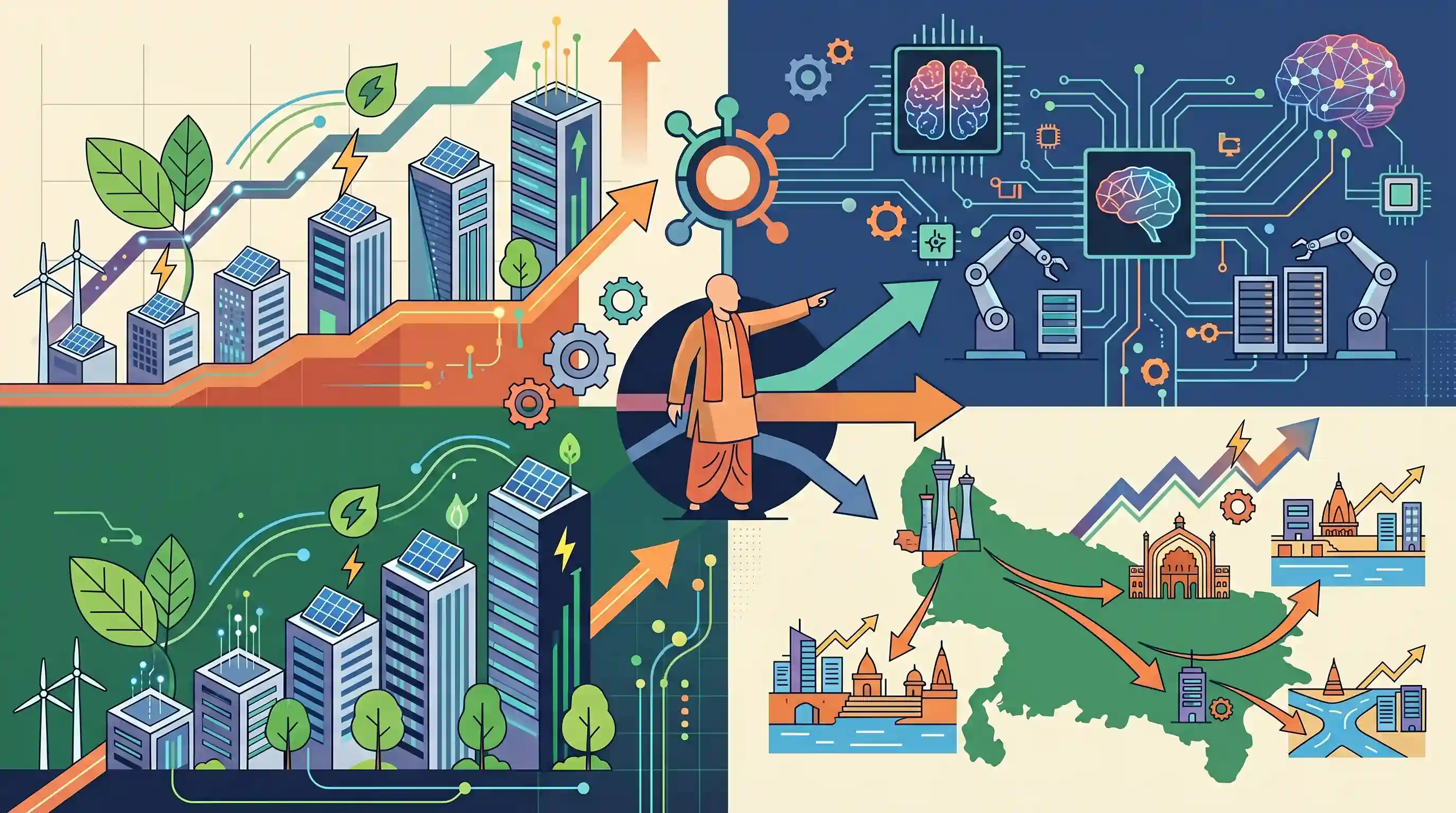
UP Chief Minister Yogi Adityanath has directed the formulation of a new, investor-friendly Data Center Policy, aiming to set up more than 2 GW of additional data center capacity in Uttar Pradesh by 2030. The revised policy will incentivize advanced AI compute infrastructure, green certified data centers, and decentralize development by expanding technology clusters beyond the NCR region into other major cities like Lucknow, Varanasi, and Prayagraj.
Key Points
- Uttar Pradesh Chief Minister Yogi Adityanath has set a target of developing over 2 Gigawatts (GW) of additional data center capacity by 2030.
- A new, more attractive Data Center Policy will be formulated to replace the existing Uttar Pradesh Data Center Policy-2021, targeting AI-based data centers and green data centers with financial incentives.
- Uttar Pradesh is projected to account for approximately 8% to 9% of India's total data center capacity by 2026.
- Under the 2021 Policy, the state has operationalized 6 data center parks and 2 units, with a committed capacity of 644 MW in progress and approved investment proposals worth ₹21,342.90 crore (against a ₹30,000 crore target).
- To promote balanced regional development, the state is actively planning to expand data center clusters beyond the NCR (Noida and Yamuna Expressway) to regions like Lucknow, Varanasi, Prayagraj, Meerut, and Sitapur.
- Multiple national and international investors have expressed interest in developing 5,410 MW of data center capacity in UP with potential investment of ₹4.90 lakh crore.
Important Terms
Uttar Pradesh Data Center Policy-2021

The state's foundational policy that initially aimed to establish 900 MW data center capacity and attract ₹30,000 crore in investments by offering capital, land, and electricity subsidies.
UPSC context
GS Paper III (Infrastructure & IT). Tests understanding of state-level policy interventions for digital infrastructure and industrial development.
Proposed Uttar Pradesh Data Center Policy
A revised, investor-friendly policy aiming for over 2 GW of additional capacity by 2030, with focused incentives on AI-enabled compute infrastructure and green-certified data centers.
UPSC context
GS Paper III (Infrastructure & IT). Tests knowledge of future-ready digital policies, clean energy transitions, and emerging tech infrastructure.
AM Green
A green energy platform that committed a $25 billion investment to set up a 1 GW green-powered AI hyperscale data center in Greater Noida using entirely carbon-free energy.
UPSC context
GS Paper III (Infrastructure & Environment). Tests understanding of sustainable infrastructure, green energy integration, and foreign/domestic direct investments.
Hiranandani Group
A major Indian infrastructure conglomerate whose subsidiary, Yotta Infrastructure, built North India’s first hyperscale data center park (Yotta D1) in Greater Noida, pioneering Uttar Pradesh’s digital storage expansion.
UPSC context
GS Paper III (Infrastructure). Tests knowledge of private sector participation, public-private synergy, and large-scale domestic investment in digital hubs.
Adani Group
A premier Indian infrastructure conglomerate developing the 100 MW AdaniConneX hyperscale data center in Noida, integrating full-stack renewable energy management to power sustainable digital operations.
UPSC context
GS Paper III (Infrastructure & Energy). Tests understanding of corporate investments, green energy transitions, and scaling up of domestic digital capabilities.
NTT Global Data Centers
A leading global IT services provider that launched a 52.8 MW data center campus in Noida, featuring advanced liquid cooling and seismic dampening to host AI-driven workloads.
UPSC context
GS Paper III (Infrastructure & Technology). Tests awareness of global tech investments, FDI in high-performance computing, and advanced disaster-resilient infrastructure.
Prelims Trap
All data centers in India, irrespective of power load or capacity, automatically enjoy Harmonized Master List 'Infrastructure Status'.
Only data centers with a minimum capacity of 5 Megawatts (MW) of IT load (and specific floor area criteria) qualify for inclusion in the Harmonized Master List.
Static Concepts Connected
What are the implications and criteria of 'Infrastructure Status' for Data Centers in India?
- Eligibility Threshold: Requires a minimum capacity of 5 Megawatts (MW) of IT power load to qualify for inclusion in the Harmonized Master List.
- Credit Access: Enables data center developers to access long-term, low-interest credit from domestic/international financial institutions and pension funds.
- External Borrowings: Allows companies to utilize External Commercial Borrowings (ECBs) with relaxed guidelines and longer maturity periods.
What are the key parameters of a Green Data Center?
- Core Definition: A facility designed to minimize environmental impact using energy-efficient technologies, renewable energy sources, and sustainable building materials.
- Efficiency Metric (PUE): Evaluated using Power Usage Effectiveness (PUE); a ratio of total facility energy to IT equipment energy, where a score closer to 1.0 indicates peak efficiency.
- Cooling Technologies: Utilizes advanced cooling techniques (like liquid immersion cooling) and AI-driven thermal management to drastically lower cooling energy demands.
Cross-Topic Patterns
Competitive federalism & digital FDI flows
Shows how sub-national policies leverage national "Infrastructure Status" to compete for global FDI, illustrating competitive federalism in digital-era industrial policy.
Green AI vs. Environmental externalities
Connects industrial incentives for AI compute with the rising carbon/water footprints of massive cooling systems, testing India's Net Zero 2070 targets.

GS-3 2026 may test the regulatory criteria of 'Infrastructure Status' alongside the ecological footprints of massive data centers.
Linked PYQs · 2
Linked PYQs · 2
- 2023UPPSC_PRELIMSGS1
The Indian Biological Data Centre is being set up in which state?
- 2023UPPSC_PRELIMSGS1
How many railways stations have been identified for modernization under Amrit Bharat Station Scheme in Uttar Pradesh as on February, 2023?
