Rani Avanti Bai Memorial and 1857 Revolt Legacy in UP
Source:uniindia ↗
Why It Matters
UPPSC frequently tests historical milestones, local leaders, and specific starting timelines of the 1857 Revolt in Uttar Pradesh. The recognition of figures like Rani Avanti Bai and Dhan Singh Gurjar is highly relevant for both state-specific and general-studies sections of the prelims paper.
Summary
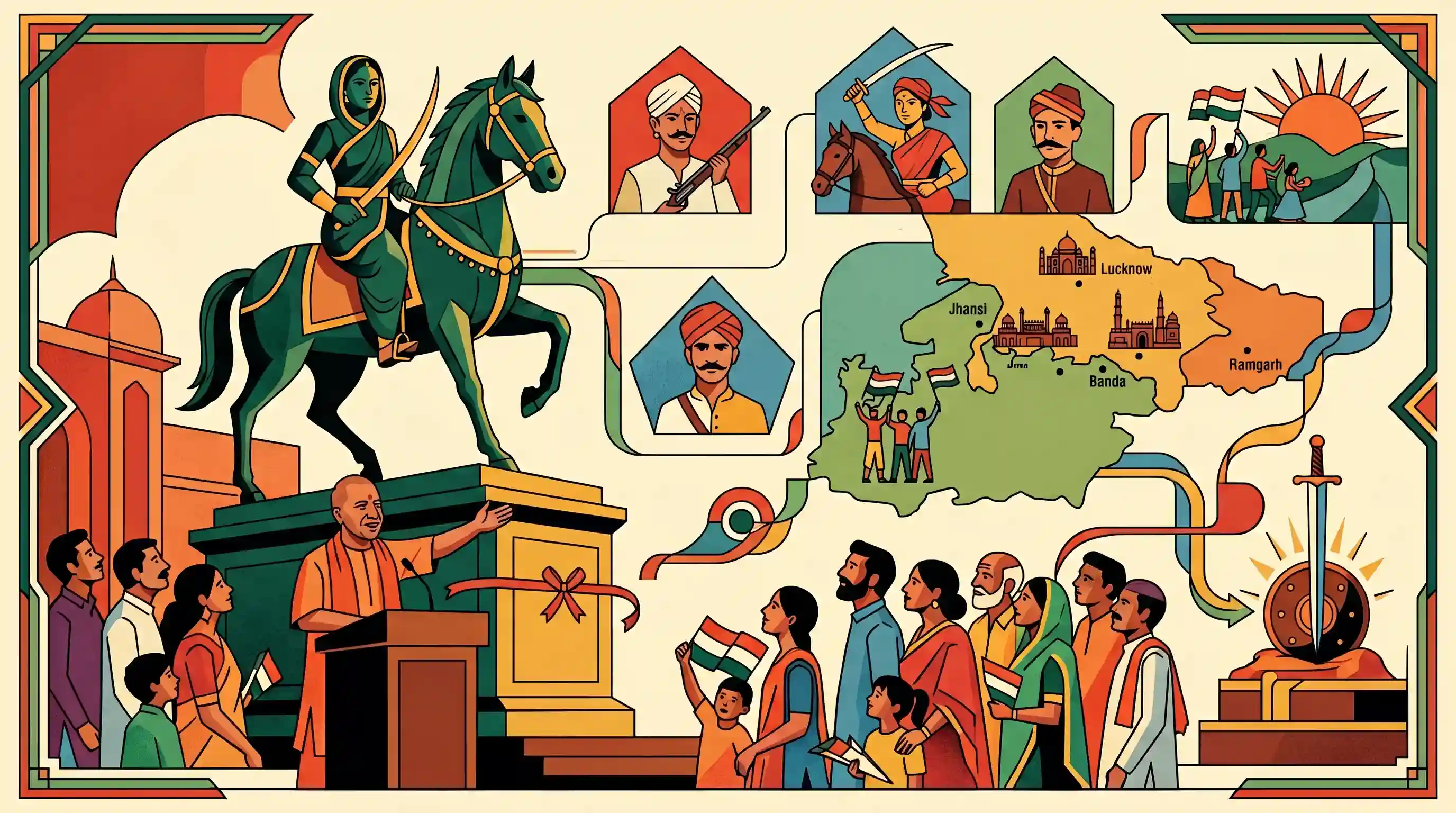
Uttar Pradesh Chief Minister Yogi Adityanath unveiled a statue of the 1857 freedom fighter Rani Avanti Bai Lodhi at Kalu Kuan Chauraha in Banda district. In his address, he paid tribute to her supreme sacrifice and highlighted the contribution of other key heroes of the 1857 First War of Independence, emphasizing the role of regional icons in shaping modern Indian history.
Key Points
- Uttar Pradesh Chief Minister Yogi Adityanath unveiled the statue of Rani Avanti Bai Lodhi at Kalu Kuan Chauraha in Banda district.
- Rani Avanti Bai Lodhi (1831–1858) was the warrior queen of Ramgarh (located in present-day Dindori/Mandla district, Madhya Pradesh) who valiantly fought against the British East India Company during the 1857 Uprising.
- The Chief Minister highlighted key contributors to the 1857 First War of Independence, naming Mangal Pandey, Kotwal Dhan Singh Gurjar (who led the Meerut rebellion on May 10, 1857), Tatya Tope, Rani Lakshmibai, and Rani Avanti Bai Lodhi.
- Honoring regional historical icons and local freedom fighters is part of Uttar Pradesh's efforts to promote cultural heritage and national pride.
- Banda's local development plans, urban infrastructure, and road connectivity projects were also lauded during the event.
Important Terms
Rani Avanti Bai Lodhi

The queen-regent of Ramgarh (present-day Madhya Pradesh) and a key female leader in the 1857 Revolt. She raised an army and used guerrilla tactics against the British before choosing martyrdom over capture.
UPSC context
GS Paper I (Modern History). Tests knowledge of regional leaders, women freedom fighters, and local resistance movements.
Revolt of 1857
A major, armed uprising against British East India Company rule that began as a sepoy mutiny in Meerut and quickly mobilized Indian rulers, peasants, and soldiers across northern and central India.
UPSC context
GS Paper I (Modern History). Tests causes, key leaders, regional variations, and systemic consequences of the uprising.
British East India Company
A joint-stock trading company chartered by the British Crown in 1600 that established a monopoly, gradually transformed into an imperial administrative power, and ruled India until dissolved in 1858.
UPSC context
GS Paper I (Modern History). Tests the administrative, economic, and political policies of British merchant-imperialism.
Doctrine of Lapse
An aggressive annexation policy extensively utilized by Governor-General Lord Dalhousie, stating that any princely state under British vassalage with no natural male heir would automatically be annexed by the East India Company.
UPSC context
GS Paper I (Modern History). Tests understanding of British expansionist strategies and the political triggers of the 1857 Revolt.
Court of Wards
A legal institution in colonial India that assumed management of estates when heirs were minors, females, or deemed incapable, frequently used by the British to encroach upon and annex independent princely territories.
UPSC context
GS Paper I (Modern History). Tests the specific legal-administrative machinery used by the British to systematically absorb native states.
Prelims Trap
Rani Avanti Bai of Ramgarh led the 1857 rebellion in the Chota Nagpur plateau region of modern-day Jharkhand.
Her Ramgarh was a princely state in Mandla/Dindori (modern Madhya Pradesh), whereas the famous "Ramgarh Session" of the Indian National Congress (1940) took place in Ramgarh, Jharkhand. UPSC often exploits identical historical place names.
Static Concepts Connected
What was the colonial Court of Wards system and how did it fuel regional revolts?
- Definition & Purpose: A legal body established by the British East India Company to manage estates when the hereditary ruler was declared minor, female, or legally incompetent.
- Economic Impact: It stripped local rulers of financial and political sovereignty, installing British administrators to extract revenues directly.
- Trigger for Revolt: In Ramgarh (MP), the Court of Wards took over after King Vikramaditya Singh's death, driving Rani Avanti Bai to organize armed resistance.
Who was Dhan Singh Gurjar and what was his role in the 1857 Meerut outbreak?
- Official Designation: He was the Kotwal (police chief) of Meerut on May 10, 1857, who actively aided the mutineers instead of suppressing them.
- Tactical Contribution: He opened the jail gates to release prisoners, mobilized thousands of local peasants, and coordinated the initial armed assault on the East India Company.
- Historiographical Shift: His actions demonstrate that the 1857 Uprising was not a sudden, isolated military mutiny but involved deep-seated civilian-police coordination.
Cross-Topic Patterns
Subaltern Icons & National Historiography
The active integration of regional, tribal, and subaltern icons like Rani Avanti Bai and Kotwal Dhan Singh Gurjar into mainstream curricula reflects a state-led push to decentralize national historiography.
Gendered Resistance & Colonial Annexation Laws
Comparing structural triggers of female-led resistance (Doctrine of Lapse for Jhansi vs. Court of Wards for Ramgarh) reveals how British legal instruments systematically alienated Indian queen-regents.

Expect a GS-1 match-the-following style question mapping lesser-known 1857 figures to their regions (e.g., Meerut, Ramgarh, Banda).
Linked PYQs · 2
Linked PYQs · 2
- 2023UPPSC_PRELIMSGS1
Which one of the following (Place of the revolt of 1857 – Start of rebellion) is not correctly matched?
- 2023UPPSC_PRELIMSGS1
Who was the leader of rebellion in Bareilly, Uttar Pradesh during 1857?
