Mukhyamantri Krishak Chhatravritti Yojana Expansion and Mandi Budget
Source:indianmasterminds ↗
Why It Matters
The expansion of the Mukhyamantri Krishak Chhatravritti Yojana and UP's Mandi Budget are highly relevant for UP-specific questions in UPPSC PCS Prelims. Furthermore, concepts like e-NAM, National Natural Farming Mission, and the Price Support Scheme (PSS) align perfectly with GS Paper 3 topics on agricultural marketing and farmer welfare.
Summary
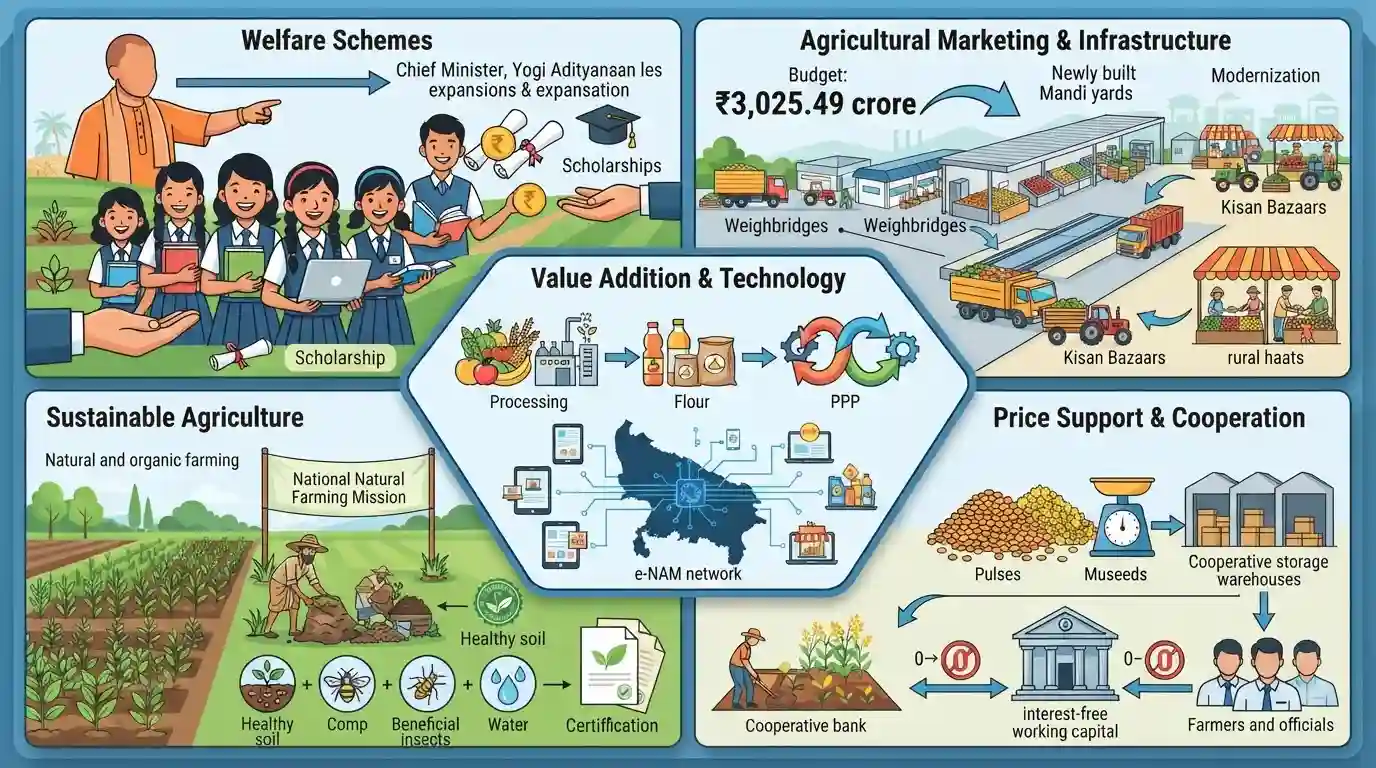
Uttar Pradesh Chief Minister Yogi Adityanath has directed the expansion of the Mukhyamantri Krishak Chhatravritti Yojana to provide scholarships to meritorious children of farmers. Additionally, the UP State Agricultural Produce Market Council approved a ₹3,025.49 crore budget for 2026-27 to strengthen mandi infrastructure, rural haats, and Kisan Bazaars. The government also emphasized establishing agricultural processing units via PPP, expanding the e-NAM network, promoting the National Natural Farming Mission, and ensuring organic certification in all districts. Interest-free working capital was approved for cooperative institutions to procure pulses and oilseeds under the Price Support Scheme (PSS).
Key Points
- UP Chief Minister Yogi Adityanath directed the expansion of the Mukhyamantri Krishak Chhatravritti Yojana to provide scholarships for more meritorious children of farmers.
- A budget of ₹3,025.49 crore for 2026-27 was approved for the UP State Agricultural Produce Market Council to enhance agricultural marketing infrastructure.
- The state government will encourage setting up agricultural processing units in mandi premises via the Public-Private Partnership (PPP) model and expand mandis linked to e-NAM.
- Yogi Adityanath instructed linking farmers to the National Natural Farming Mission and ensuring organic product certification facilities in every district.
- The Board approved providing interest-free working capital to cooperative institutions for the procurement of pulses and oilseeds under the Price Support Scheme (PSS).
Important Terms
e-NAM (National Agriculture Market)

A pan-India electronic trading portal managed by SFAC that integrates existing APMC mandis to create a unified national market for agricultural commodities. It ensures transparency, better price discovery, and direct payments to farmers.
UPSC context
GS Paper 3 (Agriculture). Tests knowledge of agricultural marketing reforms, price discovery mechanisms, and technology adoption in farming.
Price Support Scheme (PSS)
A component of the PM-AASHA framework where central nodal agencies like NAFED and NCCF physically procure pulses, oilseeds, and copra at the Minimum Support Price (MSP) when market rates fall below it.
UPSC context
GS Paper 3 (Agriculture/Economy). Relevant for questions on MSP frameworks, government procurement policies, and mechanisms ensuring farmer income security.
National Mission on Natural Farming (NMNF)
A centrally sponsored scheme promoting chemical-free, climate-resilient, agroecological farming. It utilizes a cluster-based approach integrating traditional practices and livestock to lower input costs, restore ecosystems, and enhance soil health.
UPSC context
GS Paper 3 (Agriculture/Environment). Highly relevant for topics covering sustainable agriculture, climate-resilient farming, and natural resource conservation schemes.
Mukhyamantri Krishak Chhatravritti Yojana
An Uttar Pradesh state welfare scheme providing scholarships to the meritorious children of farmers. It provides financial assistance to encourage and facilitate their access to higher education.
UPSC context
GS Paper 2 (Welfare Schemes). Important for state-specific UPPSC exams or as an example of state-level interventions bridging rural education and farmer welfare.
Prelims Trap
"Under the Price Support Scheme (PSS), the government compensates farmers for the price difference without physical procurement."
This describes the Price Deficiency Payment Scheme (PDPS). The Price Support Scheme (PSS) involves the actual physical procurement of crops (pulses, oilseeds, copra) by central and state nodal agencies.
Static Concepts Connected
What are the three components of the PM-AASHA umbrella scheme?
- Price Support Scheme: Physical procurement of pulses, oilseeds, and copra by central nodal agencies (like NAFED and FCI) along with state agencies.
- Price Deficiency Payment: Direct payment of the difference between MSP and the modal market price to pre-registered farmers, with no physical procurement involved.
- Private Procurement (PPSS): Pilot scheme allowing the participation of private players in the procurement operations of oilseeds at MSP.
How does e-NAM integrate with existing state APMCs?
- Virtual Network: It is a pan-India electronic trading portal that networks existing physical APMC mandis to create a unified national market for agricultural commodities.
- Legislative Prerequisites: Since agricultural marketing is a State subject, states must amend their APMC Acts to allow e-trading, single point market fee levy, and unified licensing.
- Implementation Node: The Small Farmers Agribusiness Consortium (SFAC) is the lead agency for implementing e-NAM under the Ministry of Agriculture.
Cross-Topic Patterns
Natural Farming & Organic Certification synergies
While natural farming avoids all external inputs (even organic fertilizers), state governments are linking natural farming outputs with organic certification (like PGS-India) to help farmers secure premium prices in urban and export markets.
PPP models shifting to Agri-Infrastructure
PPP models are expanding beyond traditional infrastructure (roads/ports) into rural mandis. This connects state APMC reforms with the central Agriculture Infrastructure Fund (AIF) to build decentralized micro-processing and storage units.

Expect a multi-statement Prelims question comparing PSS, PDPS, and the Market Intervention Scheme (MIS) for pulses vs. perishable crops.
Linked PYQs · 4
Linked PYQs · 4
- 2021UPPSC_PRELIMSGS1
Which of the following Schemes in Uttar Pradesh were introduced in Budget of 2021-22? I. Atmanirbhar Krishak Samanvit Vikas Yojna II. Mukhya Mantri Saksham Suposhan Yojna III. Mukhya Mantri Pravasi Shramik Udyamita Vikas Yojna IV. Yuva Udyamita Vikas Abhiyan Select the correct answer from the codes given below.
- 2021UPPSC_PRELIMSGS1
Which of the following is NOT the eligibility criterion before filling registration/ application forms for Uttar Pradesh Mukhya Mantri Swarojgar Yojna 2021 ?
- 2022UPPSC_PRELIMSGS1
Which one of the following is the targeted group under the 'Pradhan Mantri Swandhi Scheme'?
- 2016UPPSC_PRELIMSGS1
Which one of the following is not an objective of National Food security Mission (NFSM)?
