Yogi Adityanath Orders Immediate Rain Damage Assessment
Source:chinimandi ↗
Why It Matters
It highlights the state's institutional response, early warning systems, and resource mobilization (SDRF/NDRF) in managing recurring hydrometeorological disasters (floods, droughts, lightning) which are core components of the UPPSC syllabus concerning state-specific geography and disaster management.
Summary
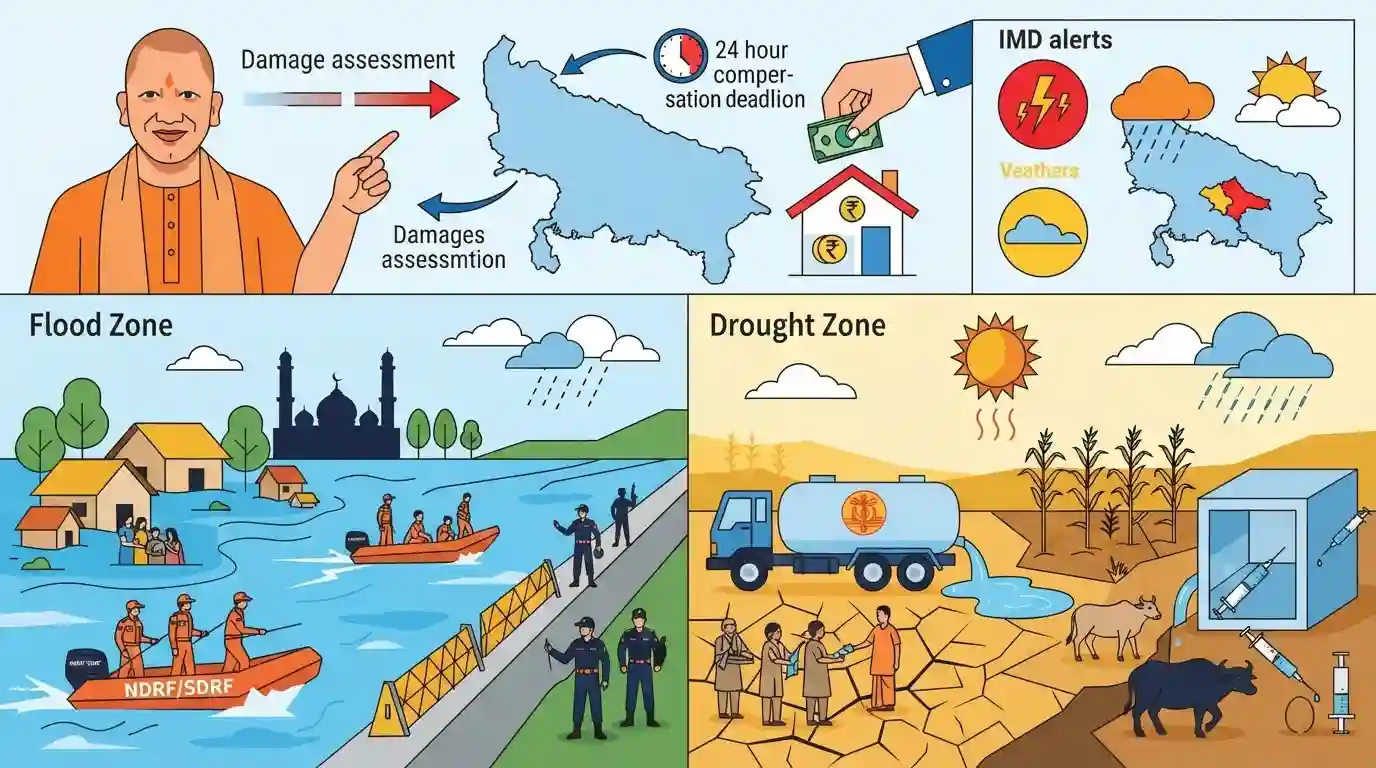
Uttar Pradesh Chief Minister Yogi Adityanath has directed state officials to rapidly assess the damage caused by heavy rainfall and lightning, mandating that compensation reach affected families within 24 hours. The state is battling twin challenges: localized flooding in certain districts and drought conditions in areas with deficient rainfall. The administration has deployed NDRF, SDRF, and PAC units for relief operations, ordered continuous patrols of river embankments, and mandated safe relocation and vaccination of livestock. Furthermore, the IMD has issued specific Red, Orange, and Yellow alerts for various districts. Affected vulnerable families are also slated to receive support through the Chief Minister Housing Scheme.
Key Points
- UP CM Yogi Adityanath directed officials to assess rain and lightning damages immediately and ensure compensation is disbursed to affected families within 24 hours.
- The state is currently managing the dual climate challenge of flooding due to heavy rains in some districts and potential droughts in rain-deficient areas.
- Relief and rescue operations are being coordinated using NDRF, SDRF, and PAC, along with round-the-clock monitoring of river embankments.
- The Chief Minister Housing Scheme will be extended to provide housing assistance to vulnerable families impacted by fires and related calamities.
- The IMD has categorized several UP districts under Red, Orange, and Yellow weather alerts depending on the expected intensity of impending rainfall.
Important Terms
National Disaster Response Force (NDRF)

A specialized central force established under the Disaster Management Act, 2005, to provide a swift, multi-disciplinary response to natural and man-made disasters across India.
UPSC context
GS Paper 3 (Disaster Management). Tests knowledge of India's statutory and institutional framework for crisis response.
State Disaster Response Force (SDRF)
A specialized state-level agency modeled after the NDRF, trained and equipped for rapid disaster response, search and rescue operations, and immediate local relief during calamities.
UPSC context
GS Paper 3 (Disaster Management). Crucial for evaluating state capacity and decentralized approaches to disaster preparedness.
India Meteorological Department (IMD)
The principal agency under the Ministry of Earth Sciences responsible for meteorological observations, weather forecasting, issuing color-coded disaster alerts, and seismology.
UPSC context
GS Paper 1 & 3 (Geography, Disaster Management). Tests awareness of early warning systems and climate monitoring mechanisms.
Chief Minister Housing Scheme
A state-level welfare initiative (Mukhyamantri Awas Yojana) providing permanent housing to vulnerable, homeless, and disaster-affected rural families who fall outside central housing schemes.
UPSC context
GS Paper 2 (Welfare Schemes). Important for understanding state-level interventions for marginalized sections and post-disaster rehabilitation.
Prelims Trap
Lightning is a nationally notified disaster, allowing states to spend unlimited SDRF funds on it without ceiling limits.
Historically, states could only spend up to 10% of their SDRF on state-specific disasters like lightning. The 16th Finance Commission recommended its official national-list inclusion for 2026-31.
Static Concepts Connected
How do SDRF and NDRF differ in statutory creation and funding patterns?
- SDRF creation: Constituted under Section 48(1)(a) of the Disaster Management Act, 2005; it serves as the primary fund available to states.
- SDRF contribution: Financed 75% by Center for General Category States (like UP) and 90% for Special Category States (Himalayan/NE).
- NDRF creation: Constituted under Section 46(1) of the DM Act, 2005; designed to assist states during disasters of a severe nature.
- NDRF financing: Financed 100% by the Central Government, primarily funded via the National Disaster Response Cess (NDRC).
What do the IMD's four color-coded weather warnings signify?
- Green Alert: No advisory issued; indicates normal weather conditions with no major hazard expected.
- Yellow Alert: Be aware; alerts authorities that weather may deteriorate, requiring watchfulness and local-level administrative prep.
- Orange Alert: Be prepared; signals extremely bad weather with potential to disrupt transport, power, and daily life.
- Red Alert: Take action; denotes extremely severe weather posing a direct risk to life and property, demanding immediate protective action.
Cross-Topic Patterns
Fiscal Federalism + Disaster Management
The 16th Finance Commission's recommendation to nationalize lightning/heatwave disasters directly reshapes state fiscal space by shifting funding burdens from limited local budgets to shared SDRF pools.
Agro-climatic zones + Climate extremes
UP's division into 9 agro-climatic zones is increasingly strained by co-existing micro-droughts and sudden flash floods, disrupting traditional crop-planning and disaster resilience models.

16th Finance Commission's new disaster classifications (lightning/heatwaves) + SDRF funding ratios is highly likely for Prelims 2026.
Linked PYQs · 3
Linked PYQs · 3
- 2021UPPSC_PRELIMSGS1
The National Disaster Management Division in India is the nodal division in the Ministry of Home Affairs for disaster management. Who is the Ex-officio Chairman of the National Disaster Management Authority?
- 2017UPPSC_PRELIMSGS1
How many agro climatic zones are found in Uttar Pradesh?
- 2014UPPSC_PRELIMSGS1
The number of agro-climate zones in Uttar Pradesh is
