Uttar Pradesh Bans Commercial Activities in Basements Amid Fire Audit
Source:indianmasterminds ↗
Why It Matters
Urban fire safety and building compliance are critical themes in public administration and disaster risk reduction (DRR). This statewide policy intervention in Uttar Pradesh underscores efforts to regulate commercial/coaching hubs, mitigate risks in basements, and decentralize emergency services down to the tehsil level.
Summary
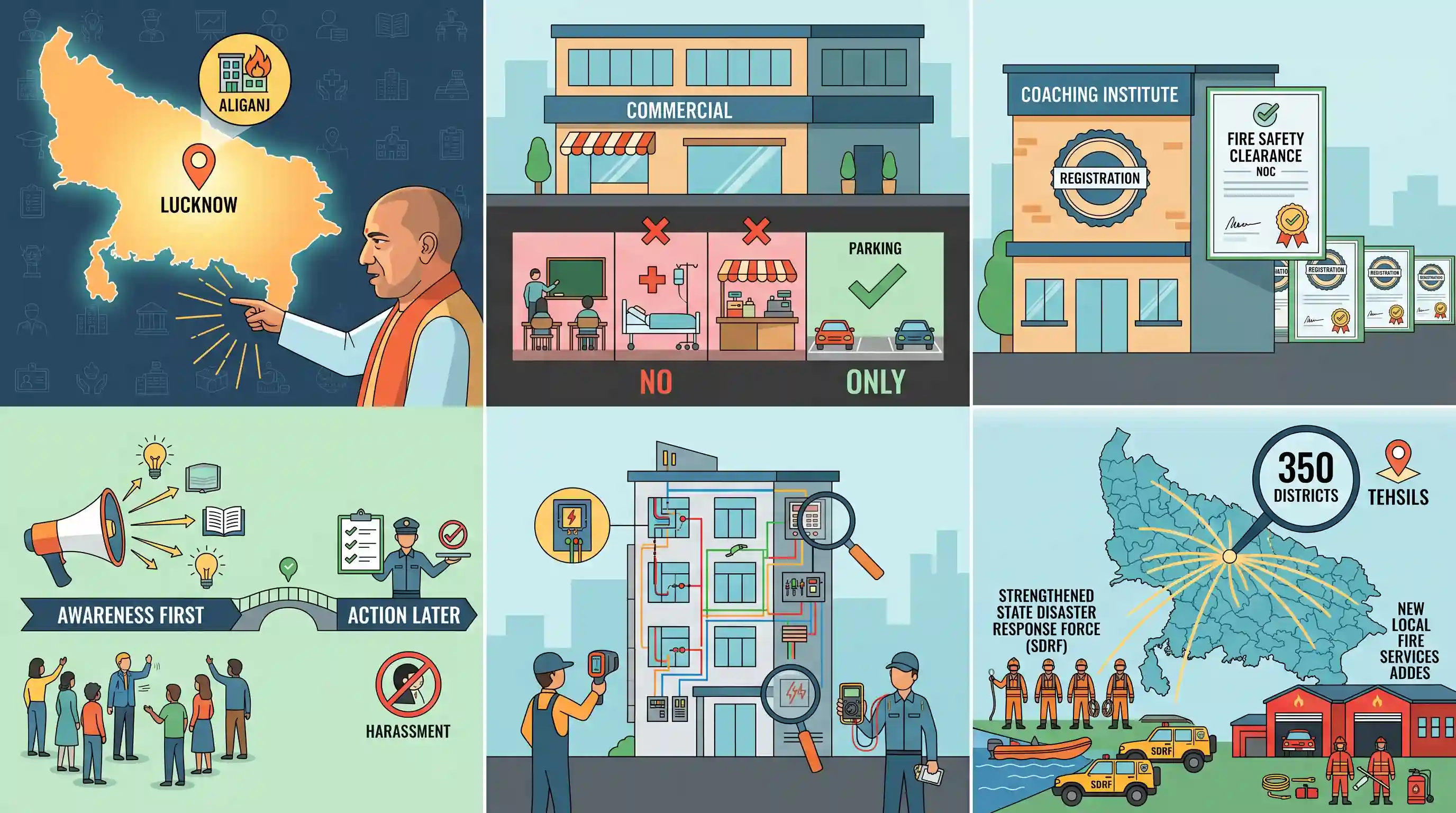
In response to a fire incident in Aliganj, Lucknow, Uttar Pradesh Chief Minister Yogi Adityanath ordered a statewide fire safety audit in 'mission mode.' The directive strictly bans coaching institutes, nursing homes, and commercial activities in basements, stipulating that basement parking areas must only be used for parking. Additionally, all coaching institutes must be registered and obtain fire safety clearances. The government is promoting an 'Awareness First, Action Later' policy to avoid harassment while enforcing electrical safety audits and strengthening the State Disaster Response Force (SDRF) and local fire services across UP's 350 tehsils.
Key Points
- UP Chief Minister Yogi Adityanath ordered a statewide 'mission mode' fire safety audit following a fire incident in Lucknow's Aliganj area.
- Strictly banned unauthorized commercial and educational activities in basements, specifically prohibiting coaching centers and nursing homes from operating underground. Basements approved for parking must strictly be used only for parking.
- Mandated the compulsory registration and fire safety clearance of all coaching institutes in the state to ensure compliance.
- Adopted an 'Awareness First, Action Later' policy, instructing authorities to educate building owners and provide reasonable time to correct deficiencies before taking legal action.
- Incentivized electrical safety inspections to check load capacities and prevent short-circuit-induced urban fires.
- Aimed to reduce response times for fire, ambulance, and SDRF services, highlighting that 296 out of 350 tehsils in Uttar Pradesh already have functional fire stations.
Important Terms
National Building Code (NBC) of India

A comprehensive national instrument published by the Bureau of Indian Standards (BIS) providing guidelines for regulating building construction, structural design, and fire safety requirements across India.
UPSC context
GS Paper 3 (Disaster Management) & GS Paper 2 (Urban Governance); tests urban safety, building bye-laws, and regulatory enforcement.
Disaster Management Act, 2005
Landmark central legislation establishing a legal, institutional, and financial framework for proactive disaster risk reduction, capacity-building, and coordinated emergency response across national, state, and district levels.
UPSC context
GS Paper 3 (Disaster Management); tests India's statutory disaster response structures, NDMA/SDMA mandates, and crisis management frameworks.
State Disaster Response Force (SDRF)
A state-level specialized rapid-response force raised and equipped by state governments under the disaster management architecture to conduct immediate on-ground rescue, search, and relief operations.
UPSC context
GS Paper 3 (Disaster Management); tests state-level operational rescue capabilities, coordination with local bodies (DDMAs), and federal disaster management.
Fire Safety Audit
A systematic evaluation of a building or complex to assess its fire hazards, verify compliance with safety codes, and test the functionality of prevention and mitigation systems.
UPSC context
GS Paper 3 (Disaster Management - Urban Hazards); tests administrative oversight, municipal enforcement, and public safety in urban structures.
Prelims Trap
The National Building Code of India is a statutory act of Parliament legally binding on all states.
The NBC is a recommendatory code published by the BIS. It only becomes legally binding when states adopt it into their local building bye-laws.
Static Concepts Connected
Under which constitutional provisions are fire services regulated in India?
- Seventh Schedule: Fire services are placed under Entry 6 of the State List, giving state governments primary legislative competence.
- Twelfth Schedule: Article 243W lists fire services under Entry 12 of the XII Schedule as a municipal function.
What is the legal status and role of the National Building Code (NBC)?
- Formulated by BIS: The Bureau of Indian Standards (BIS) publishes and updates the NBC as a comprehensive national building guidelines manual.
- Recommendatory nature: It is an advisory model code; it lacks automatic statutory force until adopted into state building bye-laws.
Cross-Topic Patterns
Urban Devolution vs Fire Safety
Disasters in commercial basements highlight the gap between Article 243W's functional devolution and the actual capacity of urban local bodies to enforce building bye-laws.
Coaching Regulation and Federalism
The implementation of Union Ministry guidelines for coaching centers relies heavily on state-specific statutes like UP's 2002 Coaching Regulation Act.

UPSC 2026 may test the recommendatory nature of the National Building Code alongside the XII Schedule's municipal fire service devolution.
Linked PYQs · 2
Linked PYQs · 2
- 2021UPPSC_PRELIMSGS1
The National Disaster Management Division in India is the nodal division in the Ministry of Home Affairs for disaster management. Who is the Ex-officio Chairman of the National Disaster Management Authority?
- 2020UPPSC_PRELIMSGS1
During the 'lockdown', the extraordinary powers used by the Government of India received legal basis from which of the following laws? 1. Mental Health Care Act, 2017 2. Disaster Management Act, 2005 3. Enemy Property Act, 1968 4. Epidemic Diseases Act, 1897 Select the correct answer using the codes given below.
