Chiluatal Tourism and Welfare Projects Launched by Yogi in Gorakhpur
Source:aninews ↗
Why It Matters
This article connects directly to key UPPSC Prelims topics: the geographical features and lakes of UP (Chiluatal), ancient history of UP (Kushinagar as the Malla capital and Buddha's Mahaparinirvana site), and major state welfare/entrepreneurship schemes (CM-YUVA).
Summary
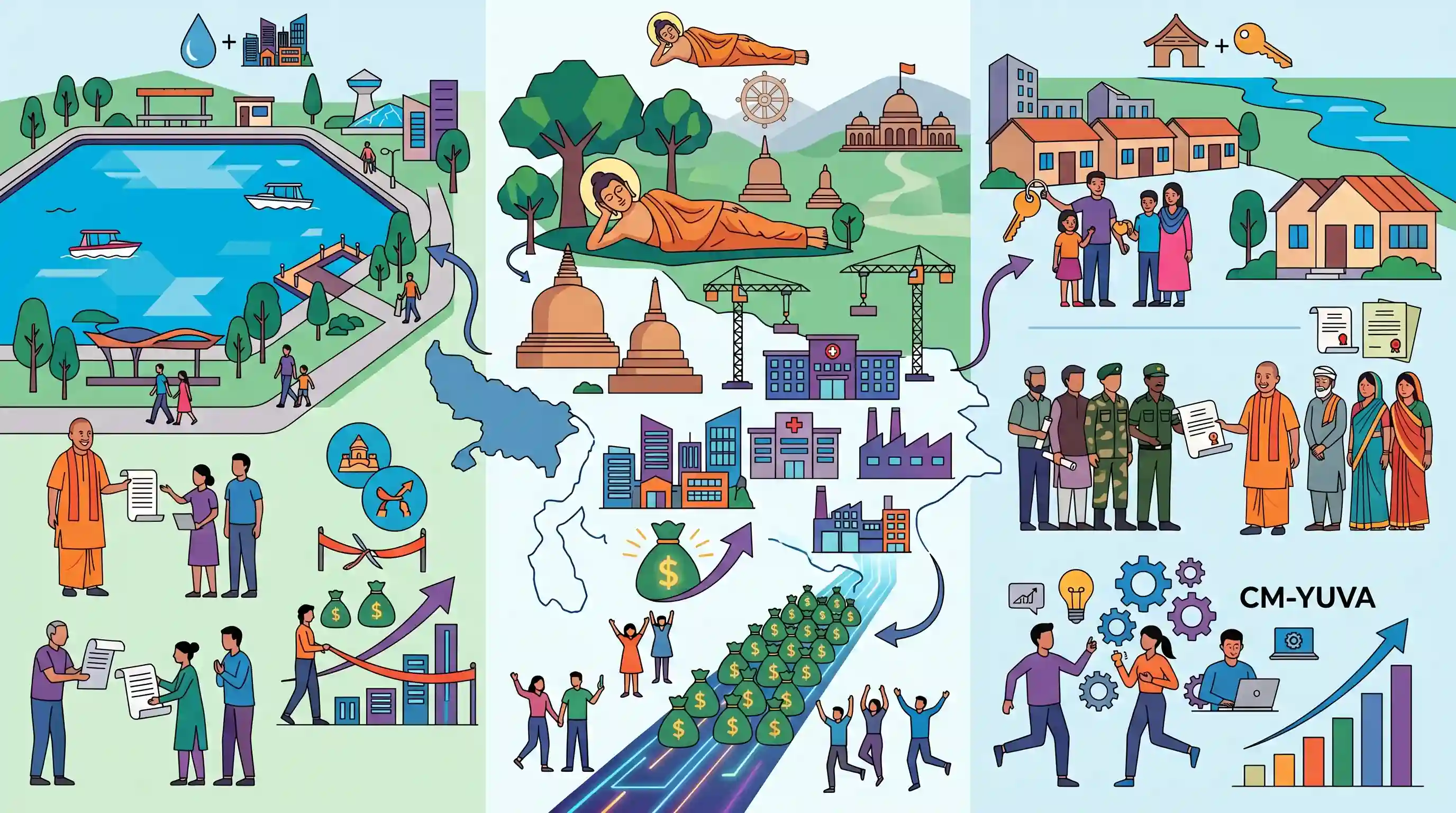
Uttar Pradesh Chief Minister Yogi Adityanath launched major development and welfare initiatives across Gorakhpur, Kushinagar, and Bijnor. In Gorakhpur, he addressed public grievances during a Janta Darshan and inaugurated the Rs 20.35 crore Chiluatal tourism development project. In Kushinagar (the site of Buddha's Mahaparinirvana), he inaugurated 278 projects worth over Rs 424 crore. Finally, in Bijnor, he distributed land ownership certificates to Pakistani displaced families and veterans, along with welfare support under PMAY and the CM-YUVA entrepreneurship scheme.
Key Points
- Uttar Pradesh Chief Minister Yogi Adityanath conducted 'Janta Darshan' at the Gorakhnath Temple in Gorakhpur to address public grievances directly and perform 'gau seva'.
- In Gorakhpur, the Chief Minister inaugurated tourism development works worth Rs 20.35 crore centered around Chiluatal (Chilua Lake).
- In Kushinagar, the Mahaparinirvana site of Lord Buddha, the CM launched 278 development projects worth over Rs 424 crore, distributing benefits under various welfare schemes.
- Historically, Kushinagar is recognized as the ancient capital of the Malla Mahajanapada (Malla Republic) where Lord Buddha attained Mahaparinirvana.
- In Bijnor, Yogi Adityanath distributed land ownership rights certificates to families displaced from Pakistan, as well as to former soldiers and lessees.
- Assistance and approval letters were also distributed in Bijnor under the Pradhan Mantri Awas Yojana (PMAY) and the state's Chief Minister Yuva Udyami Vikas Abhiyan (CM-YUVA), which promotes entrepreneurship among Uttar Pradesh's youth.
Important Terms
Chief Minister Yuva Udyami Vikas Abhiyan (CM-YUVA)

A flagship scheme by the Uttar Pradesh government to promote youth entrepreneurship by offering interest-free, collateral-free loans of up to ₹5 lakh and a 10% margin-money subsidy to establish micro-enterprises.
UPSC context
GS Paper II (Government Schemes) and Paper III (Employment); tests welfare-driven economic models and self-employment initiatives.
Pradhan Mantri Awas Yojana (PMAY)
A centrally sponsored housing scheme launched in 2015 by the Indian government to provide affordable, permanent "Housing for All" with basic amenities to eligible rural and urban low-income households.
UPSC context
GS Paper II (Welfare Schemes/Social Justice); tests government strategies for poverty alleviation and housing infrastructure.
Malla Republic
One of the sixteen ancient Mahajanapadas of India, situated in eastern Uttar Pradesh. It was a republican confederacy (gana-sangha) whose major capital was Kushinagar, the site of Gautama Buddha's Mahaparinirvana.
UPSC context
GS Paper I (Ancient Indian History); tests knowledge of early republican politics, Mahajanapadas, and Buddhist historical geography.
Nath Sect
A Shaivite sub-tradition within Hinduism founded by Matsyendranath and popularized by Gorakhnath, integrating Hatha Yoga, Shaivism, and asceticism, with its spiritual headquarters at the Gorakhnath Temple in Gorakhpur.
UPSC context
GS Paper I (Indian Heritage/Bhakti Movement); tests medieval religious movements, cultural philosophy, and yoga traditions.
Central Board of Secondary Education (CBSE)
A national-level board of school education in India for public and private schools, managed by the Union Government, which regulates curricula based on NCERT standards and conducts Class 10 and 12 examinations.
UPSC context
GS Paper II (Education/Social Sector); tests institutional governance of school education and national curriculum standardization.
Secondary Education Department
A state government administrative division responsible for managing secondary and intermediate school education, implementing academic calendars, appointing teachers, and executing educational reforms.
UPSC context
GS Paper II (Governance/Education); tests state-level administrative machinery and policy implementation in the school education sector.
Prelims Trap
Buddha attained Mahaparinirvana on the banks of the Niranjana River in the territory of the Vajji Mahajanapada.
Buddha attained Mahaparinirvana on the banks of the Hiranyavati River in Kushinagar (Malla Republic). The Niranjana River is associated with his enlightenment in Bodh Gaya.
Static Concepts Connected
What is the historical significance of the ancient Malla Mahajanapada?
- Dual capitals: Malla was a republican state (Gana-sangha) divided into two main parts with capitals at Kushinara and Pava.
- Buddhist connection: Gautama Buddha attained Mahaparinirvana in Kushinara near the Hiranyavati River in 483 BCE.
- Jain connection: Lord Mahavira, the 24th Tirthankara, attained Nirvana at Pava, making the region crucial to both religions.
What are the origin and core features of the Nath Sect?
- Founders: Founded by Matsyendranath and consolidated by Gorakhnath around the 11th century as a prominent Shaiva sub-sect.
- Philosophical syncretism: Synthesized traditional Shaivism, Buddhism, and Hatha Yoga, rejecting orthodox Brahmanical rituals and caste hierarchies.
- Spiritual headquarters: The Gorakhnath Temple in Gorakhpur serves as the premier monastic center of this pan-Indian ascetic order.
Cross-Topic Patterns
Gana-Sanghas vs Monarchies
Contrasting the democratic-oligarchic governance of the Malla and Vajji Gana-Sanghas with absolute monarchies of Magadha and Kosala is a recurrent UPSC Mains topic.
Rehabilitation and Land Reforms
Granting bhumidhari rights to displaced East Pakistan families intersects with post-independence refugee rehabilitation history and the Ninth Schedule's land reform dynamics.

The Malla Republic, Hiranyavati river, and Buddhist Mahaparinirvana geography likely to feature in a comparative Mahajanapada map-based MCQ.
Linked PYQs · 5
Linked PYQs · 5
- 2003UPPSC_PRELIMSGS1
Consider the following statements and select the correct answer from the code given below: Assertion (A): Kushinagar was the capital of Malla Republic. Reason (R): Mahatma Buddha got Mahaparinirvana at Kushinagar.
- 2004UPPSC_PRELIMSGS1
Consider the following statement and choose the correct answer from the code given below Assertion (A): Kushi Nagar was the capital of Malla Republic Reason (R): Mahatma Buddha's parinirvana occurred in Kushi Nagar.
- 2008UPPSC_PRELIMSGS1
The place in Uttar Pradesh which is famous pilgrim centre for both Buddhist and Jainism is
- 2021UPPSC_PRELIMSGS1
Which of the following Ramsar site is NOT situated in Uttar Pradesh ?
- 2025UPPSC_PRELIMSGS1
Which of the following Ramsar wetland site is/are NOT situated in Uttar Pradesh? 1. Sarsai Nawar Jheel 2. Samaspur Bird Sanctuary 3. Rudrasagar Lake 4. Sultanpur National Park Select the correct answer from the code given below:
