Hathras Development Projects and ODOP Heeng Scheme
Source:indiatoday ↗
Why It Matters
Hathras's cultural titles ('Braj ki Dehri' and 'Heeng Nagri') and its association with Heeng under the ODOP scheme are high-yield facts for UPPSC PCS Prelims. The exam frequently features questions matching UP districts with their prominent products or geographical and administrative features.
Summary
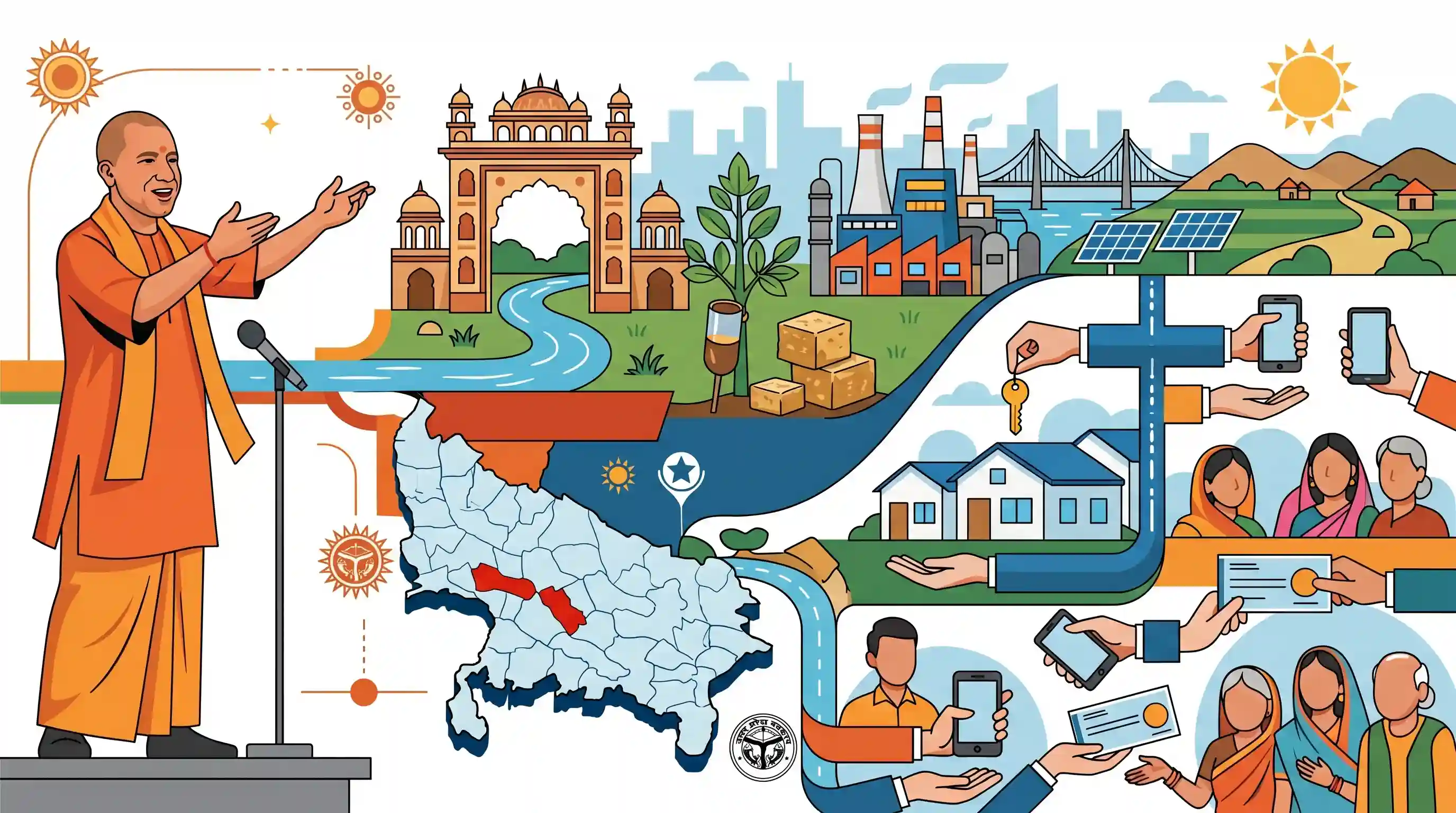
Uttar Pradesh Chief Minister Yogi Adityanath launched 143 development projects worth Rs 548 crore in Hathras, a district famously known as 'Braj ki Dehri' and 'Heeng Nagri' (due to its ODOP designation for Asafoetida). Covering the Hathras, Sikandra Rao, and Sadabad constituencies, the initiative also involved distributing welfare benefits, such as keys to homes built under the Mukhyamantri Awas Yojana, smartphones, and cheques to local beneficiaries.
Key Points
- Uttar Pradesh Chief Minister Yogi Adityanath launched 143 development projects worth Rs 548 crore in the Hathras district.
- The developmental projects cover three assembly constituencies: Hathras, Sikandra Rao, and Sadabad.
- Hathras is historically and culturally termed 'Braj ki Dehri' (The Gateway to Braj) and 'Heeng Nagri' (Asafoetida City) due to its prominent asafoetida processing trade.
- Under Uttar Pradesh's flagship One District One Product (ODOP) initiative, Hathras is designated for Heeng (Asafoetida) processing and trading.
- The Chief Minister distributed smartphones, cheques, and house keys under the Mukhyamantri Awas Yojana (MMAY) to beneficiaries at the event.
- The state leadership emphasized the development of key religious and cultural sites in UP, including Ayodhya, Mathura (Krishna Janmabhoomi), and Kashi.
Important Terms
One District One Product (ODOP) Scheme

A developmental initiative launched in Uttar Pradesh (2018) and adopted nationally to identify, brand, and promote one unique traditional product from each district, boosting local livelihoods, economic self-reliance, and MSME sector growth.
UPSC context
GS Paper III (Industrial Growth) and GS Paper II (Government Policies); tests decentralized economic planning and rural self-reliance models.
Mukhyamantri Awas Yojana (MMAY)
A housing welfare scheme in Uttar Pradesh that provides financial subsidies and construction assistance to rural and urban poor families lacking concrete "pucca" housing, operating alongside central housing schemes.
UPSC context
GS Paper II (Social Justice and Welfare Schemes); evaluates state-level affirmative actions, poverty alleviation, and rural development frameworks.
Geographical Indication (GI) Tag
A certification or sign placed on products that possess specific characteristics, reputation, or qualities fundamentally attributable to their precise geographic origin, protecting traditional knowledge and regional economies.
UPSC context
GS Paper III (Intellectual Property Rights) and GS Paper I (Art and Culture); tests knowledge of international trade frameworks and regional heritage.
Hathras Hing
The processed, culinary-grade asafoetida originating from Hathras, Uttar Pradesh, which possesses a centuries-old trading history, earned a Geographical Indication (GI) tag in 2023, and serves as the district's ODOP product.
UPSC context
GS Paper I (Geography & UP Special GK); tests understanding of local regional economies, geographic distribution, and agro-processing hubs.
Prelims Trap
Hathras is the primary agricultural cultivation hub for raw Asafoetida (Heeng) plants in India under the ODOP scheme.
Hathras is only a processing and trading hub. It imports raw resin. Domestic cultivation trials are limited to cold desert regions like Lahaul & Spiti.
Static Concepts Connected
Cultivation profile and botanical origin of Asafoetida (Heeng)
- Plant Source: Obtained from the oleo-gum resin of the taproots of the perennial herb Ferula assa-foetida.
- Climatic Requirements: Requires cold, arid, high-altitude desert conditions; traditionally native to Iran, Afghanistan, and Uzbekistan.
- Indian Status: Historically imported 100% of raw resin; experimental domestic cultivation was initiated in Lahaul and Spiti in 2020.
Genesis and expansion of the One District One Product (ODOP) model
- Global Origin: Inspired by the 'One Village One Product' (OVOP) movement started in Japan's Oita Prefecture in 1979.
- National Integration: Adopted by India's DPIIT and Ministry of Commerce to boost regional heritage, manufacturing, and local employment.
Cross-Topic Patterns
Cold-desert agro-diversification and Import substitution
CSIR’s introduction of Ferula cultivation in Himachal highlights how ecological niche mapping is leveraged to reduce India’s absolute import reliance on Central Asian spices.
Social safety nets and Marginalized tribes
State-specific housing programs like MMAY-G fill federal implementation gaps by targeting highly vulnerable communities like Vantangiyas and Musahars omitted from PMAY-G databases.

CSIR's cold-desert cultivation of Ferula assa-foetida is highly testable as a multi-statement question on import-reliant spices.
Linked PYQs · 3
Linked PYQs · 3
- 2025UPPSC_PRELIMSGS1
As per the One District One Product (ODOP) scheme of Uttar Pradesh, Moonj products are associated with which of the following districts? 1. Amethi 2. Sultanpur 3. Sant Kabir Nagar Select the correct answer from the code given below:
- 2021UPPSC_PRELIMSGS1
Which among the following districts of Uttar Pradesh is smallest in terms of area ?
- 2012UPPSC_PRELIMSGS1
In Uttar Pradesh the highest production of Aonla come from
