Uttar Pradesh Forms Two Member SIT to Probe Lucknow Fire Tragedy
Source:economictimes ↗
Why It Matters
This topic is highly relevant for UPPSC Prelims as it combines state-specific administrative appointments (SIT members) with crucial static topics under Indian Polity and Governance, such as the Disaster Management Act, 2005, and urban local body guidelines like the National Building Code.
Summary
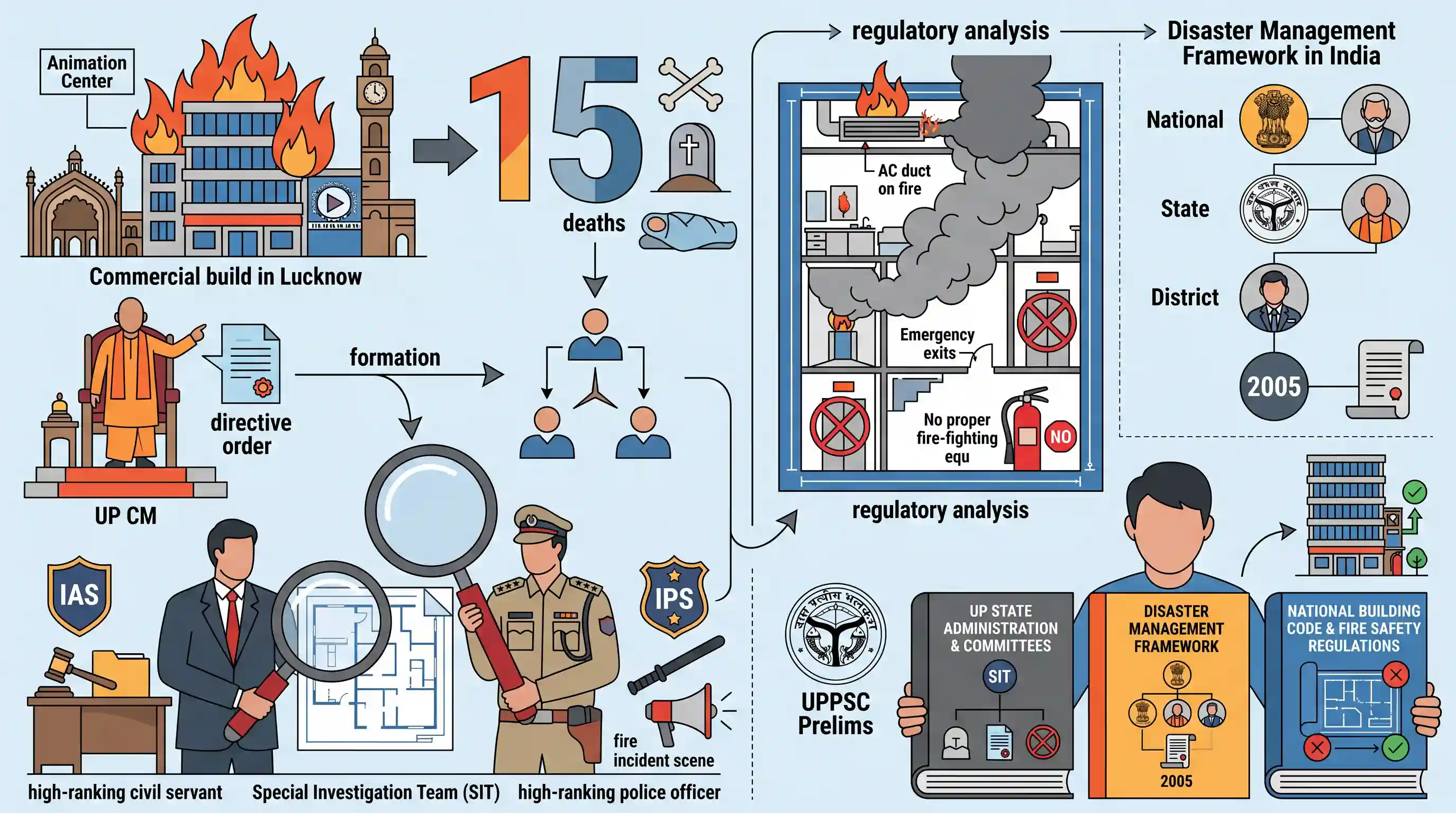
Uttar Pradesh Chief Minister Yogi Adityanath has formed a two-member Special Investigation Team (SIT) comprising ACS Amrit Abhijat and ADG Praveen Kumar to probe the Aliganj, Lucknow commercial building fire that resulted in 15 deaths. This incident highlights critical regulatory lapses regarding building guidelines, bringing the National Building Code (NBC) and the Disaster Management Act, 2005, into sharp administrative focus for UPPSC Prelims preparation.
Key Points
- SIT Formation: Uttar Pradesh Chief Minister Yogi Adityanath constituted a high-level two-member Special Investigation Team (SIT) to investigate the tragic fire incident in Aliganj, Lucknow, which claimed 15 lives and injured several others.
- SIT Composition: The probe team is composed of two senior officials: Amrit Abhijat (Additional Chief Secretary, Tourism Department) and Praveen Kumar (Additional Director General of Police, Lucknow Zone).
- Incident Context: The fire broke out in a three-storey commercial complex on Usha Mehta Marg in Aliganj, which housed an animation training centre. Preliminary reports by Urban Development and Energy Minister A. K. Sharma pointed to an AC duct malfunction and the complete absence of a proper emergency exit route, leading to asphyxiation.
- Static Polity Connection (Disaster Management Act, 2005): Under this Act, statutory response teams such as the NDRF and SDRF are deployed during emergencies. The National Disaster Management Authority (NDMA) is headed by the Prime Minister as Ex-officio Chairman, while the State Disaster Management Authority (SDMA) is headed by the state's Chief Minister.
- Static Governance Connection (National Building Code of India): Building design, fire escapes, and layout regulations are governed under the National Building Code (NBC) of India, formulated by the Bureau of Indian Standards (BIS). Part 4 of the NBC specifically regulates 'Fire and Life Safety' standards across commercial and residential structures.
Important Terms
Disaster Management Act, 2005

A landmark Indian legislation providing a comprehensive, multi-tiered legal and institutional framework for proactive disaster management, mitigation, capacity-building, and emergency response across India.
UPSC context
GS Paper III (Disaster Management); tests administrative mechanisms, statutory authorities (NDMA/SDMA), and emergency response powers.
National Building Code of India (NBC)
A national standard model code providing authoritative guidelines for regulating building construction, structural safety, disaster resilience, and fire safety requirements across India.
UPSC context
GS Paper III (Disaster Management/Urbanization); tests regulatory frameworks for urban safety, structural engineering guidelines, and hazard prevention.
National Disaster Response Force (NDRF)
A specialized, multi-disciplinary central force established under the Disaster Management Act, 2005, mandated to provide rapid, expert rescue operations during disasters.
UPSC context
GS Paper III (Disaster Management); tests specialized emergency response mechanisms, central-state coordination, and operational relief architecture.
State Disaster Response Force (SDRF)
A state-level specialized disaster response force operating as the first line of defense during regional emergencies, working under State Disaster Management Authorities.
UPSC context
GS Paper III (Disaster Management); tests state-level disaster preparedness, first-responder capabilities, and federal governance.
Bureau of Indian Standards (BIS)
The statutory National Standards Body of India, operating under the Ministry of Consumer Affairs, responsible for standardisation, quality certification, hallmarking, and consumer safety.
UPSC context
GS Paper II/III (Statutory Bodies/Indian Economy); tests regulatory governance, consumer protection, and quality certification regimes.
Special Investigation Team (SIT)
An ad hoc, specialized investigative body constituted by courts or governments to probe specific high-profile crimes or administrative failures demanding impartial inquiry.
UPSC context
GS Paper II (Polity and Governance); tests accountability mechanisms, judicial oversight, and executive investigative powers.
Prelims Trap
The National Building Code is a legally binding central act formulated by the Ministry of Housing and Urban Affairs.
The NBC is a model code formulated by the Bureau of Indian Standards (BIS), not MoHUA. It is strictly advisory and has no legal force unless explicitly adopted into state municipal bylaws.
Static Concepts Connected
What is the legal status and drafting authority of the National Building Code (NBC) of India?
- Formulating Authority: Formulated and published by the Bureau of Indian Standards (BIS), a statutory body under the Ministry of Consumer Affairs, Food and Public Distribution.
- Recommendatory Nature: It functions as a model code/guideline and is not automatically legally binding or enforceable across India.
- Enforcement Mechanism: To enforce NBC provisions legally, state governments must explicitly integrate them into their local building bylaws or State Fire Service Acts.
How is 'Fire Services' constitutionally structured in India's federal framework?
- Constitutional Schedule: It is classified as a municipal subject listed as Item No. 7 under the Twelfth Schedule of the Constitution (Article 243W).
- Devolution of Power: Added by the 74th Constitutional Amendment Act, 1992, vesting the primary responsibility of fire prevention in Urban Local Bodies (ULBs).
- Administrative Challenge: Because fire services fall under municipal/state domains, India lacks a unified central fire service command, leading to highly variable enforcement standards.
Cross-Topic Patterns
Urban Governance + Disaster Mitigation
Links the operational failure of 74th Amendment mandates (weak local bodies) to poor implementation of National Disaster Management Authority (NDMA) guidelines on urban fires.
Advisory Standards + Cooperative Federalism
Examines how central advisory codes (NBC) require cooperative federalism and state-level legislative action to convert model standards into enforceable municipal bylaws.

2026 Prelims may test the recommendatory nature of NBC/BIS standards alongside the constitutional delegation of fire services under Art 243W.
Linked PYQs · 1
Linked PYQs · 1
- 2021UPPSC_PRELIMSGS1
The National Disaster Management Division in India is the nodal division in the Ministry of Home Affairs for disaster management. Who is the Ex-officio Chairman of the National Disaster Management Authority?
