Uttar Pradesh Launches Project Ganga for Rural Broadband Expansion
Source:The Hindu ↗
Why It Matters
UPPSC Prelims extensively tests facts regarding newly launched state schemes, their launch dates, target beneficiaries, implementing partners (Hinduja Group), phase-1 details (21 districts), and financial loan limits (Rs 5 lakh interest-free under CM Yuva Scheme). Questions also cover rural infrastructure models and state organizations like the State Transformation Commission.
Summary
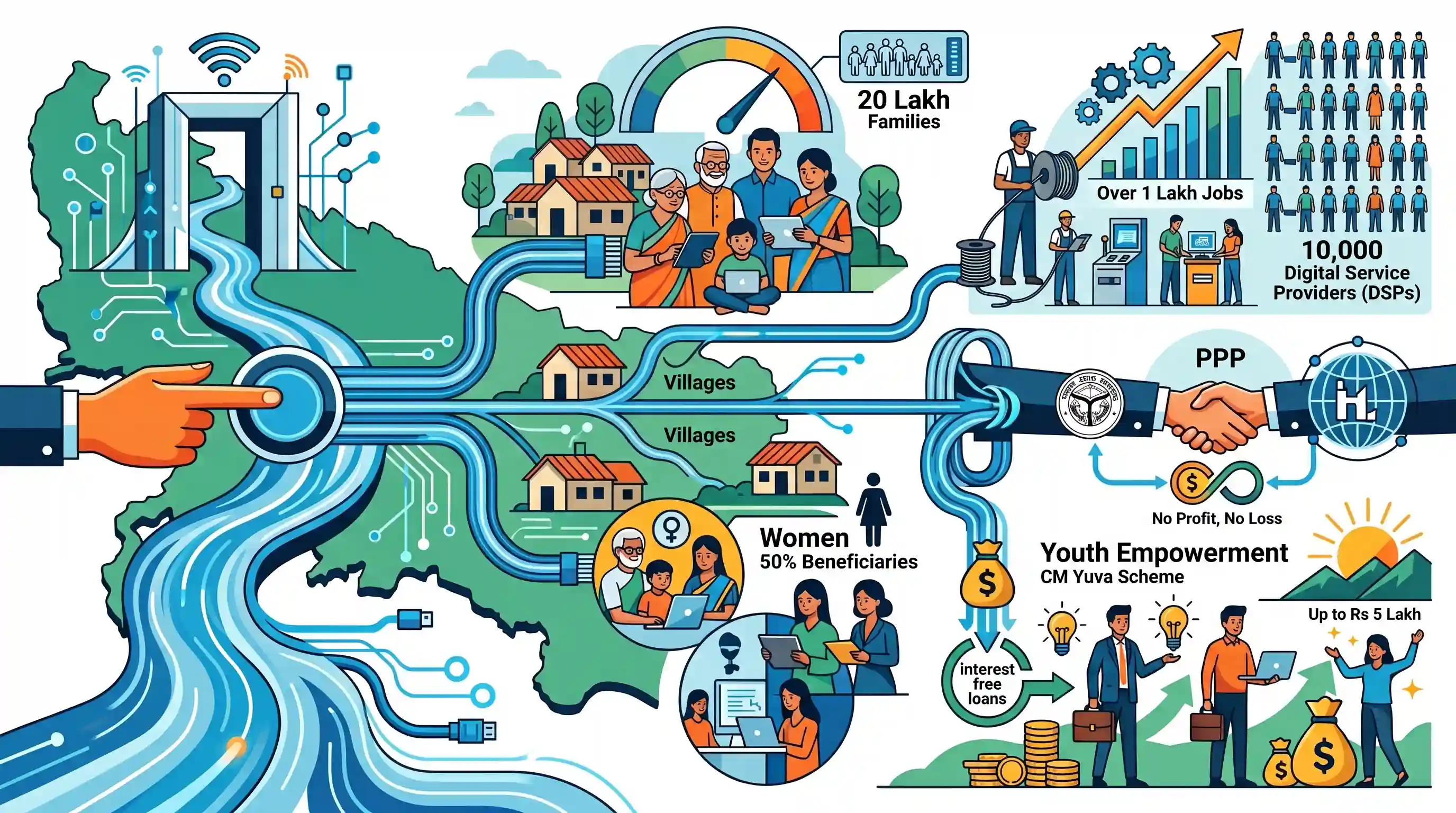
Uttar Pradesh Chief Minister Yogi Adityanath launched 'Project Ganga' on June 9, 2026, a major rural broadband initiative aimed at expanding high-speed internet connectivity across Uttar Pradesh villages. The project, acting as a 'Digital Expressway,' targets 20 lakh families, looks to create up to 10,000 rural Digital Service Providers (DSPs), and is projected to generate over 1 lakh jobs. It is being executed in partnership with the Hinduja Group on a 'No Profit, No Loss' basis, with a special emphasis on women representing 50% of the beneficiaries. In its first phase, the project covers 21 districts, with plans to expand to all 57,000 Gram Panchayats and 8,000 Nyaya Panchayats. Youth establishing these digital networks can access interest-free loans of up to Rs 5 lakh under the CM Yuva Scheme.
Key Points
- Project Ganga was launched on June 9, 2026, by Uttar Pradesh Chief Minister Yogi Adityanath to serve as the state's 'Digital Expressway' for rural broadband connectivity.
- The primary objectives are providing high-speed internet to 20 lakh families, creating 8,000 to 10,000 Digital Service Providers (DSPs), and generating over 1 lakh direct and indirect employment opportunities.
- The project is launched in 21 districts during its first phase, with a long-term goal of reaching all 57,000 Gram Panchayats and 8,000 Nyaya Panchayats in Uttar Pradesh.
- The Hinduja Group is partnering with the UP state government to support Project Ganga on a 'No Profit, No Loss' basis.
- Approximately 50% of the project's beneficiaries will be women, aiming to ensure gender inclusion in rural digital development.
- Selected digital entrepreneurs (DSPs) can avail themselves of interest-free loans of up to Rs 5 lakh under the 'CM Yuva scheme' to set up their enterprises.
- Manoj Kumar Singh, Chairman of the State Transformation Commission (STC), highlighted that Project Ganga represents a new model of local entrepreneurship where local youth will build and maintain fiber broadband networks.
Important Terms
Project Ganga

An initiative launched by the Uttar Pradesh government to provide last-mile fiber-based broadband connectivity to rural households, creating digital service providers (DSPs) to bridge the digital divide.
UPSC context
GS Paper II & III (Digital Infrastructure); tests rural connectivity models, e-governance initiatives, and public-private partnerships.
CM Yuva Scheme
A flagship Uttar Pradesh scheme promoting self-employment by providing interest-free, collateral-free loans up to Rs 5 lakh to trained and educated youth for establishing micro-enterprises.
UPSC context
GS Paper III (Employment/Government Schemes); evaluates state-level interventions for skill development, entrepreneurship, and rural employment creation.
Digital India
A nationwide campaign launched in 2015 by the Government of India to ensure public services are made available electronically by improving online infrastructure and internet connectivity.
UPSC context
GS Paper III (IT & Digital Infrastructure); highly relevant for understanding national e-governance policies and bridging the rural-urban digital divide.
BC Sakhi
A program in Uttar Pradesh deploying trained rural women from Self-Help Groups as Banking Correspondents to provide doorstep digital banking and financial services in remote villages.
UPSC context
GS Paper III (Financial Inclusion) & II (Social Justice/Women Empowerment); highlights grass-roots digital banking and women-led livelihood initiatives.
Gram Sachivalaya
Local administrative and service delivery centers established at the Gram Panchayat level in Uttar Pradesh to provide online public services directly to villagers near their homes.
UPSC context
GS Paper II (Local Governance/Panchayati Raj); tests mechanisms of decentralization, village-level service delivery, and digital governance at grassroots.
State Transformation Commission (STC)
A premier policy think tank in Uttar Pradesh, replacing the Planning Commission in 2022, responsible for resource evaluation, outcome monitoring, and economic planning.
UPSC context
GS Paper II (Planning Bodies/Governance); evaluates state-level planning institutions modeled on NITI Aayog to drive regional economic transformation.
Prelims Trap
Project GANGA is a central-sector ecological scheme aimed at rejuvenating the Ganges river basin.
Aspirants may reflexively link 'GANGA' with river rejuvenation (Namami Gange) or water transport, overlooking its identity as a rural broadband/telecom network in UP.
Static Concepts Connected
What is the Rural Digital Divide and its gender dimension?
- Access Disparity: Disparities in physical infrastructure, network bandwidth, and device affordability between urban centers and rural hinterlands.
- Gender Gap: A pronounced gap where rural women have significantly less independent access to smartphones and digital literacy compared to men.
- Developmental Drag: Restricts access to modern digital public infrastructure (DPI) such as UPI, e-health, and online education, cementing socio-economic inequality.
How do 'No-Profit, No-Loss' Public-Private Partnerships operate?
- Non-Commercial Mandate: Private entities execute and maintain public utility projects without aiming for commercial profit margins, often as CSR or strategic long-term development.
- State Facilitation: Government reduces risks for the private player by providing administrative support, single-window clearances, or interest-free credit channels for end-users.
- Social Infrastructure Focus: Typically deployed in high-social-impact sectors like rural connectivity, primary healthcare, and drinking water access.
Cross-Topic Patterns
Broadband + Rural Women Entrepreneurship
Connecting state fiber networks to local rural women entrepreneurs (like BC Sakhis) transforms passive internet pipelines into active tools for financial inclusion and female labor force participation.
Cooperative Federalism + Agile Infrastructure
The evolution of State Planning Boards into State Transformation Commissions (STC) reflects a NITI Aayog-style decentralization of infrastructure design using flexible, agile PPP structures.

State-led digital PPP models (like Ganga Fiber) vs Central BharatNet will likely feature in GS-3 questions on bridging the digital divide.
Linked PYQs · 3
Linked PYQs · 3
- 2021UPPSC_PRELIMSGS1
Which of the following is NOT the eligibility criterion before filling registration/ application forms for Uttar Pradesh Mukhya Mantri Swarojgar Yojna 2021 ?
- 2025UPPSC_PRELIMSGS1
Which of the following Department prepares the National Indicator Framework Progress Report related to Sustainable Development Goals in Uttar Pradesh? 1. Department of Finance 2. Department of Education 3. Department of Planning Select the correct answer from the code given below:
- 2015UPPSC_PRELIMSGS1
Which one of the following is not a component of 'Bharat Nirman' launched in 2005-2006?
