Uttar Pradesh Farmer Welfare Schemes and Agricultural Budget Expansion
Source:indianmasterminds ↗
Why It Matters
State-specific agricultural welfare schemes and marketing infrastructure upgrades (like e-NAM integration and MSP procurement) are highly relevant for UPPSC Prelims and Mains (UP Special Papers 5 & 6, and GS-3). Questions frequently test knowledge of the exact provisions, target beneficiaries, and validity periods of such flagship state initiatives.
Summary
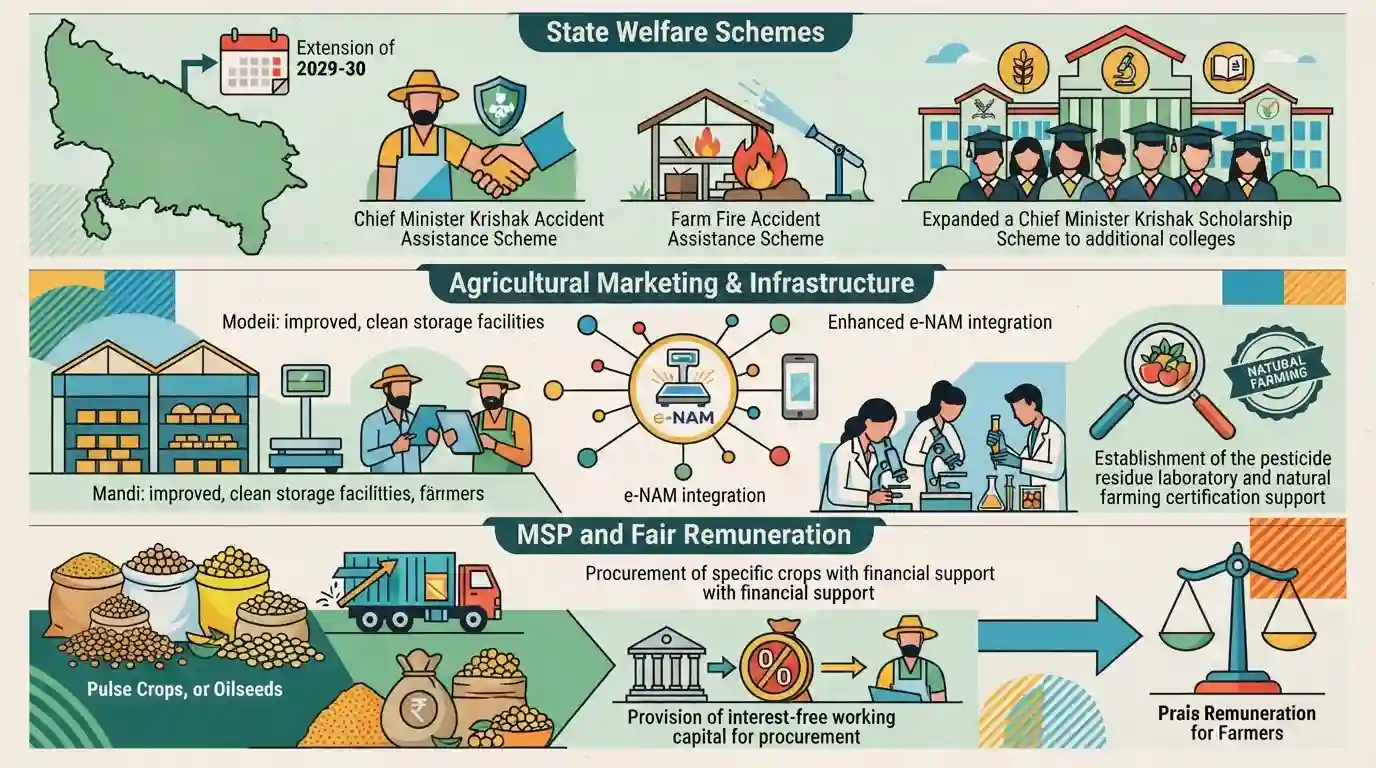
The Uttar Pradesh government has substantially expanded its agricultural welfare initiatives by extending key schemes—including the Chief Minister Krishak Accident Assistance Scheme and the Farm Fire Accident Assistance Scheme—until the 2029-30 financial year. The Chief Minister Krishak Scholarship Scheme has also been broadened to include students in 63 previously uncovered agricultural and home science colleges. Concurrently, the State Agricultural Produce Markets Board (Mandi Parishad) approved a ₹3,025 crore budget to modernize mandi infrastructure, enhance e-NAM integration, and set up a pesticide residue testing laboratory to boost natural farming certification. To ensure fair remuneration, the state will facilitate interest-free working capital for the procurement of pulses and oilseeds.
Key Points
- The UP government expanded the CM Krishak Scholarship Scheme to 63 unserved state-run agricultural and home science colleges, paying students ₹3,000 monthly.
- The CM Krishak Accident Assistance Scheme and CM Farm Fire Accident Assistance Scheme have been extended through 2029-30 to ensure continued social security for farmers.
- A ₹3,025.49 crore budget for 2026-27 was approved for the Mandi Parishad to upgrade APMC infrastructure and integrate e-NAM systems.
- The government will provide interest-free working capital for the procurement of pulses and oilseeds under the Price Support Scheme.
- A pesticide residue testing laboratory was approved under the National Mission on Natural Farming to assist with organic product certification.
Important Terms
e-NAM

A pan-India electronic trading portal launched in 2016 that integrates existing Agricultural Produce Market Committee (APMC) mandis to create a unified, transparent national market for agricultural commodities.
UPSC context
GS Paper III (Agricultural Marketing, Technology in Aid of Farmers); tests understanding of digital market integration and electronic trading platforms.
Price Support Scheme
A core component of the PM-AASHA umbrella scheme under which central agencies physically procure oilseeds, pulses, and copra at the Minimum Support Price (MSP) when market prices fall below it.
UPSC context
GS Paper III (Issues related to Direct and Indirect Farm Subsidies and MSP); tests agricultural price stabilization policies.
National Mission on Natural Farming
A standalone Centrally Sponsored Scheme approved in November 2024 to promote chemical-free, climate-resilient, livestock-integrated, and traditional-knowledge-driven agroecological farming across India.
UPSC context
GS Paper III (Sustainable Agriculture, Environment); tests policies on chemical-free and ecological farming practices.
NAFED
An apex cooperative marketing organization established in 1958 under the Multi-State Co-operative Societies Act, primarily responsible for agricultural marketing, procurement at MSP, and price stabilization.
UPSC context
GS Paper III (Agricultural Cooperatives, Public Procurement); tests the institutional structure of agricultural marketing and market interventions.
NCCF
The apex body of consumer cooperatives in India, established in 1965 under the Ministry of Consumer Affairs, operating as a central nodal agency for market intervention, procurement, and price stabilization.
UPSC context
GS Paper III (Cooperative Sector, Food Inflation Management); tests awareness of consumer protection and market stabilization tools.
Chief Minister Krishak Scholarship Scheme
A welfare initiative in Uttar Pradesh where the State Agricultural Produce Markets Board provides monthly financial scholarships to meritorious children of farmers and agricultural laborers pursuing agricultural/home science degrees.
UPSC context
GS Paper II (State welfare schemes) and UPPSC; tests knowledge of state-level educational and agricultural promotional initiatives.
Chief Minister Krishak Accident Assistance Scheme
A social security scheme in Uttar Pradesh providing up to ₹5 lakh in financial compensation to registered farmers, their families, and sharecroppers in the event of accidental death or permanent disability.
UPSC context
GS Paper II (Social Security and Welfare Schemes); tests understanding of risk-mitigation and insurance measures for agricultural communities.
Prelims Trap
The Price Support Scheme (PSS) for pulses is an entirely state-funded and state-designed market intervention program.
PSS is a central sector scheme under the PM-AASHA umbrella. While states facilitate logistics or interest-free capital, the core procurement losses are underwritten by the Centre.
Static Concepts Connected
What is the Price Support Scheme (PSS) under PM-AASHA?
- Central Nodal Agencies: Implemented by agencies like NAFED and FCI to procure pulses, oilseeds, and copra when market prices fall below MSP.
- Loss Underwriting: The central government bears the financial losses incurred during these price support procurement operations.
How does e-NAM reform the traditional APMC structure?
- Unified License: Enables traders to bid and buy across all integrated mandis within a state using a single, unified license.
- Quality Assaying: Integrates mandatory scientific testing of produce in mandis to ensure fair price discovery based on quality.
Cross-Topic Patterns
APMC upgrades + export competitiveness
Upgrading physical APMCs with pesticide residue testing labs directly tackles sanitary and phytosanitary (SPS) barriers, linking local farm infrastructure to global trade standards.
Cooperative federalism in agri-procurement
States providing interest-free working capital to backstop central schemes like PSS highlights cooperative federalism's role in driving crop diversification toward pulses.

State-level natural farming incentives and the operational mechanics of PSS under PM-AASHA will likely feature in 2026 GS3 Agriculture.
Linked PYQs · 4
Linked PYQs · 4
- 2023UPPSC_PRELIMSGS1
Which of the following scheme/s is/are related to Uttar Pradesh? (1) Anuthee Uphar Scheme (2) Matra Shakti Udyamita Scheme (3) Kaushalya Matritva Scheme (4) Stree Nidhi Scheme Select the 'correct' answer using the code given below -
- 2023UPPSC_PRELIMSGS1
Which of the following Scheme/Programme is not the Central Government Programme and it is Uttar Pradesh Government's Programme?
- 2004UPPSC_PRELIMSGS1
NAFED is associated with
- 2018UPPSC_PRELIMSGS1
From 4th July 2018 the Minimum Support Price (MSP) during 2018-19 for paddy per quintal is
