Uttar Pradesh mandates free H1N1 testing at all state hospitals
Source:the-print ↗
Why It Matters
Crucial for understanding state-level interventions in public health management, communicable disease surveillance, and healthcare accessibility in Uttar Pradesh.
Summary
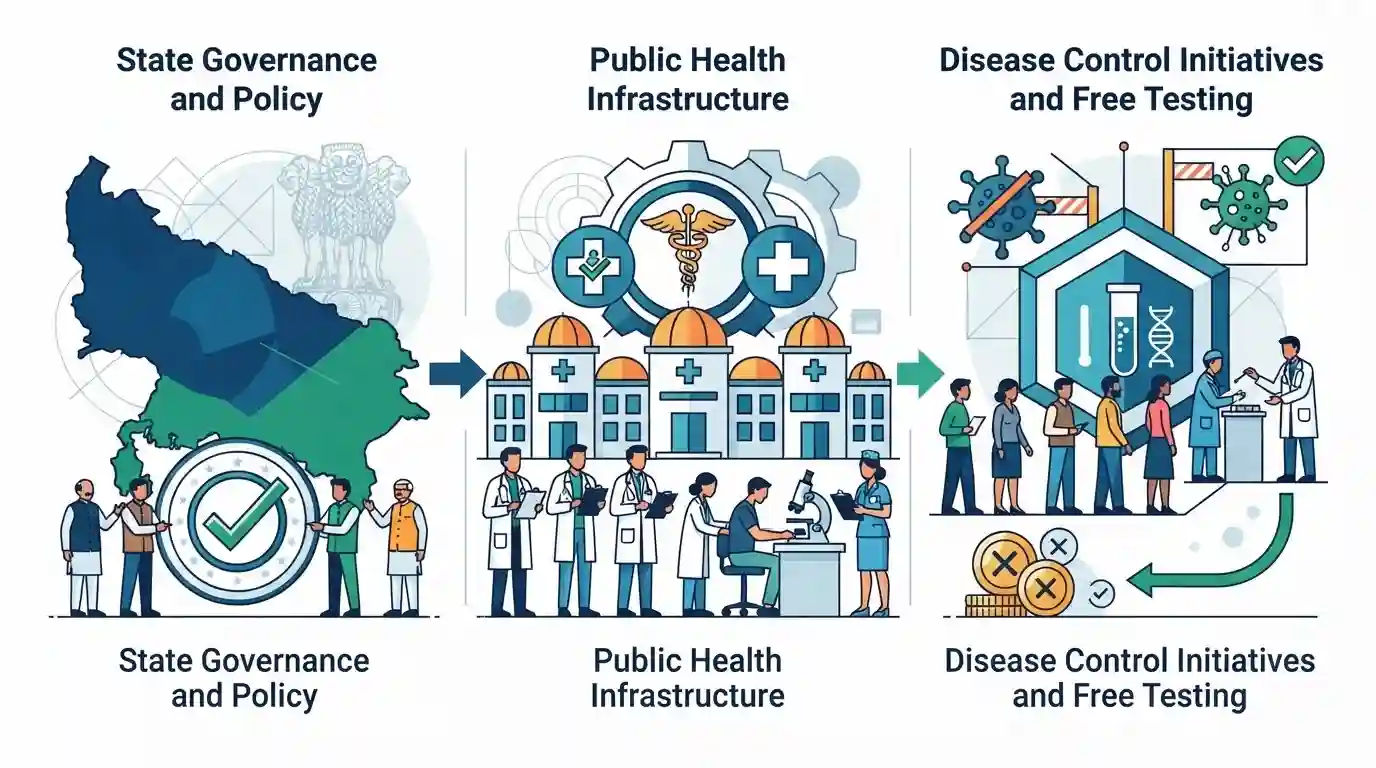
The Uttar Pradesh government has mandated free H1N1 (swine flu) testing across all state-run health facilities to strengthen public health infrastructure and facilitate early disease detection.
Key Points
- Uttar Pradesh Chief Minister Yogi Adityanath directed that H1N1 (swine flu) testing be provided free of cost at all government health facilities across the state.
- The decision aims to ensure early diagnosis and containment of the H1N1 influenza virus, preventing potential outbreaks and providing accessible healthcare to vulnerable populations.
- State health facilities have been instructed to ramp up diagnostic capabilities and stock essential medications for treatment.
Important Terms
H1N1 (Swine Flu)

A respiratory infection caused by the Influenza A virus subtype H1N1, spreading via droplets and causing seasonal outbreaks managed through public health advisories and testing.
UPSC context
Important for UPPSC Prelims and Mains (General Studies Paper II - Health, Governance and Social Sector initiatives).
Uttar Pradesh Government
The state-level apex executive authority of Uttar Pradesh responsible for framing policies, administering public health, and executing disease-control measures across districts.
UPSC context
Relevant for UPPSC GS Paper V and VI (Uttar Pradesh Specific Governance, Public Administration, and Welfare Schemes).
Health Department Uttar Pradesh
The administrative wing of UP government tasked with implementing health policies, managing disease surveillance, running public hospitals, and executing state-wide epidemic control programs.
UPSC context
Tested in UPPSC Mains GS Paper II and VI regarding public health delivery mechanisms and administrative responses to outbreaks in UP.
Prelims Trap
H1N1 is a water-borne bacterial infection spreading through contaminated food and water during monsoons.
Aspirants often confuse H1N1 (Influenza A) as a water-borne disease or a bacterial infection, missing its viral respiratory droplet transmission route.
Static Concepts Connected
What are the key characteristics and transmission dynamics of the H1N1 (Swine Flu) virus?
- Viral Classification: Causative agent: Influenza A virus subtype H1N1, originating from a combination of bird, swine, and human genes.
- Transmission Route: Transmission mode: Primarily spreads through droplet infection via coughing or sneezing, similar to seasonal influenza.
- Medical Treatment: Primary antiviral: Oseltamivir (Tamiflu) is widely recommended by WHO and health protocols for treating H1N1 infections.
Cross-Topic Patterns
Health Mandates and SDG 3 Goals
State-level public health mandates like free swine flu testing directly support SDG 3 (Good Health and Well-being) and test cooperative federalism in managing epidemic-prone vector and droplet infections.
Grassroots Health Machinery and Disease Surveillance
The mobilization of ASHA workers and ANMs for door-to-door flu screening highlights the backbone of rural healthcare delivery systems tested in UP PCS exams.

UPPCS often asks direct factual questions on disease causative agents, vector/transmission types, and state health scheme mandates like H1N1.
Linked PYQs · 3
Linked PYQs · 3
- 2022UPPSC_PRELIMSGS1
The bacillus haemophilus influenza causes
- 2023UPPSC_PRELIMSGS1
Which type of vaccine protect against Diphtheria?
- 2023UPPSC_PRELIMSGS1
Match list-I with list-II and select the correct answer using code given below. List-I (Diseases): (A) Peptic ulcers (B) Dengue (C) Elephant Foot (D) Malaria List-II (Factors): 1. Virus 2. Protozoa 3. Worm 4. Bacteria
