Uttar Pradesh targets 5 crore saplings for environment campaign
Source:abplive ↗
Why It Matters
This highlights Uttar Pradesh's major ecological targets (5 crore saplings, plastic-free ULBs) and large-scale public administrative challenges (2.9 million-candidate exam management) which are typical themes tested under environment, local governance, and administration sections of the UPPSC Prelims exam.
Summary
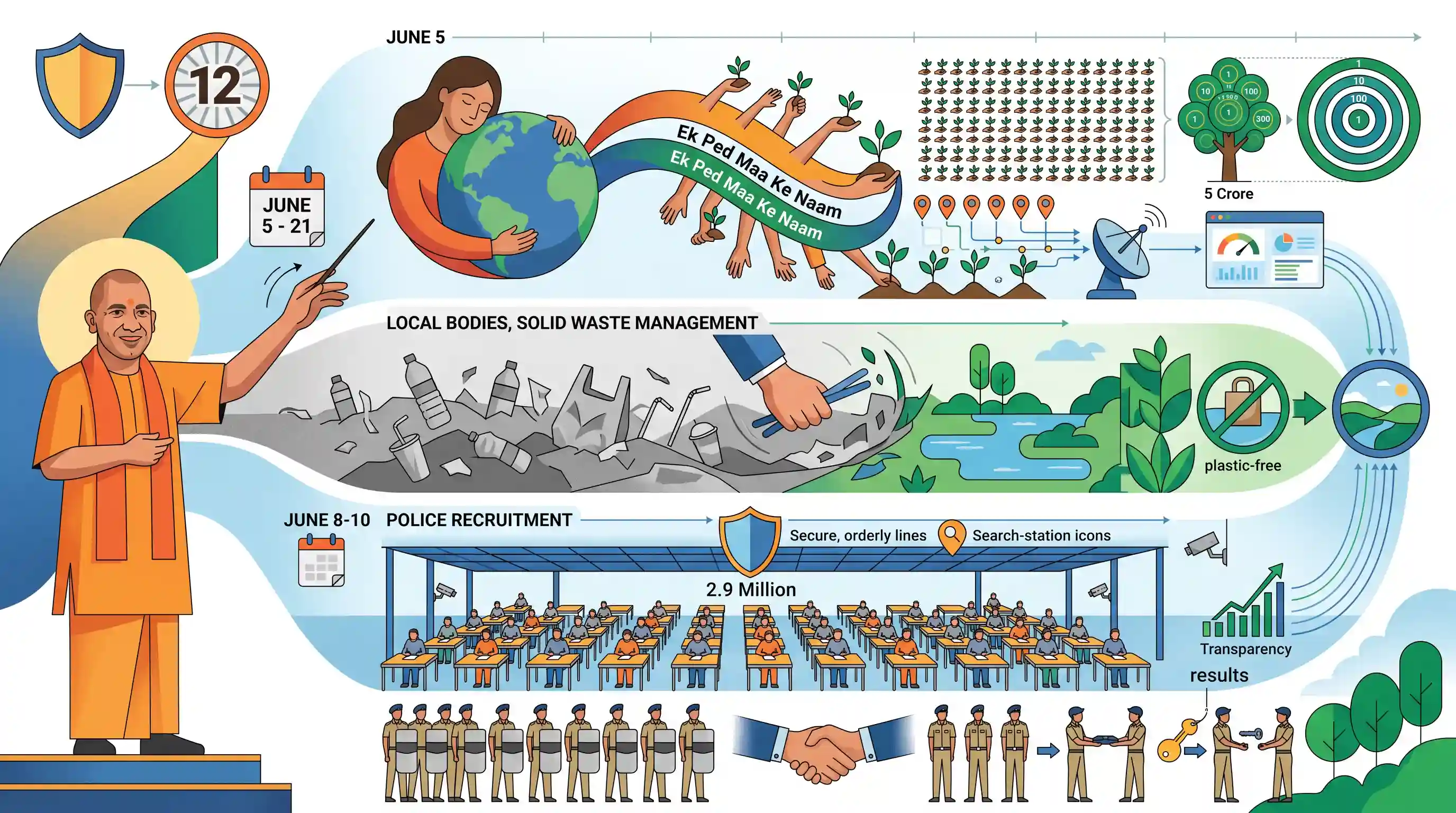
Uttar Pradesh Chief Minister Yogi Adityanath directed state officials to organize massive public awareness campaigns from June 5 to June 21, 2026, marking 12 years of the Modi-led Central government. Key highlights include planting 5 crore saplings under the 'Ek Ped Maa Ke Naam' campaign on World Environment Day, ensuring geo-tagging, making local bodies single-use plastic-free, and securely administering a massive police recruitment exam for 2.9 million candidates between June 8-10.
Key Points
- Campaign Timeline: The mass awareness and public outreach events will run from June 5 (World Environment Day) to June 21, 2026 (International Day of Yoga), marking 12 years of the Modi government.
- Ek Ped Maa Ke Naam: Uttar Pradesh has set a target to plant and geo-tag at least 5 crore (50 million) saplings on June 5, with instructions to guarantee their post-plantation survival and protection.
- Plastic-Free Initiatives: CM Adityanath directed officials to make all gram panchayats and urban local bodies (ULBs) in the state completely free of single-use plastic.
- Welfare and Health Outreach: Cleanliness campaigns, public health fairs, and district-level exhibitions showcasing governance achievements will be conducted statewide.
- UP Police Recruitment Security: The state is preparing to run the civil police constable recruitment exam from June 8-10, 2026, for 2.9 million candidates, focusing on complete transparency and strict action against social media rumours.
Important Terms
Ek Ped Maa Ke Naam Campaign

A nationwide afforestation initiative launched on World Environment Day 2024 by PM Narendra Modi, urging citizens to plant trees as a tribute to their mothers, combining ecological action with personal and emotional values.
UPSC context
GS Paper III (Environment & Biodiversity); tests understanding of environmental conservation strategies, community participation, and national afforestation campaigns like Mission LiFE.
Geo-tagging
The process of assigning precise geographical GPS coordinates (latitude and longitude) to physical objects, such as saplings, creating a verifiable digital profile to monitor growth and ensure transparency in administration.
UPSC context
GS Paper II & III (Governance, Science & Technology); tests the deployment of digital technology in public service delivery and forestry management.
Single-use Plastic
Disposable plastic items designed to be used once before being thrown away or recycled, characterised by low utility and high littering potential, posing a major threat to terrestrial and marine ecosystems.
UPSC context
GS Paper III (Environmental Pollution & Degradation); tests knowledge of waste management, environmental hazards, and policies combating plastic pollution in India.
Plastic Waste Management Rules, 2016
India's regulatory framework governing plastic waste, which introduced Extended Producer Responsibility (EPR) and sets specific thickness limits for plastic packaging and carry bags to encourage recycling and discourage single-use plastics.
UPSC context
GS Paper III (Environment Legislation & Waste Management); tests policy provisions, amendment frameworks (like EPR targets), and enforcement challenges of waste management in India.
World Environment Day
An annual global event observed on June 5, led by the United Nations Environment Programme (UNEP), to raise awareness and drive action on critical environmental challenges like climate change and pollution.
UPSC context
GS Paper III (Environment & Ecology); tests awareness of major international conservation platforms, key environmental milestones, and global sustainable development objectives.
Prelims Trap
The nationwide ban on single-use plastics applies uniformly to all materials, including those made of compostable plastics.
Under the Plastic Waste Management Rules, the ban on identified single-use plastic items specifically excludes commodities made of compostable plastics, which are permitted subject to BIS standards.
Static Concepts Connected
What are the core parameters of environmental "Carrying Capacity"?
- Resource regeneration: The rate of resource harvesting and extraction must not exceed the rate of natural resource regeneration.
- Waste assimilation: The generation of waste and pollution must remain within the natural assimilative or absorptive capacity of the ecosystem.
- Threshold limits: Breaching these biophysical limits leads to irreversible environmental degradation, resource depletion, and ecological collapse.
What are the key provisions of India's Plastic Waste Management (Amendment) Rules, 2021?
- Thickness mandates: Mandated increasing the minimum thickness of plastic carry bags to 120 microns to facilitate reuse and discourage littering.
- Compostable exemption: The ban on identified single-use plastic items does not apply to commodities made of certified compostable plastics.
- Statutory penalties: Violations of the single-use plastic ban are penalized under Section 15 of the parent Environment Protection Act, 1986.
Cross-Topic Patterns
Afforestation & Carbon Credit Trading
Linking massive state-led tree plantation campaigns like 'Ek Ped Maa Ke Naam' to India's Carbon Credit Trading Scheme (CCTS) to monetize and incentivize long-term sapling survival.
Cooperative Federalism & Green Governance
State-level execution of central mandates like the single-use plastic ban highlights the critical reliance on Gram Panchayats and Urban Local Bodies for environmental enforcement.

UPSC may test the statutory basis of plastic bans and the specific exemptions (like compostable plastics) under the PWM Rules.
Linked PYQs · 3
Linked PYQs · 3
- 2022UPPSC_PRELIMSGS1
Which of the following trees is dangerous for environment ?
- 2025UPPSC_PRELIMSGS1
With reference to 'Carrying Capacity of Environment', which of the following statements is/are correct ? 1. The rate of resource extraction should remain above the rate of resource generation. 2. Generation of waste should remain within the absorption capacity of environment. Select the correct answer from the code given below :
- 2024UPPSC_PRELIMSGS1
Consider the following days and arrange them in chronological order : 1. World Health Day 2. National Maritime Day 3. World Athletics Day 4. World Red Cross Day Select the correct answer from the codes given below :
