Uttar Pradesh approves new startup and data centre policies for growth
Source:indianexpress ↗
Why It Matters
This policy update represents a substantial revamp of Uttar Pradesh's technology and industrial policies. For UPPSC aspirants, the specific financial figures, targets (such as the 2 GW data capacity and ₹2 lakh crore investment goal), institutional bodies (Startup Mission Directorate), and regional priorities (Bundelkhand and Purvanchal) are highly testable areas in both Prelims (MCQs on targets/policy provisions) and Mains (GS Paper 5 and 6 on UP's economy and infrastructure).
Summary
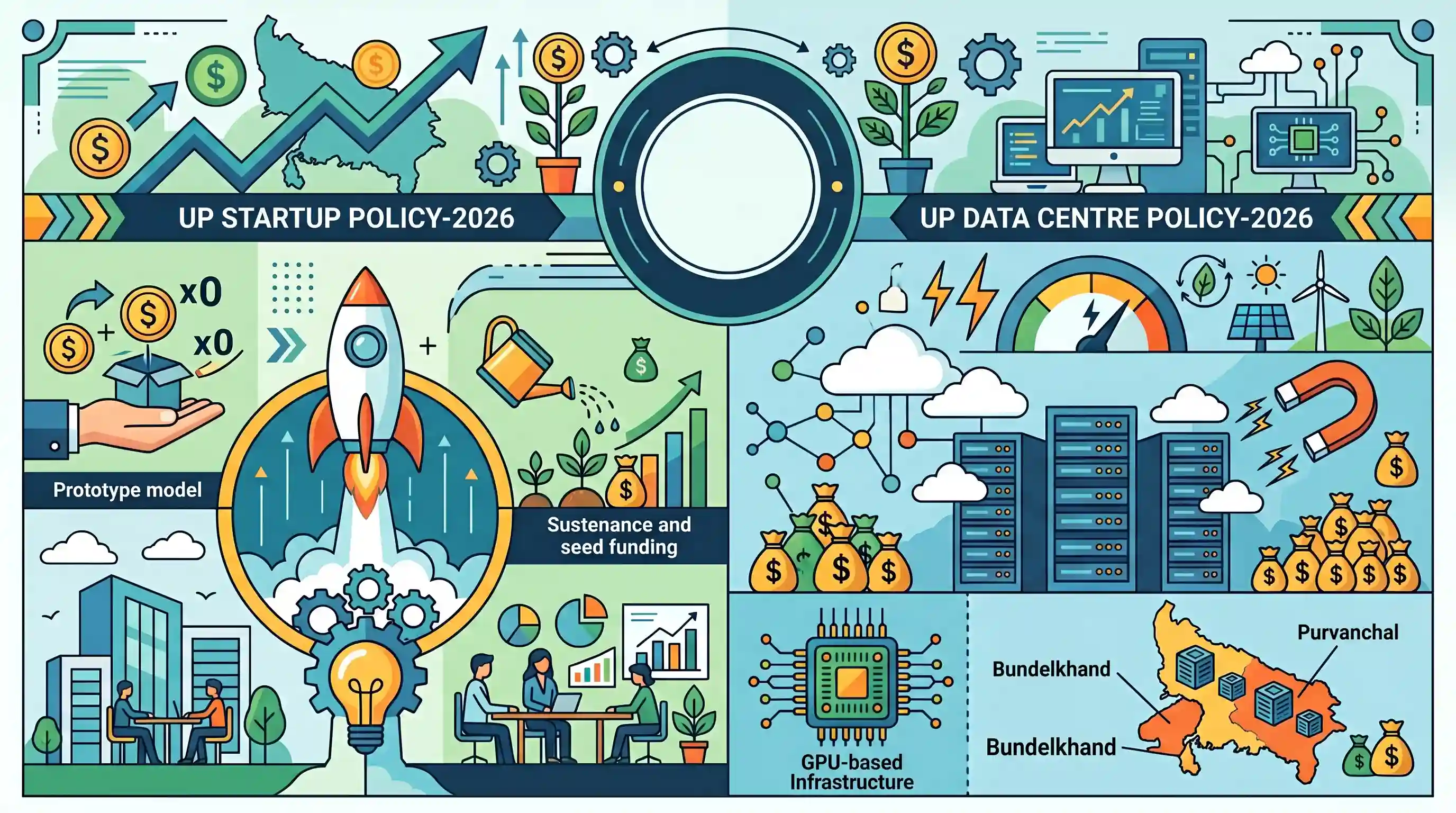
The Uttar Pradesh Cabinet approved two major policies—the UP Startup Policy-2026 and the UP Data Centre Policy-2026—designed to drive tech-led investments, boost employment, and support the state's $1-trillion economy ambition. The Startup Policy significantly enhances financial incentives, including doubling prototype grants and increasing sustenance and seed funding allowances, alongside establishing a dedicated Startup Mission Directorate. Concurrently, the Data Centre Policy aims to expand state capacity by 2 GW and attract ₹2 lakh crore in investment with a focus on green energy, GPU-based infrastructure, and specialized regional incentives for Bundelkhand and Purvanchal.
Key Points
- The Uttar Pradesh Cabinet, chaired by CM Yogi Adityanath, approved the Uttar Pradesh Startup Policy-2026 and the Uttar Pradesh Data Centre Policy-2026 to stimulate investment, innovation, and help achieve UP's goal of becoming a $1-trillion economy.
- The UP Startup Policy-2026 increases the monthly sustenance allowance for startups from ₹17,500 (for 1 year) to ₹20,000 (for 2 years), doubles prototype grants to ₹10 lakh, and doubles seed funding to ₹15 lakh (up to ₹50 lakh under special circumstances).
- Deep-tech startups specializing in AI, robotics, quantum technology, and space tech will receive prototype assistance of up to ₹20 lakh, seed funding of up to ₹30 lakh, patience capital support of up to ₹100 crore, and up to 40% R&D financial assistance.
- Capital grants for startup incubators are increased to ₹1.25 crore (up to ₹1.50 crore in Bundelkhand and Purvanchal), with annual operational expenditure grants raised to ₹40 lakh. Financial support for establishing 20 new Centres of Excellence (CoEs) is raised to ₹12 crore each.
- A new Startup Mission Directorate will be established under the Societies Registration Act, operating under the Department of IT & Electronics as the nodal agency to govern the state's 17,000+ registered startups.
- The UP Data Centre Policy-2026 targets developing 2 Gigawatts (GW) of additional data centre capacity and attracting over ₹2 lakh crore in investment, emphasizing GPU-based infrastructure, energy efficiency, and extra incentives for Bundelkhand and Purvanchal.
- Under the predecessor 2021 Data Centre Policy (amended in 2022), 7 out of 6 planned data centre parks and 2 units with <40 MW capacity (involving ₹21,343 crore investment) have already become operational.
Important Terms
Uttar Pradesh Startup Policy-2026

A policy framework approved in July 2026 that enhances financial incentives, doubles prototype grants, introduces deep-tech support, and sets up a dedicated Directorate to accelerate UP's startup ecosystem.
UPSC context
GS Paper II & III: Government policies on industrial growth, technology-led investment, and entrepreneurship development.
Uttar Pradesh Data Centre Policy-2026
A policy approved in July 2026 aiming to develop UP into a green, AI-ready data centre hub by adding 2 GW capacity and attracting ₹2 lakh crore in digital infrastructure investment.
UPSC context
GS Paper III: Digital infrastructure, AI computing, technology policy, and sustainable economic development.
Startup Mission Directorate
A dedicated government agency established in July 2026 as a registered society to oversee, coordinate, and implement startup and innovation-led policies across Uttar Pradesh.
UPSC context
GS Paper II: Governance, institutional frameworks, and state-level statutory or non-statutory bodies.
Uttar Pradesh Data Centre Policy-2021 (First Amendment-2022)
The predecessor digital policy framework in Uttar Pradesh that successfully catalyzed early private sector investment in several state-of-the-art data centre parks before expiring in January 2026.
UPSC context
GS Paper III: Policy evolution, evaluation of state-level digital frameworks, and infrastructure growth.
Societies Registration Act, 1860
A nineteenth-century Indian legislation that provides for the registration and legal standing of literary, scientific, charitable, and non-profit societies or directorates.
UPSC context
GS Paper II: Regulatory frameworks, civil society organizations, and governance of non-profit entities.
Centres of Excellence (CoEs)
Specialized research institutions designated to promote advanced research, innovation, and startup mentoring in emerging fields like artificial intelligence, robotics, and deep-tech.
UPSC context
GS Paper III: Science and technology development, indigenous technology, and research infrastructure.
Prelims Trap
The Startup Mission Directorate is a statutory body established by a state legislative assembly act.
The Directorate is actually registered as a society under the Societies Registration Act, operating under the IT Department rather than being statutory.
Static Concepts Connected
What is 'Patient Capital' and why is it vital for deep-tech?
- Definition: Long-term investment capital where investors do not expect quick returns, accepting high risk and long gestation periods.
- Deep-tech relevance: Crucial for sectors like quantum computing, space-tech, and biotech that require years of research before commercial viability.
- Valley of death: Helps startups survive the capital-intensive phase between basic research and market-ready product launch.
What is the infrastructure status of Data Centres in India?
- Harmonized Master List: Granted infrastructure status in 2022, easing access to institutional credit, external commercial borrowings, and long-term funds.
- Strategic importance: Essential for data localization under the DPDP Act and hosting computational power like GPU-based AI clusters.
Cross-Topic Patterns
Federalism and digital infrastructure
Competitive federalism drives states to draft aggressive data-centre policies, altering national economic geography and supporting India's sovereign AI computational capacity.
Regional disparity and industrial policy
By structuring higher incentives for Bundelkhand and Purvanchal, the policy uses digital-economy assets to correct historical geographic development imbalances.

State-level deep-tech and GPU-infrastructure policies reflect a federal shift to capture AI-hardware supply chains under GS-3.
Linked PYQs · 2
Linked PYQs · 2
- 2013UPPSC_PRELIMSGS1
In Uttar Pradesh I.T. City is being established in
- 2021UPPSC_PRELIMSGS1
Which of the following Schemes in Uttar Pradesh were introduced in Budget of 2021-22? I. Atmanirbhar Krishak Samanvit Vikas Yojna II. Mukhya Mantri Saksham Suposhan Yojna III. Mukhya Mantri Pravasi Shramik Udyamita Vikas Yojna IV. Yuva Udyamita Vikas Abhiyan Select the correct answer from the codes given below.
