Uttar Pradesh Approves New Startup and Data Centre Policies
Source:Indian Express ↗
Why It Matters
These policies reflect the critical role of state-level interventions (subnational governance) in achieving national developmental goals like AI adoption, green energy transition, and deep-tech innovation. They serve as excellent case studies for GS3 answers on digital infrastructure, industrial policies, and mitigating regional disparities through technology-led growth.
Summary
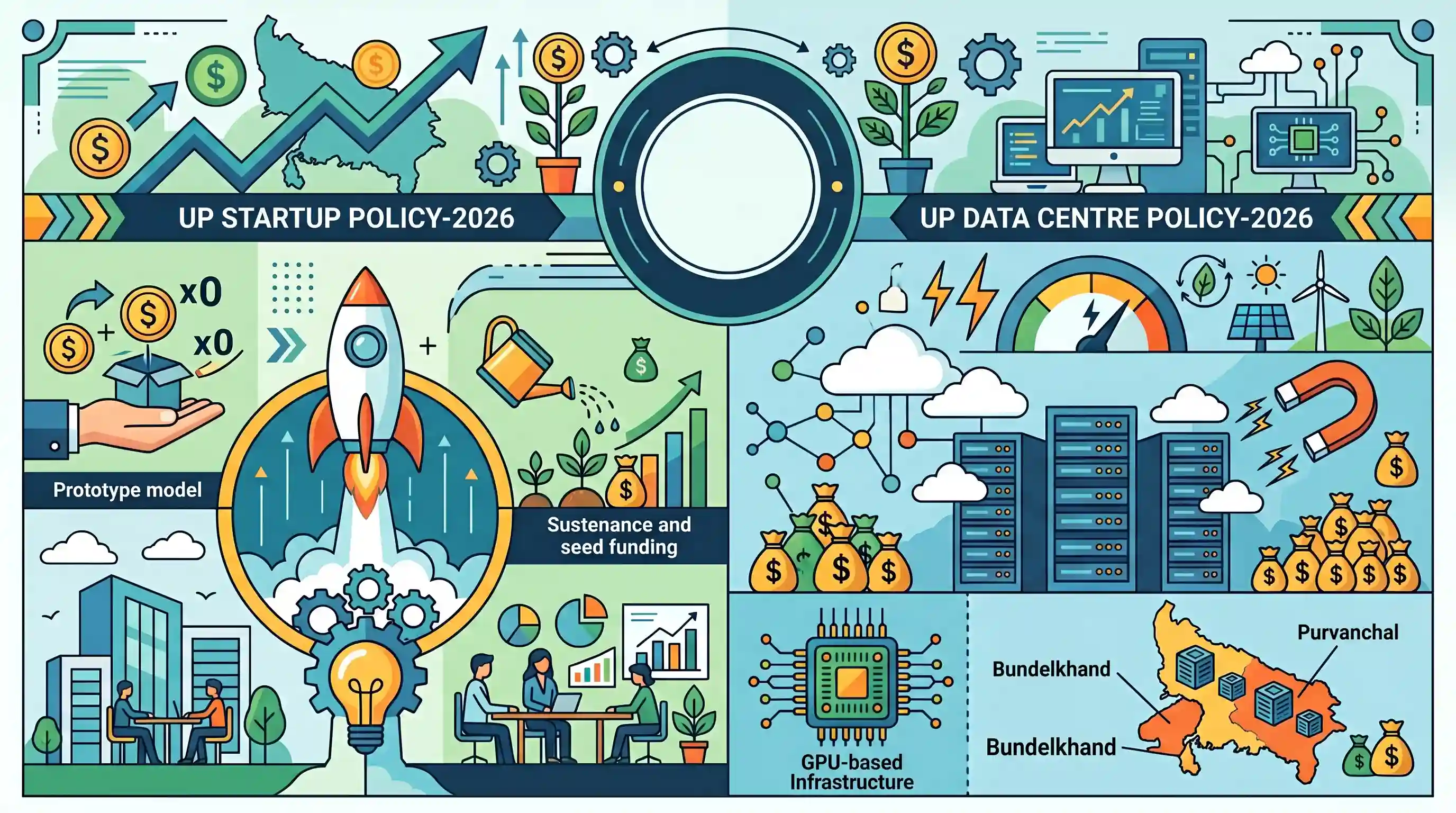
The Uttar Pradesh Cabinet has approved the UP Startup Policy-2026 and the UP Data Centre Policy-2026 to foster innovation, attract over ₹2 lakh crore in investment, and support the state's transition to a $1-trillion economy. The Startup Policy scales up financial assistance across the board, introduces specialized incentives for deep-tech ventures (including R&D support and patience capital), increases incubator funding, and establishes a state-level Startup Mission Directorate. Concurrently, the Data Centre Policy aims to build 2 GW of capacity, with a strong focus on GPU-based AI compute infrastructure and green computing. Both policies incorporate special fiscal incentives for the Bundelkhand and Purvanchal regions to address historical regional development disparities.
Key Points
- The Uttar Pradesh Cabinet approved two forward-looking policies: the Uttar Pradesh Startup Policy-2026 and the Uttar Pradesh Data Centre Policy-2026, aimed at accelerating investment, innovation, and employment to support UP's goal of becoming a $1-trillion economy.
- The Startup Policy-2026 increases financial incentives significantly: sustenance allowance raised to ₹20,000/month for 2 years, prototype grants doubled to ₹10 lakh, and seed funding increased to ₹15 lakh (up to ₹50 lakh under special circumstances).
- Deep-tech startups in AI, robotics, quantum technology, and space tech will receive special incentives, including up to ₹20 lakh for prototype assistance, ₹30 lakh for seed funding, ₹100 crore in patience capital, and 40% R&D financial assistance.
- Infrastructure and institutional support are enhanced via 20 new Centres of Excellence (CoEs with ₹12 crore funding each), the establishment of a Deep-Tech U-Hub, and the creation of a Startup Mission Directorate under the Department of IT & Electronics.
- The Data Centre Policy-2026 aims to add 2 GW of capacity and attract over ₹2 lakh crore in investment, emphasizing GPU-based AI-compute infrastructure, energy-efficient operations, and green computing (with incentives for Tier-3/4 data centers).
- Both policies actively promote balanced regional development by offering higher financial incentives (such as ₹1.50 crore capital grants for incubators) and extra fiscal benefits for projects located in the economically backward Purvanchal and Bundelkhand regions.
Important Terms
Uttar Pradesh Startup Policy-2026

A comprehensive framework approved in July 2026 to foster innovation, offering ₹1,000 crore in funding, doubled seed capital, higher sustenance allowances, and special incentives to position Uttar Pradesh as a national startup hub.
UPSC context
GS Paper III (Economy & Mobilization of Resources); tests subnational policies for digital economy, job creation, and industrial growth.
Uttar Pradesh Data Centre Policy-2026
A policy aimed at making the state a green, AI-ready data center hub, targeting over ₹2 lakh crore in investments, 2 GW capacity, GPU-based compute infrastructure, and regional development incentives.
UPSC context
GS Paper III (Infrastructure & Science/Technology); tests state-level initiatives in digital infrastructure, energy-efficient computing, and balanced growth.
Startup Mission Directorate (Uttar Pradesh Startup Mission)
A newly approved, dedicated institutional body registered as a society in Uttar Pradesh to coordinate, manage financial administration, track mentorship, and oversee incubators and Centres of Excellence.
UPSC context
GS Paper II (Governance & Institutional Frameworks); tests administrative reforms for executing industrial policies and startup ecosystem handholding.
Deep-Tech U-Hub
A state-level facility designated for construction in Lucknow and Noida to act as a shared convergence base providing deep-tech startups with incubation, mentorship, investment, and lab access.
UPSC context
GS Paper III (Science & Technology/Innovation); tests infrastructure models bridging academic research and commercial technology commercialization.
Centres of Excellence (CoEs)
Dedicated research and innovation centers (UP plans 20 new ones) funded up to ₹12 crore each to focus on AI, health-tech, space tech, and other emerging sectors.
UPSC context
GS Paper III (Science and Technology); tests state-driven institutional frameworks for promoting specialized R&D and indigenous technology development.
Uttar Pradesh Data Centre Policy-2021 (First Amendment-2022)
The state's predecessor digital infrastructure policy under which projects worth over ₹21,000 crore were approved across several data center parks, laying the foundation for UP's tech pivot.
UPSC context
GS Paper III (Infrastructure); tests evolution of digital infrastructure policy frameworks and their long-term economic outcomes at subnational levels.
Prelims Trap
The Startup Mission Directorate of Uttar Pradesh is established as a statutory body under a state startup act.
The Startup Mission Directorate is an autonomous body registered under the Societies Registration Act (to ensure professionalized, single-window execution), rather than a statutory body established by a specific state legislative act.
Static Concepts Connected
What is Patient Capital and how does it address the "Valley of Death" in deep-tech startups?
- Definition: Long-term investment capital where investors do not expect quick returns (often 10+ years), allowing startups to focus on deep scientific R&D.
- Deep-tech alignment: Deep-tech sectors (quantum, space, robotics) require prolonged laboratory validation and heavy capital expenditure before reaching market readiness.
- Valley of Death: Bridges the critical funding gap between academic research/prototyping and commercial scaling where standard venture capital is highly risk-averse.
What is the significance of granting 'Infrastructure Status' to Data Centres in India?
- Policy designation: Data centres with more than 5 MW capacity were granted 'Harmonized Infrastructure Status' in the Union Budget 2022-23.
- Credit access: Allows developers to access cheaper, long-term credit via External Commercial Borrowings (ECBs) and tap into pension and insurance funds.
- Sovereign data security: Accelerates local cloud infrastructure growth, critical for compliance with national data localization mandates under the DPDP Act.
Cross-Topic Patterns
Asymmetric sub-state fiscal incentives
Using differential fiscal incentives (e.g., higher capital grants for Bundelkhand/Purvanchal) to correct sub-state economic imbalances connects GS3 industrial policy to GS1 regionalism and balanced development.
AI compute vs. Green energy goals
High-density GPU-based AI compute servers consume up to five times more power than traditional CPU servers, directly linking GS3 digital infrastructure growth to India's green grid integration and 2070 Net-Zero commitments.

State-led deep-tech policies and sovereign GPU-compute infrastructure targets will likely feature as a GS3 Mains digital economy question in 2026.
Linked PYQs · 3
Linked PYQs · 3
- 2023MainsGS3
What is the status of digitalization in the Indian economy? Examine the problems faced in this regard and suggest improvements.
- 2024MainsGS1
What is regional disparity? How does it differ from diversity? How serious is the issue of regional disparity in India?
- 2021MainsGS3
“Investment in infrastructure is essential for more rapid and inclusive economic growth.” Discuss in the light of India's experience.
