Uttar Pradesh Senior Citizen Property Protection Rules
Source:etvbharat ↗
Why It Matters
This is a crucial governance and social justice reform at the state level in Uttar Pradesh, directly relevant to the UPPSC Prelims syllabus under 'State Policies' and 'Issues related to vulnerable sections'. Awareness of specific state amendments and the legal framework for senior citizen protection is often tested in the UPPSC examination.
Summary
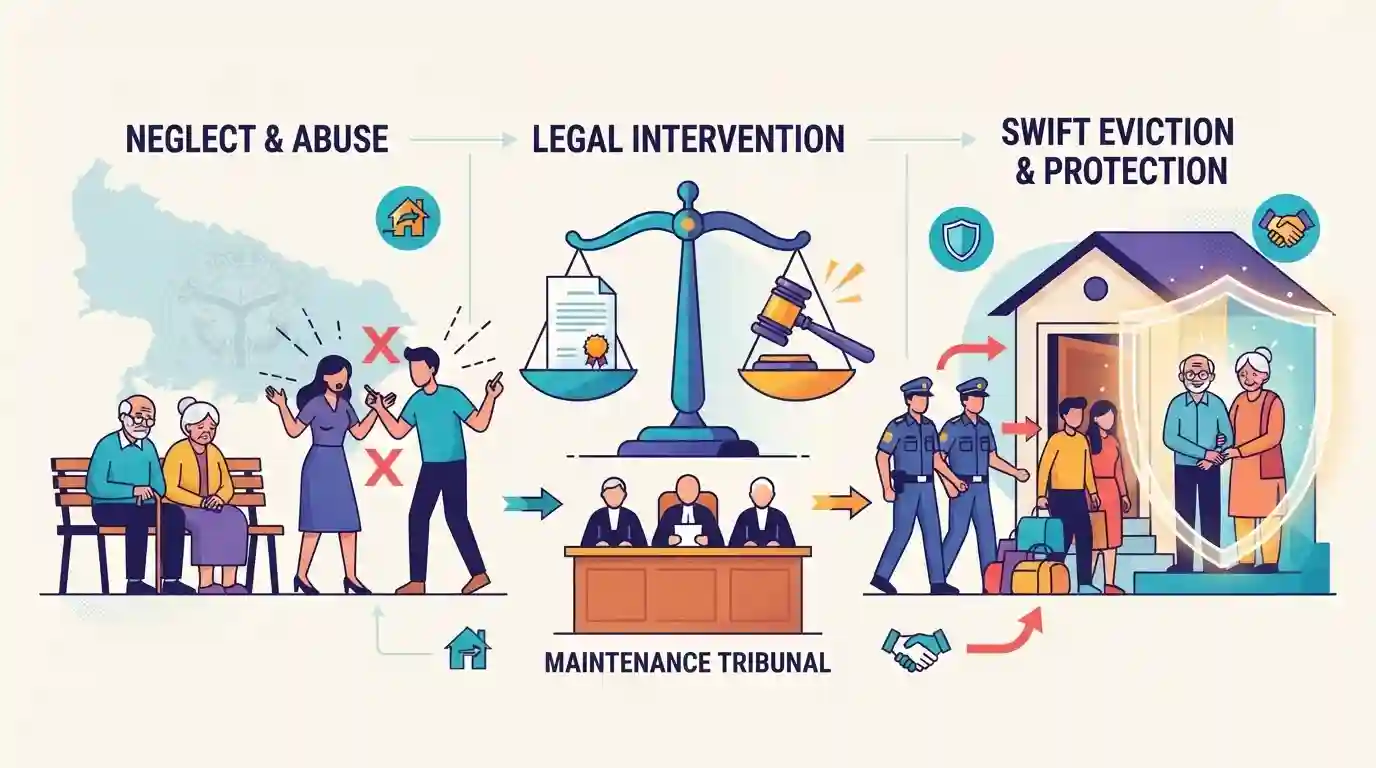
The Uttar Pradesh government has introduced stringent measures to protect senior citizens from neglect and abuse by amending the Uttar Pradesh Maintenance and Welfare of Parents and Senior Citizens Rules-2014. The updated rules establish a clear legal pathway for elderly parents to evict uncooperative or abusive children and legal heirs from their properties. By empowering Maintenance Tribunals and District Magistrates to enforce swift evictions—backed by police support if necessary—the state aims to ensure a dignified and secure life for its aging population.
Key Points
- The Uttar Pradesh Cabinet has approved amendments to the UP Maintenance and Welfare of Parents and Senior Citizens Rules-2014 to safeguard the rights of elderly parents.
- Under the newly inserted Rules 22A, 22B, and 22C, elderly parents can now evict children or legal heirs from their property (ancestral or self-acquired) if they face negligence, abuse, or fail to receive proper maintenance.
- Complaints can be lodged with the Maintenance Tribunal (presided over by the SDM), which must resolve the issue within 30 days. Valid complaints will result in an eviction notice requiring the heirs to vacate the property within 30 days.
- If the heirs refuse to vacate, the tribunal can enlist police assistance to enforce the eviction. The District Magistrate acts as an appellate authority and monitors monthly reports from the tribunals.
- The state government will also issue a toll-free helpline number for senior citizens to report grievances easily.
Important Terms
Uttar Pradesh Maintenance and Welfare of Parents and Senior Citizens Rules, 2014

State regulations, recently amended (adding Rules 22-A, 22-B, 22-C), empowering District Magistrates to enforce the swift eviction of abusive or negligent children from their elderly parents' property.
UPSC context
Crucial for UPPSC GS Paper 2 (UP State Policies/Social Justice). Tests knowledge of specific welfare interventions for vulnerable groups.
Maintenance and Welfare of Parents and Senior Citizens Act, 2007
A central legislation making it legally obligatory for adult children and heirs to provide maintenance to elderly parents, offering simple, speedy procedures to protect their life and property.
UPSC context
Highly relevant for UPPSC GS Paper 2 (Social Justice). Tests awareness of statutory protections for marginalized and vulnerable sections.
Maintenance Tribunal
A specialized quasi-judicial body set up under the 2007 Senior Citizens Act, presided over by a Sub-Divisional Officer, empowered to hear maintenance claims and issue eviction orders against abusive children.
UPSC context
Important for UPPSC GS Paper 2 (Statutory Bodies/Governance). Evaluates understanding of decentralized grievance redressal mechanisms for the elderly.
UP State Law Commission
An advisory body that reviews state laws and suggests legislative reforms. It recommended the pivotal amendments to the UP Senior Citizens Rules to permit the legal eviction of negligent children.
UPSC context
Key for UP-specific GS Paper 5 (UP Polity & Governance). Tests knowledge of state-level institutional roles in policy formulation and welfare.
Prelims Trap
Parents can only evict children from self-acquired property, not ancestral property.
Aspirants often assume property laws only allow eviction from self-acquired assets. The UP amendment explicitly covers BOTH ancestral and self-acquired properties to close legal loopholes.
Static Concepts Connected
Which Constitutional provisions mandate state support and dignity for the elderly?
- Article 41 (DPSP): Directs the State to make effective provision for securing the right to public assistance in cases of old age, sickness, and disablement.
- Article 21: Interpreted by the Supreme Court to encompass the right to live with human dignity, covering basic needs and shelter for senior citizens.
- Entry 9 (State List): Places the relief of the disabled and unemployable squarely in the legislative domain of state governments.
What is the institutional framework under the Maintenance of Senior Citizens Act 2007?
- Maintenance Tribunal: Must be constituted by the State government for each sub-division, presided over by an officer not below the rank of Sub-Divisional Magistrate (SDM).
- Appellate Tribunal: Headed by the District Magistrate (DM) to hear and monitor appeals against the initial orders of the Maintenance Tribunal.
- Legal Representation: To ensure quick and inexpensive justice, advocates are generally barred from representing parties in these maintenance proceedings.
Cross-Topic Patterns
Aging Population & Demographic Transition
While UP focuses heavily on its youth demographic dividend, this policy highlights the simultaneous, growing governance challenge of geriatric care and social security for vulnerable groups.
Implementing Article 41 (DPSP)
Such state rules are practical applications of Part IV. UPPSC frequently asks to match specific welfare legislation with its corresponding Constitutional directive.

Expect a statement-based question identifying the SDM as the Maintenance Tribunal head and the DM as the Appellate Authority.
Linked PYQs · 2
Linked PYQs · 2
- 2013UPPSC_PRELIMSGS1
'Swadhar' is the scheme for
- 2021UPPSC_PRELIMSGS1
With reference to the 'Uttar Pradesh Population Control, Stabilisation and Welfare' Bill, 2021 which of the following(s) is/are correct ? 1. This Bill aims to bring the birth rate down to 2.1 per thousands population by 2026. 2. At present, the fertility rate in the State is 2.7 per thousand. Select the correct answer using the codes given below.
