Land Ownership Rights for Partition Displaced Families in UP
Source:theprint ↗
Why It Matters
This policy decision by the UP government addresses a decades-old humanitarian and administrative issue concerning partition refugees, giving them formal property rights and integrating them securely into state revenue records.
Summary
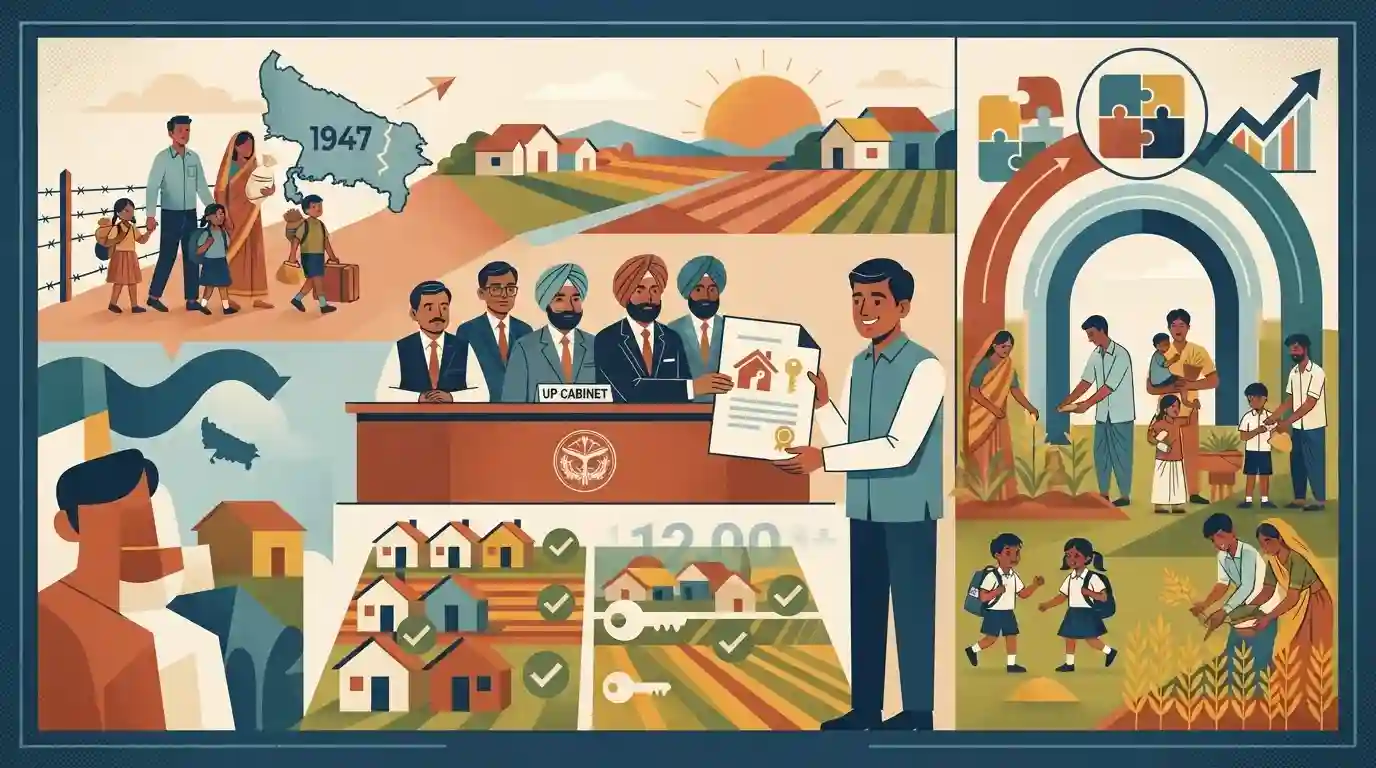
The Uttar Pradesh Cabinet has cleared land ownership rights for more than 12,000 families who were resettled in the state after the 1947 partition, providing them with long-awaited legal titles, tenure security, and socio-economic integration.
Key Points
- The Uttar Pradesh Cabinet approved land ownership rights for over 12,000 families who were resettled in the state following the partition of India in 1947.
- This decision resolves long-standing administrative and property ownership hurdles faced by partition-displaced families residing across various districts of Uttar Pradesh.
- The move ensures legal security of tenure, enabling beneficiaries to access government welfare schemes, bank loans, and inheritance rights associated with their lands.
Important Terms
Uttar Pradesh Cabinet

The apex executive decision-making body of the state government of Uttar Pradesh, headed by the Chief Minister, responsible for formulating state policies, administrative measures, and welfare schemes.
UPSC context
Important for UPPSC GS Papers (Polity and UP-Specific Administration), testing knowledge of executive governance, policy formulation, and state decision-making.
State Government of Uttar Pradesh
The principal provincial government exercising executive, legislative, and administrative authority within the state of Uttar Pradesh under the framework of the Indian Constitution.
UPSC context
Core concept for UPPSC syllabus regarding state administration, governance structures, welfare implementation, and regional socio-economic policies.
Uttar Pradesh Revenue Code, 2006
The principal legislation governing land tenure, revenue administration, ownership rights, and dispute resolution across rural and urban areas in the state of Uttar Pradesh.
UPSC context
Crucial for UPPSC GS Paper V/VI (Uttar Pradesh Special) and GS Paper II (Land Reforms and Governance).
Prelims Trap
The cabinet decision grants unconditional ownership rights over any land parcel currently occupied by partition-displaced families in Uttar Pradesh.
Aspirants might assume these ownership rights apply universally across all land sizes and public categories, whereas they are strictly capped at up to one acre and exclude public lands like ponds or grazing grounds.
Static Concepts Connected
What are the key features and structure of the Uttar Pradesh Revenue Code, 2006?
- Statutory Scope: Consolidation scope: It consolidates and amends laws relating to land tenure, land revenue, and land administration in Uttar Pradesh.
- Tenure Classes: Class of tenure holders: It defines classes of tenure holders such as Bhumidhar with transferable rights and Bhumidhar with non-transferable rights.
- Administrative Hierarchy: Revenue authorities: It establishes the hierarchy of revenue courts and officers including the Board of Revenue, Commissioner, Collector, and Tehsildar.
Cross-Topic Patterns
Partition rehabilitation meets modern land titling reforms
Partition rehabilitation policies intersect with modern land titling reforms, echoing national programs like SVAMITVA that prioritize property cards and rural legal empowerment.
Refugee rehabilitation as financial inclusion catalyst
Providing legal titles to partition families links refugee rehabilitation history with financial inclusion and welfare scheme saturation in rural UP.

UP Cabinet decisions amending revenue codes for partition-displaced families will feature in statement-based GS Paper V questions.
Linked PYQs · 2
Linked PYQs · 2
- 2023UPPSC_PRELIMSGS1
Which of the following scheme/s is/are related to Uttar Pradesh? (1) Anuthee Uphar Scheme (2) Matra Shakti Udyamita Scheme (3) Kaushalya Matritva Scheme (4) Stree Nidhi Scheme Select the 'correct' answer using the code given below -
- 2021UPPSC_PRELIMSGS1
The functions of the State Public Service Commission of Uttar Pradesh can be extended by
