Uttar Pradesh cabinet approves electric buses and semiconductor policy
Source:etgovernment ↗
Why It Matters
UPPSC GS Papers (especially Papers 5 and 6) frequently test state-specific developments, municipal plans, welfare schemes, and economic indicators such as the Minimum Support Price (MSP) set by the state. Accurate figures such as the maize MSP (₹2,400/quintal) and specific cities targeted for new town planning (Agra, Bareilly, Prayagraj) are high-yield areas for multiple-choice questions.
Summary
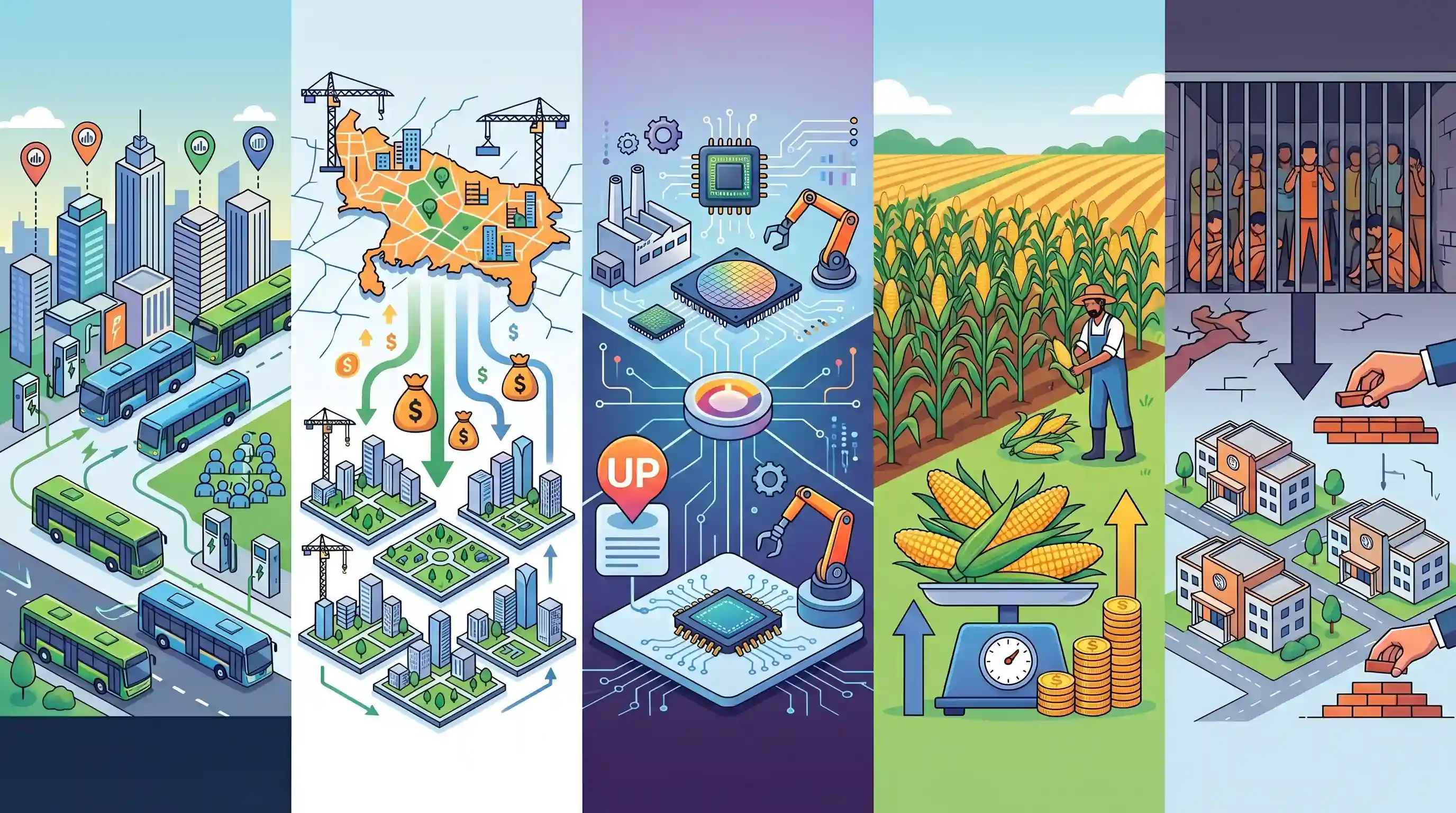
The Uttar Pradesh Cabinet, chaired by Chief Minister Yogi Adityanath, approved 24 diverse development proposals. Key decisions include the deployment of 1,725 air-conditioned electric buses under the Gross Cost Contract (GCC) model in 18 cities, releasing ₹225 crore for developing three new planned cities under the Mukhyamantri Shehri Vistarikaran scheme, amending the UP Semiconductor Policy 2024 to align with the central mission, setting the Kharif Maize procurement MSP at ₹2,400 per quintal, and constructing five new district jails to ease inmate overcrowding.
Key Points
- Urban Mobility: Approved deployment of 1,725 air-conditioned e-buses across 18 UP cities (including Lucknow, Kanpur, Agra, Varanasi, Prayagraj, Ghaziabad, and Noida) under the Gross Cost Contract (GCC) model for 12 years. Provides a subsidy of ₹40 lakh for each 12m bus and ₹35 lakh for each 9m bus. UP currently operates 743 e-buses.
- New Cities Development: Released first installment of ₹225 crore under the 'Mukhyamantri Shehri Vistarikaran/Naye Shehar Protsahan Yojana' for proposed new cities in Agra, Bareilly, and Prayagraj. The scheme funds up to 50% of land acquisition costs as seed capital for up to 20 years, with ₹3,500 crore earmarked for FY27.
- Semiconductor Policy 2024 Amendments: Aligned the state policy with the Centre's India Semiconductor Mission to make it investor-friendly. Under the amended guidelines, investors must sustain commercial production for at least 3 years post-commencement.
- Maize Procurement MSP: Approved the Kharif Maize Procurement Policy under the Price Support Scheme, fixing the Minimum Support Price (MSP) of Maize at ₹2,400 per quintal. A target of 25,000 metric tonnes has been set for procurement across 25 districts between June 15 and July 31.
- Prison Infrastructure & Reforms: Sanctioned more than ₹1,460 crore for constructing 5 new district jails in Moradabad (2,000 capacity), Kanpur Nagar (2,030), Auraiya (1,056), Lalitpur (552), and Bhadohi (574). Also formulated the 'UP Inmate Death and Compensation Policy' to speed up compensation for unnatural custodial deaths.
- Additional Decisions: Approved the transfer of state-run ESI Pandunagar Hospital to the Centre and centrally run ESI Jajmau Hospital to the UP State. Approved 5 acres of land in Jhansi for a cow shelter and animal service centre, and land transfer for a sub-registrar office in Mohanlalganj, Lucknow.
Important Terms
India Semiconductor Mission

A flagship initiative of MeitY to develop a sustainable semiconductor and display ecosystem in India, offering financial incentives for chip design, fabrication, and packaging projects.
UPSC context
GS Paper III (Science and Technology, Industrial Policy); tests knowledge of domestic chip manufacturing ecosystems and self-reliance strategies.
Uttar Pradesh Semiconductor Policy 2024
A state-level framework designed to attract electronics investments by providing interest, land, and capital subsidies, aligned with India’s national semiconductor objectives.
UPSC context
GS Paper III (Economic Development and Infrastructure); evaluates understanding of state policies driving electronics manufacturing and industrial growth.
Gross Cost Contract Model
A public-private partnership model where a private operator operates and maintains vehicles (like e-buses) for a fixed per-kilometer fee, while government authorities manage fare collections and revenue risks.
UPSC context
GS Paper III (Infrastructure and Public-Private Partnerships); tests understanding of risk-sharing mechanisms in urban public transport systems.
Mukhyamantri Shehri Vistarikaran/Naye Shehar Protsahan Yojana
A Uttar Pradesh government scheme aimed at funding urban expansion, land acquisition, and infrastructural planning to develop new planned townships and satellite cities.
UPSC context
GS Paper I (Urbanization, its problems, and remedies); tests strategies for managing urban sprawl and modern civic planning.
Prelims Trap
Under a Gross Cost Contract (GCC) model for public e-buses, the private operator bears the passenger demand and fare collection risk.
In a GCC model, the public transport authority retains the farebox (demand) risk and collects fares, paying the private operator a fixed rate per kilometer.
Static Concepts Connected
What is the difference between Gross Cost Contract (GCC) and Net Cost Contract (NCC) in PPPs?
- Farebox Risk: In a GCC, the public authority collects all fare revenues and bears the demand/farebox risk, whereas in an NCC, the private operator retains fares and bears the revenue risk.
- Operator Compensation: Under GCC, the private operator is compensated on a pre-determined metric (such as per-kilometer operated), which provides a stable, annuity-like income stream.
- Operational Focus: GCC allows the operator to focus on operational efficiency and schedule adherence without worrying about passenger volumes, making it ideal for transitioning to high-capital clean energy assets like e-buses.
What are the constitutional and judicial frameworks governing custodial deaths in India?
- NHRC Reporting: The NHRC mandates that all deaths occurring in police or judicial custody must be reported to the Commission within 24 hours of occurrence.
- Strict State Liability: In Nilabati Behera v. State of Orissa (1993), the Supreme Court held that the State has strict liability for custodial deaths and must pay compensation under public law.
- Judicial Inquiry: Section 176(1A) of the CrPC (now updated under BNSS) mandates a judicial magistrate inquiry (instead of an executive inquiry) in cases of death, disappearance, or rape in custody.
Cross-Topic Patterns
State subsidies & India Semiconductor Mission
UP aligning its semiconductor policy with ISM shows how state-level fiscal incentives act as critical downstream execution tools for central strategic technology mandates.
Urban transport & climate commitments
Scaling e-buses via Gross Cost Contracts bridges the gap between state-level municipal transport deficits and India's national Panchamrit net-zero commitments.

UPSC may contrast GCC and NCC infrastructure models or test judicial precedents on state liability for custodial deaths in GS-2/3.
Linked PYQs · 3
Linked PYQs · 3
- 2018UPPSC_PRELIMSGS1
From 4th July 2018 the Minimum Support Price (MSP) during 2018-19 for paddy per quintal is
- 2020UPPSC_PRELIMSGS1
Which of the following Indian States/Union Territories launched Electric Vehicle Policy on 7th August, 2020 ?
- 2020UPPSC_PRELIMSGS1
No. of cities in U.P. which are covered under the 'Smart City' Scheme
