UP Cabinet Approves Indian Knowledge Research Chairs
Source:the-statesman ↗
Why It Matters
UP-specific current affairs regarding the establishment of new academic institutions and research chairs are frequently asked in UPPSC Prelims. Furthermore, the state's active implementation of the National Education Policy (NEP) 2020 makes this an important topic under the governance and education sections.
Summary
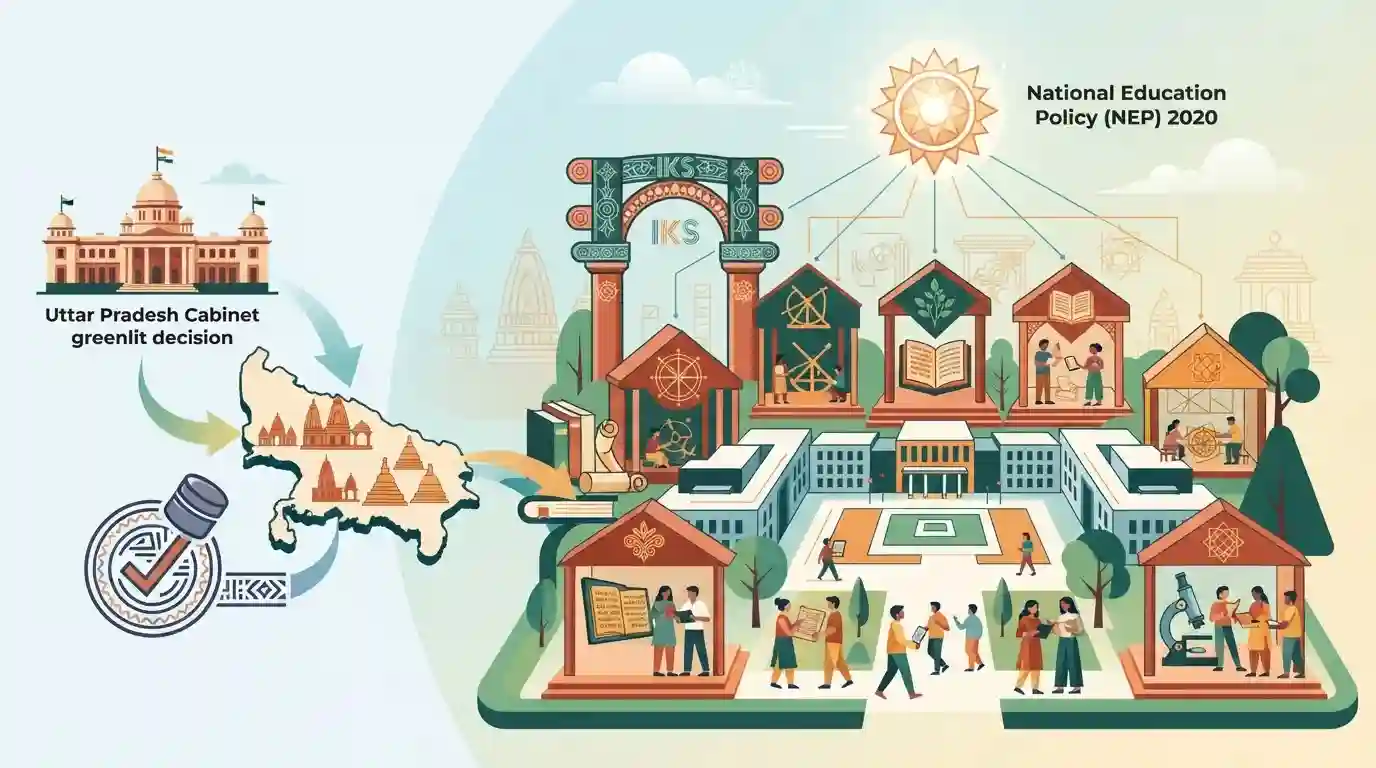
The Uttar Pradesh Cabinet has greenlit the setting up of 'Bharatiya Gyan Parampara Samvardhan Shodhpeeths' (Indian Knowledge Tradition Promotion Research Chairs) in state universities. This strategic move aims to foster research, learning, and integration of traditional Indian knowledge systems into modern higher education. The initiative is a direct implementation of the National Education Policy (NEP) 2020's emphasis on reviving and incorporating India's rich cultural and intellectual heritage, thereby strengthening the academic infrastructure for indigenous research in the state.
Key Points
- The Uttar Pradesh Cabinet has approved the establishment of 'Bharatiya Gyan Parampara Samvardhan Shodhpeeths' (Indian Knowledge Tradition Promotion Research Chairs) in universities across the state.
- The initiative aims to encourage advanced research, teaching, and documentation of Indian Knowledge Systems (IKS), including ancient sciences, philosophy, arts, and traditional practices.
- This step aligns with the vision of the National Education Policy (NEP) 2020, which strongly advocates the integration of India's traditional knowledge and heritage into the contemporary higher education framework.
- The Shodhpeeths will provide dedicated institutional backing and academic platforms for scholars to explore and revitalize Bharatiya Gyan Parampara.
Important Terms
Bharatiya Gyan Parampara Samvardhan Shodhpeeths

Research chairs established by the UP government in state universities to promote the study, research, and dissemination of traditional Indian knowledge systems, philosophy, and science, integrating heritage with modern education.
UPSC context
Relevant for GS Paper 2 (Education) and GS 1 (Culture). Illustrates state-level execution of NEP 2020's indigenous research vision.
National Education Policy (NEP) 2020
India's 21st-century education framework aimed at transforming learning into a flexible, multidisciplinary, and holistic system. It emphasizes foundational skills, critical thinking, and rooting education in the Indian ethos.
UPSC context
Crucial for GS Paper 2 (Education). Tests understanding of structural reforms, learning outcomes, and culturally integrated educational strategies.
Indian Knowledge Systems (IKS)
The vast body of traditional wisdom from the Indian subcontinent, spanning mathematics, astronomy, medicine, philosophy, and arts. It is being actively preserved and integrated into modern academic curricula.
UPSC context
Important for GS Paper 1 (Culture) and GS 2 (Education). Tests awareness of ancient heritage and its contemporary academic applications.
Prelims Trap
The Indian Knowledge Systems division operates under the Ministry of Culture, and IKS courses are strictly non-credit extracurricular activities.
IKS is under the Ministry of Education (housed at AICTE). Furthermore, UGC mandates that higher education students earn at least 5% of their degree credits from IKS courses, making it credit-bearing.
Static Concepts Connected
How does NEP 2020 integrate the Indian Knowledge System (IKS) into formal education?
- Credit requirements: UGC mandates that undergraduate and postgraduate students earn at least 5% of their total required degree credits from IKS-based courses.
- NCrF integration: Through the National Credit Framework (NCrF), students earn academic credits for proficiency in 18 traditional theoretical disciplines (Vidyas) and 64 practical crafts (Kalas).
- Institutional backing: The policy promotes setting up specialized research centers and bilingual/multilingual teaching to revitalize ancient sciences, arts, and philosophy.
What is the National Credit Framework (NCrF)?
- Unified mechanism: A meta-framework under NEP 2020 integrating school, higher, and vocational education to allow seamless credit accumulation and transfer.
- Multiple entry-exit: Enables students to drop out and re-enter the education system, storing academic credits in the digital Academic Bank of Credits (ABC).
- Holistic equivalence: Removes hard separations by granting formal academic credits for extracurriculars, vocational training, and specialized traditional knowledge.
Cross-Topic Patterns
NEP 2020 + Intangible Cultural Heritage
The formal credit system for 64 'Kalas' under NCrF synergizes with UNESCO Intangible Cultural Heritage goals by institutionalizing the transmission of traditional Indian crafts and arts to the next generation.
Indian Knowledge Systems + IP Rights (TKDL)
Academic documentation of ancient sciences via state Shodhpeeths can feed into India's Traditional Knowledge Digital Library (TKDL), preventing bio-piracy and unethical patenting of indigenous medicine and environmental practices.

Expect a multi-statement Prelims question linking NEP 2020's National Credit Framework (NCrF) with the mandatory 5% IKS credit rule.
Linked PYQs · 2
Linked PYQs · 2
- 2020UPPSC_PRELIMSGS1
The Uttar Pradesh Cabinet has approved on 29th July, 2020 to establish a National Law University at which of the following cities ?
- 2020UPPSC_PRELIMSGS1
Consider the following statements about New National Education Policy approved by Union Cabinet of India on 29th July, 2020 : 1. It was drafted by a Committee headed by Dr. K Kasturirangan. 2. It will replace the previous Education Policy which has been followed since last 38 years. Select the correct statement(s) from the codes given below.
