UP Cabinet approves Jewar Link Expressway and other proposals
Source:magicbricks ↗
Why It Matters
These projects underscore the Uttar Pradesh government's emphasis on world-class transport connectivity, technological modernization, and agricultural safety nets. They serve as prime examples of state-led infrastructure scaling, directly relevant for questions on regional development, connectivity initiatives (like expressways), and policy measures in UPPSC Mains and Prelims.
Summary
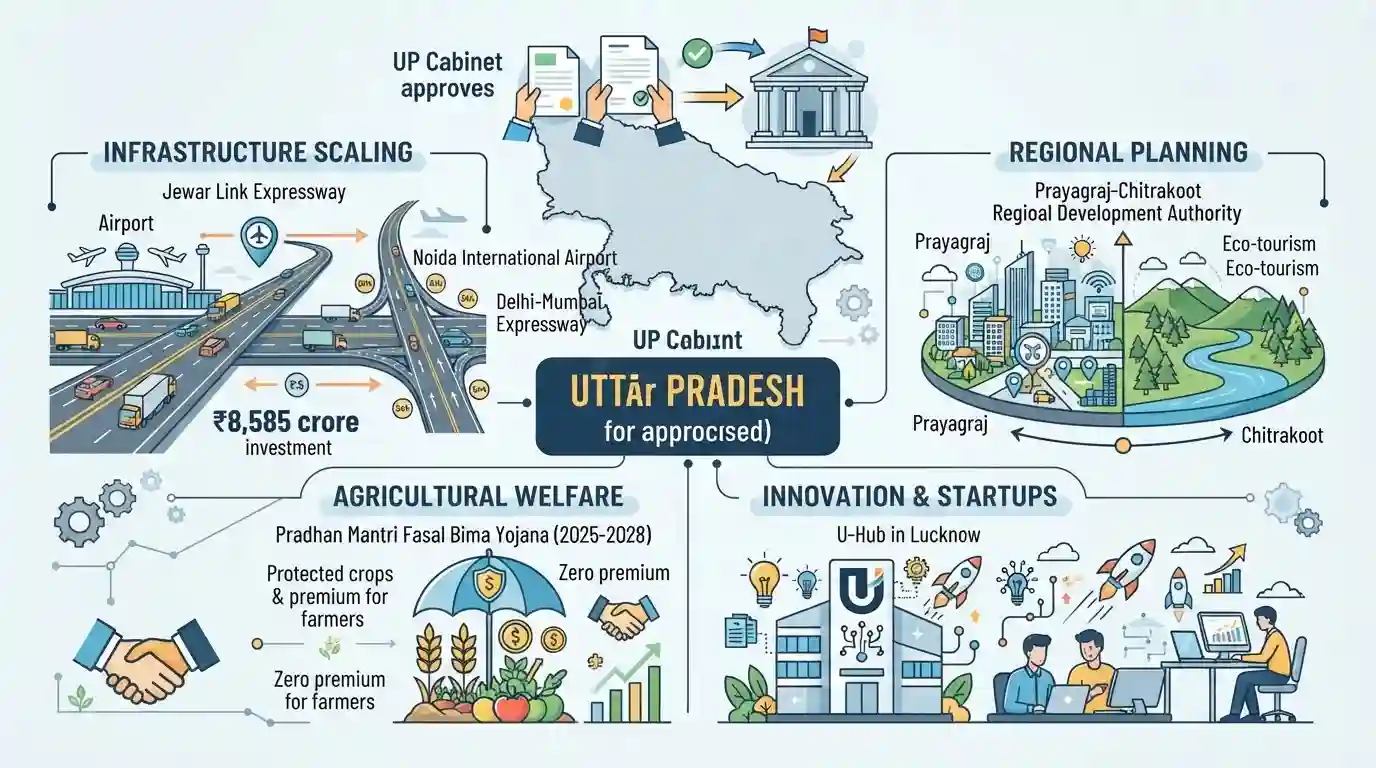
The Uttar Pradesh Cabinet has approved over 20 major proposals, predominantly focusing on infrastructure scaling, innovation, and agricultural welfare. Highlighting state development, it sanctioned a ₹8,585 crore Jewar Link Expressway to connect the Noida International Airport with the Delhi-Mumbai Expressway. The government extended the Pradhan Mantri Fasal Bima Yojana (2025-2028) at zero premium to benefit state farmers. Additionally, the establishment of the U-Hub in Lucknow for deep-tech startups and the Prayagraj-Chitrakoot Regional Development Authority reflect a multi-pronged approach toward regional planning, eco-tourism, and technological innovation.
Key Points
- The Uttar Pradesh Cabinet approved a 31.4 km Jewar Link Expressway project to connect the upcoming Noida International Airport with the Delhi-Mumbai Expressway.
- The government sanctioned the creation of U-Hub in Lucknow to stimulate deep-tech innovations and provide startup incubation.
- The Prayagraj-Chitrakoot Regional Development Authority was formed to facilitate planned eco-tourism, regional development, and infrastructure scaling.
- The UP Cabinet extended the implementation of the Pradhan Mantri Fasal Bima Yojana for the years 2025-2028, offering crop insurance at zero premium to farmers.
- Approvals were granted for setting up multipurpose logistics hubs to attract investment and foster employment generation across the state.
Important Terms
Jewar Link Expressway

A ₹8,585 crore, 74.5-km six-lane greenfield expressway connecting the Noida International Airport (Jewar) to the Delhi-Mumbai and Ganga Expressways. It is being developed under the EPC model to boost regional logistics.
UPSC context
GS Paper 3 (Infrastructure). Highlights state-led transport connectivity, logistics corridors, and infrastructure-driven regional economic growth.
Pradhan Mantri Fasal Bima Yojana (PMFBY)
A central crop insurance scheme mitigating agricultural risks. The Uttar Pradesh government extended it for 2025–2028, offering it at zero premium to state farmers to shield them from natural calamities and stabilize incomes.
UPSC context
GS Paper 2 & 3 (Government Policies, Agriculture). Demonstrates state-level welfare adaptations for agricultural risk management.
U-Hub (Uttar Pradesh Innovation Hub)
An independent deep-tech platform established in Lucknow and Noida to foster startups in AI, quantum computing, robotics, and advanced biotechnology. Supported by an initial ₹100 crore budget, it provides infrastructure and commercialisation support.
UPSC context
GS Paper 3 (Science & Technology). Illustrates state initiatives to promote emerging technologies, startups, and R&D commercialization.
Prayagraj-Chitrakoot Regional Development Authority
A newly formed administrative body covering six districts, including Prayagraj and Chitrakoot. It aims to drive planned urbanisation, balanced regional development, and tourism infrastructure across the spiritual circuit without burdening the state exchequer.
UPSC context
GS Paper 1 & 3 (Urbanization, Regional Planning). Tests decentralized administrative frameworks, heritage tourism, and infrastructure planning.
Prelims Trap
PMFBY provides comprehensive crop insurance at zero premium to all farmers across India.
Standard PMFBY requires farmers to pay 1.5% to 5% premium. The "zero premium" model is uniquely funded by the UP state government, not a central scheme mandate.
Static Concepts Connected
What is the farmer premium structure under the standard Pradhan Mantri Fasal Bima Yojana (PMFBY)?
- Kharif Crops: Farmers pay a maximum premium of 2% of the sum insured for all Kharif crops.
- Rabi Crops: Farmers pay a maximum premium of 1.5% of the sum insured for all Rabi crops.
- Commercial Crops: Farmers pay a maximum premium of 5% for annual commercial and horticulture crops.
- Premium Subsidy: The balance premium is subsidized by the Centre and States (usually 50:50, but 90:10 for North Eastern and Himalayan states).
What differentiates a Greenfield infrastructure project from a Brownfield one?
- Greenfield Projects: Built from scratch on unused land without existing structural constraints. The Delhi-Mumbai Expressway and Noida International Airport are prime examples.
- Brownfield Projects: Involves modifying, upgrading, or expanding existing infrastructure, which often comes with complex land acquisition, demolition, and legacy constraints.
Cross-Topic Patterns
State customizations of Central Schemes
UP's zero-premium PMFBY mirrors states providing extra top-ups to PM-KISAN. UPSC frequently tests the boundary between standard central mandates and state-funded customizations in Centrally Sponsored Schemes.
Multimodal connectivity & PM Gati Shakti
Integrating the Jewar Expressway with the Delhi-Mumbai route highlights the PM Gati Shakti master plan's focus on multimodal connectivity, linking greenfield airports directly to arterial freight corridors.

Expect a 2026 prelims statement trapping aspirants by confusing PMFBY's standard 1.5-5% farmer premium with state-level zero-premium waivers.
Linked PYQs · 3
Linked PYQs · 3
- 2023UPPSC_PRELIMSGS1
Which of the following Scheme/Programme is not the Central Government Programme and it is Uttar Pradesh Government's Programme?
- 2020UPPSC_PRELIMSGS1
Which of the following Airports in Uttar Pradesh has been granted International Status on 24th June, 2020 by Union Cabinet of India ?
- 2020UPPSC_PRELIMSGS1
In which of the following places the Bio-technology Park is located in Uttar Pradesh ?
