Uttar Pradesh Electric Bus Procurement and Women Travel
Source:theprint ↗
Why It Matters
This development is highly relevant for the UPPSC PCS Prelims as it covers direct state government initiatives (Sashakt Nari under Lok Kalyan Sankalp) for vulnerable sections (elderly women). Furthermore, the integration of public transport modernization with regional environmental directives (CAQM norms for NCR) reflects current governance priorities regarding sustainability and pollution control.
Summary
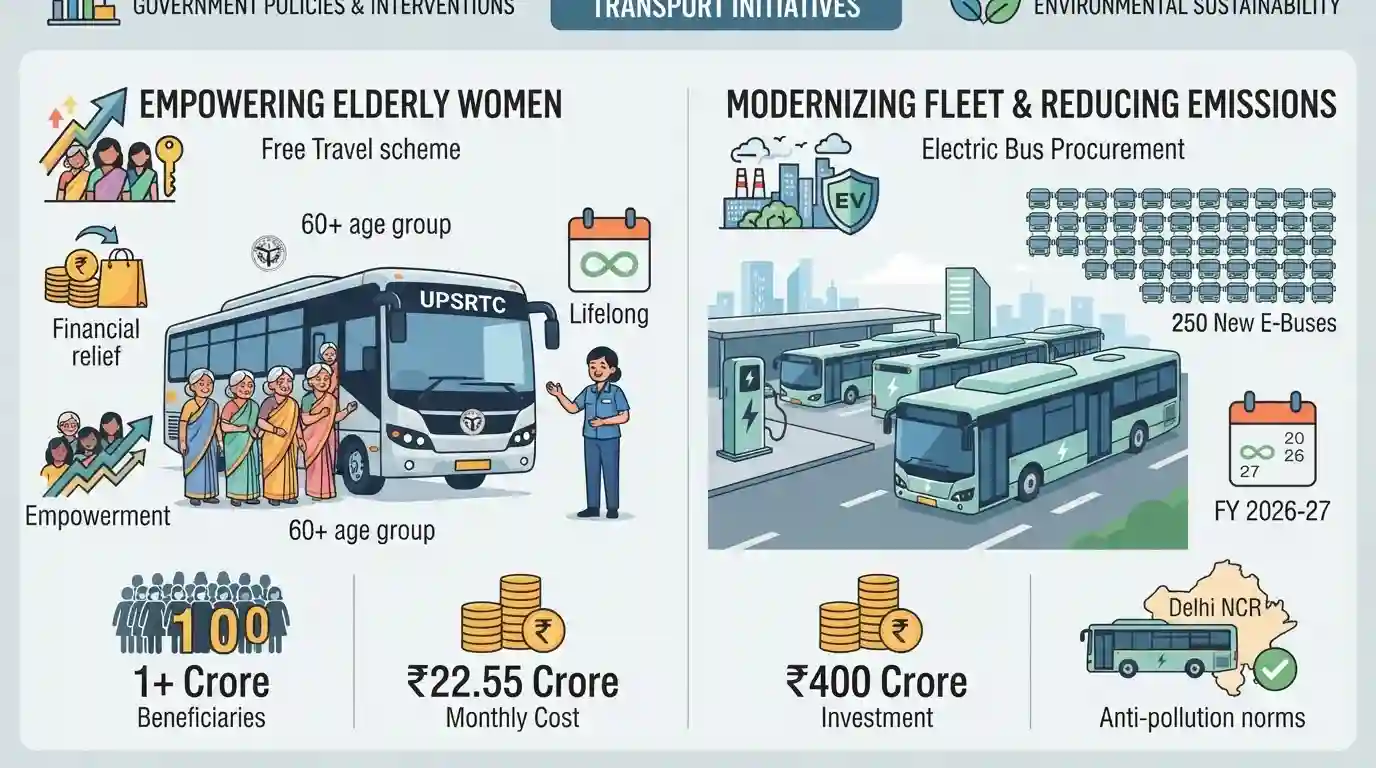
The Uttar Pradesh Cabinet has approved a scheme under the 'Sashakt Nari' initiative to provide lifelong free travel for women aged 60 and above on all UPSRTC general buses. The move is expected to benefit over one crore elderly women, requiring an additional monthly expenditure of Rs 22.55 crore. Additionally, to strengthen public transport and adhere to anti-pollution norms in the NCR, the Cabinet sanctioned Rs 400 crore for the procurement of 250 new air-conditioned electric buses for the 2026-27 financial year, complying with recent CAQM guidelines restricting non-clean fuel buses from entering Delhi.
Key Points
- The UP Cabinet has approved lifelong free bus travel for women aged 60 and above on all UPSRTC buses under the 'Sashakt Nari' pledge.
- The initiative will benefit over one crore elderly women and will cost the state exchequer approximately Rs 22.55 crore per month.
- Women can use a valid identity card such as Aadhaar, voter ID, or passport to avail of this benefit.
- The Cabinet also approved a Rs 400-crore proposal to procure 250 new air-conditioned electric buses for the UPSRTC fleet during 2026-27.
- The EV procurement aligns with CAQM guidelines, which mandate that only CNG, electric, and BS-6 compliant diesel buses will be allowed to enter Delhi from November 1, 2026.
Important Terms
Sashakt Nari

A UP government initiative focused on women's empowerment. It includes the recently approved pledge to provide free, lifelong travel on state buses for women aged 60 and above under the Lokmata Ahilyabai Matrushakti Yojana.
UPSC context
Highly relevant for UPPSC GS Paper 5 (UP State Policies) and Social Justice/Women Empowerment topics.
Commission for Air Quality Management (CAQM)
A statutory body established to monitor and improve air quality in the National Capital Region and adjoining areas, coordinating anti-pollution efforts and mandating clean-energy transitions for regional public transport.
UPSC context
Crucial for GS Paper 3 (Environment & Pollution Control) and questions regarding UP's NCR districts.
CAQM guidelines
Specific environmental directives issued by the CAQM. Recent guidelines restrict non-clean fuel buses from entering Delhi post-November 2026, prompting UP to procure electric buses for its NCR routes.
UPSC context
Important for GS Paper 3 (Environmental Degradation) highlighting state policy responses to federal pollution mandates.
Uttar Pradesh State Road Transport Corporation (UPSRTC)
Uttar Pradesh's state-owned road transport operator. It provides extensive intra-state and inter-state bus services and is currently modernizing its fleet with electric buses to meet environmental standards in the NCR.
UPSC context
Relevant for UPPSC GS Paper 5 (UP Infrastructure and Transport). Tests knowledge of state assets.
Lok Kalyan Sankalp-2022
The ruling party's 2022 Uttar Pradesh election manifesto. It serves as a foundational policy roadmap for the state government, containing key administrative pledges like the "Sashakt Nari" free bus travel initiative.
UPSC context
Useful for GS Paper 2 and 5 (State Governance & Welfare Schemes), tracing the origin of state policies.
Prelims Trap
Lifelong free travel is provided for all women across all UPSRTC bus categories.
The scheme strictly applies only to women aged 60 and above (elderly), and is limited to UPSRTC 'general' buses, excluding premium or AC fleets.
Static Concepts Connected
What is the statutory status and mandate of CAQM?
- Statutory Body: Established under the Commission for Air Quality Management in NCR and Adjoining Areas Act, 2021.
- Jurisdiction: Covers the National Capital Region and adjoining districts in Uttar Pradesh, Haryana, Rajasthan, and Punjab.
- Overriding Powers: Its orders and directions supersede those of the CPCB and respective State Pollution Control Boards.
How does UP integrate EVs into its public transit framework?
- UP EV Policy: The Uttar Pradesh Electric Vehicle Manufacturing and Mobility Policy 2022 aims for a 100% transition of public transport fleets to EVs by 2030.
- Fleet Modernization: The state provides significant capital subsidies for EV procurement and mandates green routes in major urban nodes, directly aligning with NCR anti-pollution directives.
Cross-Topic Patterns
Elderly Mobility & Geriatric Welfare
Unlike broad free-transit schemes targeting female labor force participation, the 60+ age limit specifically addresses senior citizen social security, improving access to healthcare and independent mobility for elderly women.
CAQM Mandates & Interstate Fiscal Stress
Centralized air quality regulations for the NCR force neighboring states to abruptly scale up capital expenditure, demonstrating the financial spillover of cross-border environmental governance.

Sashakt Nari's 60+ age limit and 'general bus' caveat are highly likely to be tested as trick statements in a UP-specific welfare question.
Linked PYQs · 3
Linked PYQs · 3
- 2023UPPSC_PRELIMSGS1
Which of the following scheme/s is/are related to Uttar Pradesh? (1) Anuthee Uphar Scheme (2) Matra Shakti Udyamita Scheme (3) Kaushalya Matritva Scheme (4) Stree Nidhi Scheme Select the 'correct' answer using the code given below -
- 2025UPPSC_PRELIMSGS1
Consider the following and arrange them in correct chronological order. 1. Jawahar Rojgar Yojana 2. Development of women and children in Rural Areas 3. Integrated Rural Development Programme 4. National Rural Employment Programme Select the correct answer from the code given below :
- 2020UPPSC_PRELIMSGS1
Which of the following Indian States/Union Territories launched Electric Vehicle Policy on 7th August, 2020 ?
