UP cabinet approves amendment to Madarsa Education Act
Source:newsbharati ↗
Why It Matters
This amendment reflects significant judicial and legislative recalibration regarding the administration of minority educational institutions, balancing the preservation of traditional education with the standardization of state higher education frameworks.
Summary
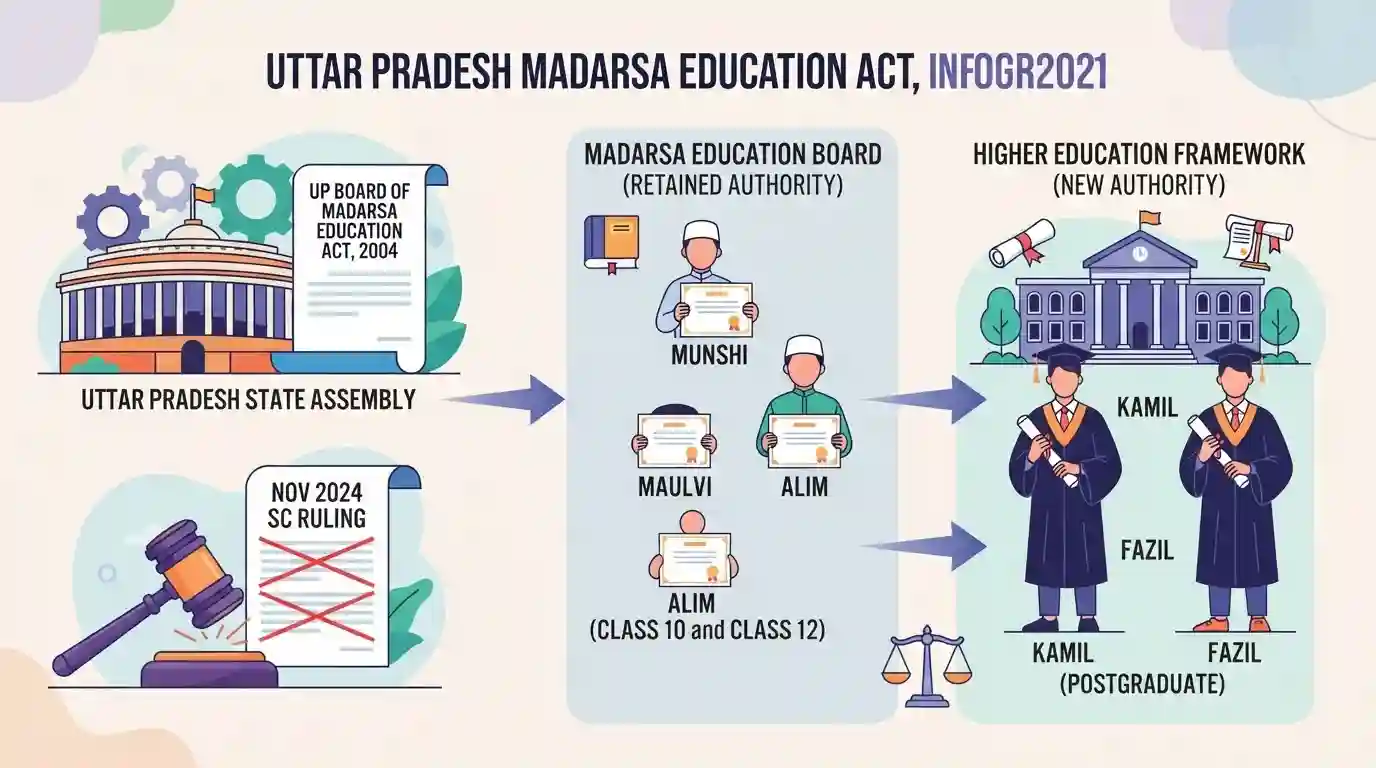
The Uttar Pradesh Cabinet has approved amendments to the UP Board of Madarsa Education Act, 2004, removing the Madarsa Education Board's authority to regulate and award higher education degrees such as Kamil (undergraduate) and Fazil (postgraduate). This decision aligns with a November 2024 Supreme Court ruling that upheld the Act but struck down its higher education provisions. Consequently, Kamil and Fazil courses will now be integrated into the state's standard higher education framework, potentially under the Khwaja Moinuddin Chishti Language University. The Madarsa Board will retain regulatory control over education up to the Class 12 equivalent, encompassing Munshi, Maulvi, and Alim degrees.
Key Points
- The UP Cabinet approved an amendment to the UP Board of Madarsa Education Act, 2004, stripping the board of its authority to award higher education qualifications.
- The board can no longer regulate or grant undergraduate (Kamil) and postgraduate (Fazil) degrees.
- Higher education courses from madarsas will now integrate into the state's higher education system, likely under Khwaja Moinuddin Chishti Language University.
- The Madarsa Board will continue to oversee school-level education up to the Class 12 equivalent (Munshi, Maulvi, and Alim).
- This amendment aligns with a November 2024 Supreme Court verdict that upheld the Act's constitutional validity but restricted its regulatory powers over higher education.
Important Terms
UP Board of Madarsa Education Act, 2004

A state legislation regulating the establishment, curriculum, and administration of madarsas in Uttar Pradesh to standardise education. The Supreme Court recently upheld its constitutionality but struck down provisions allowing it to regulate higher education degrees.
UPSC context
GS Paper 2 (Polity/Education). Tests knowledge of minority educational rights (Article 30), secularism, and state regulatory powers.
Supreme Court November 2024 Judgment
A landmark apex court verdict upholding the UP Madarsa Act, 2004, ruling it did not violate secularism. However, it declared provisions granting higher degrees (Kamil and Fazil) unconstitutional for conflicting with the UGC Act.
UPSC context
GS Paper 2 (Judgments/Constitution). Highly relevant for questions on basic structure, secularism, and minority rights vs. regulatory laws.
UP Board of Madarsa Education
A statutory body established by the UP Madarsa Act, 2004, responsible for prescribing curricula and regulating state-recognised madarsas. Post-SC ruling, its authority is strictly limited to education up to the Class 12 equivalent.
UPSC context
GS Paper 2 (Governance/Statutory Bodies). Highlights the role of state bodies in integrating minority education into mainstream standards.
Allahabad High Court
The state high court that, in March 2024, struck down the UP Madarsa Act in its entirety as unconstitutional and violative of secularism—a decision subsequently overturned by the Supreme Court in November 2024.
UPSC context
GS Paper 2 (Polity/Judiciary). Important for understanding judicial review, basic structure doctrine, and the appellate hierarchy of Indian courts.
Khwaja Moinuddin Chishti Language University
A state language university in Uttar Pradesh. Madarsa students pursuing undergraduate (Kamil) and postgraduate (Fazil) courses will potentially be integrated into its framework to comply with UGC regulations following the SC judgment.
UPSC context
GS Paper 2 (Education Policy). Pertinent as a case study for integrating minority-run higher education into mainstream university systems.
Prelims Trap
Article 30 guarantees minority educational institutions absolute autonomy, exempting them from state regulations and central higher education standards.
Article 30 is not absolute. The State can impose reasonable regulations for academic excellence, and higher education standards (Entry 66, Union List) override State-level minority boards.
Static Concepts Connected
What are the limits on minority educational institution autonomy under Article 30?
- Not Absolute: Article 30 rights are not absolute; the State can enforce reasonable regulatory measures to maintain educational standards, sanitation, and academic excellence.
- RTE Harmony: Minority rights must be harmoniously interpreted with Article 21A, allowing the State to mandate essential secular competencies alongside religious instruction.
How is legislative power over education divided in the Seventh Schedule?
- Concurrent List (Entry 25): Entry 25 covers general education, universities, and medical/technical education, granting both Parliament and State legislatures the power to make laws.
- Union List (Entry 66): Entry 66 specifically covers the coordination and determination of standards in higher education or research institutions.
- Federal Supremacy: Union laws (like the UGC Act) enacted under Entry 66 strictly override State legislation enacted under Entry 25 in cases of conflict.
Cross-Topic Patterns
Harmonizing Article 30 and Article 21A
The Supreme Court consistently balances the right to administer minority institutions with the State's mandate to ensure basic secular competencies under the Right to Education Act (Article 21A).
Federal Supremacy in Higher Education
This case exemplifies the tension between Concurrent List Entry 25 and Union List Entry 66, reiterating that Central standard-setting agencies (like UGC) override State boards.

Expect a 2026 multi-statement question testing Article 30 autonomy limits and the overriding power of Entry 66 (UGC) over State boards.
Linked PYQs · 2
Linked PYQs · 2
- 2021UPPSC_PRELIMSGS1
The functions of the State Public Service Commission of Uttar Pradesh can be extended by
- 2022UPPSC_PRELIMSGS1
Right to Education has been included into the Fundamental Rights by the
