Buddhist tourism infrastructure expansion in Uttar Pradesh
Source:uniindia ↗
Why It Matters
UPPSC frequently tests candidates on ancient historical geography, specifically Buddhist and Jain pilgrimage sites located within Uttar Pradesh (like Kaushambi, Shravasti, and Sarnath). This news provides valuable current statistical data regarding pilgrim influx (surpassing 81 lakh in 2025) and ongoing state tourism infrastructure programs designed to integrate new transport and lodging hubs like Lucknow into the thematic Buddhist Circuit.
Summary
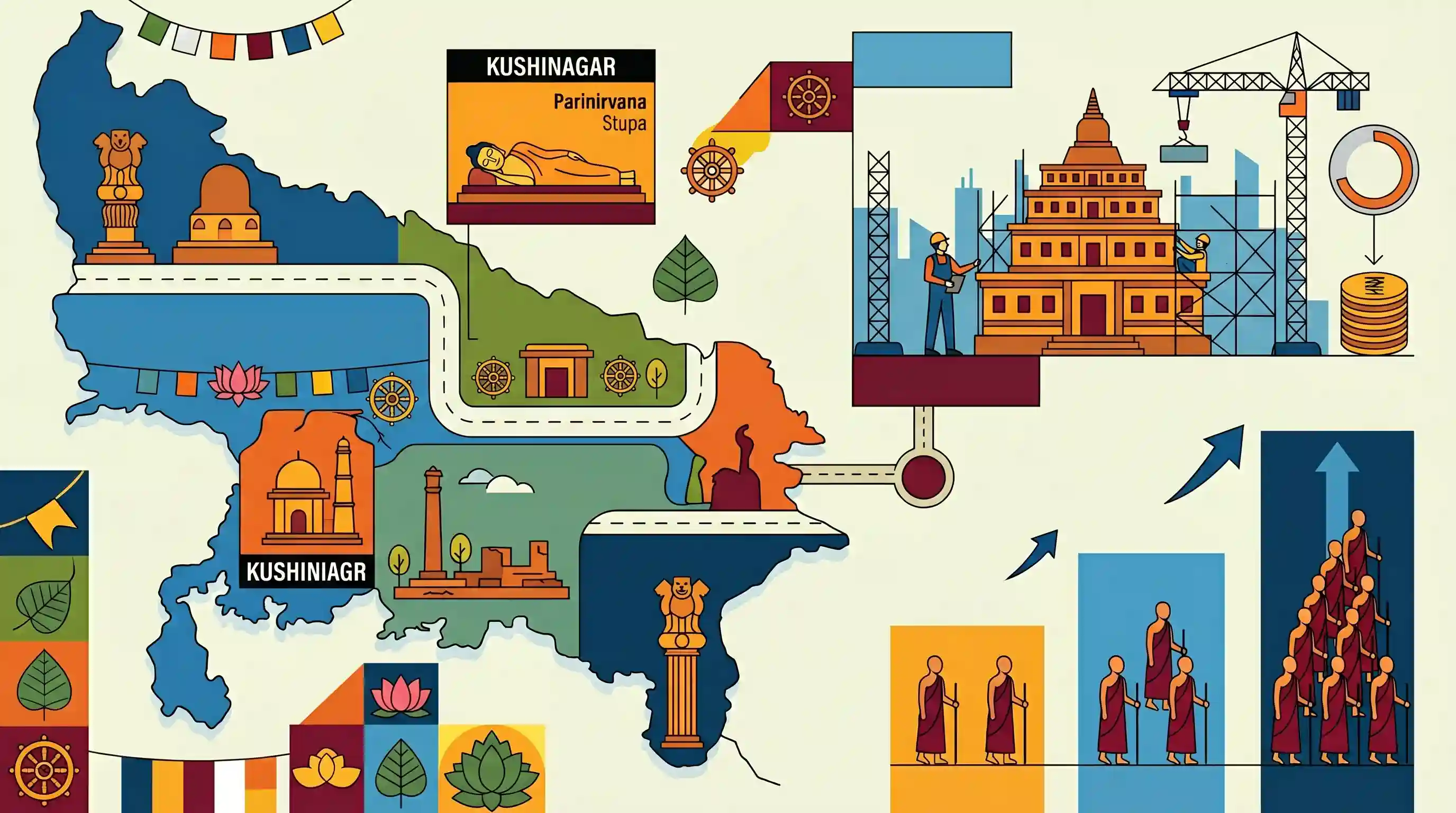
Uttar Pradesh is bolstering its Buddhist tourism infrastructure with the development of the Tathagata Buddha Vihar at Sarojini Nagar in Lucknow, a Rs 75-lakh project that is 70% complete. This initiative aims to establish Lucknow as a major stop on the state's Buddhist Circuit, complementing historic sites like Sarnath, Kushinagar, Shravasti, Kaushambi, and Sankisa. The project comes in response to an exponential growth in Buddhist pilgrim arrivals in the state, which rose from over 47 lakh in 2023 to 61 lakh in 2024, and surpassed 81 lakh in 2025.
Key Points
- Uttar Pradesh is expanding its Buddhist tourism infrastructure by developing the Tathagata Buddha Vihar at Sarojini Nagar in Lucknow.
- The Rs 75-lakh development project is around 70% complete and will feature a modern prayer and community hall, a pilgrim dormitory, sanitation facilities, an approach road, and a grand entrance gateway.
- The state has seen a massive surge in Buddhist pilgrim arrivals, rising from over 47 lakh in 2023 to 61 lakh in 2024, and crossing 81 lakh in 2025.
- The new facility in Lucknow is designed to complement existing infrastructure along UP's major Buddhist Circuit, which includes Sarnath, Kushinagar, Shravasti, Kaushambi, and Sankisa.
- UP Tourism and Culture Minister Jaiveer Singh and Additional Chief Secretary (Tourism, Culture, and Religious Affairs) Amrit Abhijat stated that this will boost tourism-driven economic opportunities around Lucknow.
Important Terms
Buddhist Circuit

A tourist route connecting primary sites associated with the life and teachings of Gautam Buddha across India and Nepal, aimed at boosting spiritual tourism.
UPSC context
GS Paper I (Culture) & GS Paper III (Tourism); tests major cultural tourism initiatives and heritage corridors.
Swadesh Darshan Scheme
A central sector scheme launched by India's Ministry of Tourism in 2014-15 for the integrated development of theme-based tourist circuits across the country.
UPSC context
GS Paper II (Government Policies); tests central welfare and development initiatives in the tourism and infrastructure sector.
Uttar Pradesh Tourism and Culture Department
The state government agency in Uttar Pradesh responsible for the development of tourism infrastructure, cultural heritage conservation, and promoting pilgrimage sites.
UPSC context
GS Paper II (Governance) & GS Paper III (Economy); tests the state-level execution of infrastructure projects.
Sarnath
A highly revered Buddhist site near Varanasi, Uttar Pradesh, where Siddhartha Gautama delivered his first sermon after attaining enlightenment.
UPSC context
GS Paper I (Art & Culture/Ancient History); tests key locations, architecture, and historical events of Buddhism.
Kushinagar
A major Buddhist pilgrimage site in Uttar Pradesh, recognized as the place where Gautama Buddha attained Mahaparinirvana under a Sal tree.
UPSC context
GS Paper I (Art & Culture/Ancient History); tests geographical locations and religious significance in ancient Indian history.
Prelims Trap
Kaushambi, Shravasti, and Sankisa are exclusively Buddhist monuments with no historical significance for the Jain religious tradition.
Kaushambi and Shravasti are vital dual-heritage sites, serving as birthplaces for the 6th and 3rd Jain Tirthankaras respectively.
Static Concepts Connected
Which ancient Mahajanapadas correspond to the major Buddhist circuit sites in UP?
- Vatsa (Kaushambi): Capital of Vatsa; hosted Buddha at Ghositarama monastery; dual-heritage site as the birthplace of Jain Tirthankara Padmaprabha.
- Kosala (Shravasti): Capital of Kosala; hosted Buddha's maximum rainy retreats (Jetavana); dual-heritage site as the birthplace of Jain Tirthankara Sambhavanatha.
- Malla (Kushinagar): Capital of Mallas; site of Buddha's Mahaparinirvana; features the Ramabhar Stupa and ancient Mahaparinirvana temple.
What are the key zoomorphic Ashokan capitals found along these ancient sites?
- Sankisa Elephant: Features a single, damaged Elephant capital atop an abacus adorned with honeysuckle floral motifs.
- Sarnath Lions: Features the iconic four addorsed lions sitting on an abacus with relief carvings of four animals.
Cross-Topic Patterns
Buddhist diplomacy and Act East
Leveraging domestic Buddhist infrastructure to consolidate cultural ties, counter Chinese footprint, and boost tourism receipts from Southeast Asian nations.
Tourism-led regional economic development
Integrating circuit tourism under central schemes to generate local employment and revitalize ancient towns through modern transit infrastructure.

UPSC may test the dual Buddhist-Jain heritage of sites like Kaushambi and Shravasti alongside their Mahajanapada identities in 2026.
Linked PYQs · 3
Linked PYQs · 3
- 2008UPPSC_PRELIMSGS1
The place in Uttar Pradesh which is famous pilgrim centre for both Buddhist and Jainism is
- 2009UPPSC_PRELIMSGS1
In U.P., the famous pilgrim centre of both Jain and Bauddha Dharma is
- 2017UPPSC_PRELIMSGS1
Swadesh Darshan Scheme launched by Government of India does not include development of which of the following tourist circuits?
