World Bank Funded UP AGREES Project for Agriculture
Source:rediff ↗
Why It Matters
The UP-AGREES project is a massive UP-specific initiative combining foreign institutional funding (World Bank) and corporate technological partnerships (Google, ITC) to revolutionize state agriculture. It is highly relevant for UPPSC Prelims and Mains given its focus on climate resilience, UP rural economy, agricultural tech (AI, DSR), and regional development in Bundelkhand and Eastern UP.
Summary
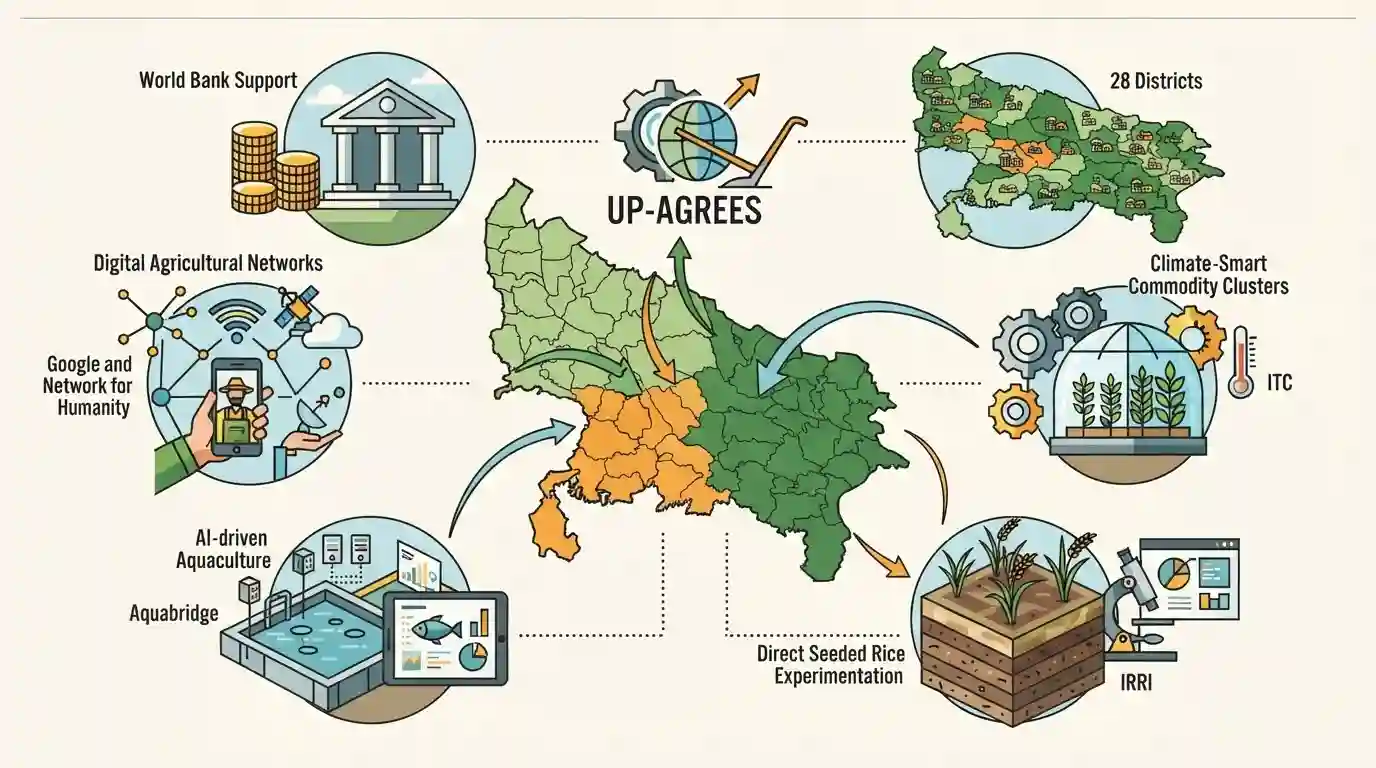
The Uttar Pradesh government has launched the UP-AGREES project to modernize agriculture, boost farmers' incomes, and enhance climate resilience. Backed by the World Bank, the Rs 4,000-crore initiative covers 28 districts in eastern UP and Bundelkhand. Under this project, MoUs were signed with Google and Network for Humanity for digital agricultural networks, ITC for climate-smart commodity clusters, Aquabridge for AI-driven aquaculture, and IRRI for Direct Seeded Rice (DSR) experimentation.
Key Points
- The World Bank-supported UP-AGREES project, worth approximately Rs 4,000 crore, targets agricultural modernization in 28 districts (21 in eastern UP and 7 in Bundelkhand).
- The initiative aims to benefit 10 lakh farmers and 35,000 fish farmers by boosting productivity, income, and climate resilience.
- Google and Network for Humanity will collaborate to develop an 'Open Network for Agriculture', providing farmers with a unified interface for weather, market, and soil data.
- ITC will establish climate-resilient commodity clusters for paddy and wheat, with a goal to reduce urea usage by 25% and save labor and irrigation resources.
- Aquabridge will introduce technology-driven, AI-based aquaculture, including an integrated 60-acre project in Unnao.
- Direct Seeded Rice (DSR) is being piloted in partnership with the International Rice Research Institute (IRRI) across 3,000 hectares.
Important Terms
UP-AGREES Project

The UP Agriculture Growth and Rural Enterprise Ecosystem Strengthening (UP-AGREES) project is a ₹4,000-crore, World Bank-backed initiative to boost farm productivity, climate resilience, and incomes across 28 districts in Eastern UP and Bundelkhand.
UPSC context
Crucial for UPPSC GS Paper 5 (UP Economy) and GS Paper 3 (Agriculture) regarding state-specific schemes for rural development.
Uttar Pradesh Diversified Agriculture Support Project (UPDASP)
The state-level nodal implementing agency executing the UP-AGREES initiative. It is responsible for driving agricultural diversification, introducing modern farming technologies, and strengthening agricultural value chains across Uttar Pradesh.
UPSC context
Important for UPPSC GS Paper 5 to understand the institutional framework driving UP\'s agricultural policy and rural enterprise development.
International Rice Research Institute (IRRI)
A global agricultural research organization serving as the knowledge partner for UP-AGREES. It provides technical expertise to scale sustainable, climate-resilient rice systems, including Direct Seeded Rice (DSR) experimentation in Eastern UP.
UPSC context
Relevant for UPPSC GS Paper 3 (Agriculture) and Paper 5 as an example of global institutional partnerships modernizing regional farming.
Aquabridge
A technical partner in the UP-AGREES project tasked with modernizing fish farming in the state. It introduces AI-driven aquaculture management, automated feeding technologies, and capacity-building training for local fishers.
UPSC context
Highlights technology in allied agricultural sectors (Fisheries), critical for UPPSC GS Paper 3 (E-technology) and GS Paper 5.
ITC
An agribusiness corporate partner under the UP-AGREES initiative focusing on developing climate-smart commodity clusters for paddy and wheat, including a major proposed 1,500-acre paddy cluster in Bahraich, Uttar Pradesh.
UPSC context
Illustrates public-private partnerships (PPP) in state agriculture, aligning with UPPSC GS Paper 3 (Supply Chain) and GS Paper 5.
Network for Humanity
An organization partnering with the UP government and Google under UP-AGREES to build an Open Network for Agriculture. This digital infrastructure provides farmers unified access to market prices, weather, and advisories.
UPSC context
Directly relevant to UPPSC GS Paper 3 (E-technology for farmers) and GS Paper 5 digital governance topics.
Prelims Trap
UP-AGREES is a statewide agricultural modernization project covering all 75 districts of Uttar Pradesh.
The project is not statewide. It specifically targets 28 districts located only in the historically backward regions of Purvanchal (21) and Bundelkhand (7).
Static Concepts Connected
What is Direct Seeded Rice (DSR) and its primary ecological benefits?
- No nursery: Seeds are sown directly into the main field, bypassing the labor-intensive traditional nursery preparation and manual transplantation.
- Water efficiency: It drastically reduces water requirements by 15-30%, as continuous flooding of the fields is unnecessary.
- Methane reduction: DSR significantly lowers methane emissions compared to traditional puddled transplanted rice, mitigating climate change impacts.
What are the agro-climatic characteristics of the regions targeted by UP-AGREES?
- Bundelkhand Zone: Characterized by erratic rainfall, shallow soils, and rainfed agriculture, making it highly drought-prone (Zone 8 of UP's 9 zones).
- Eastern Plains: Purvanchal falls mostly under the Eastern plains, dealing with recurrent floods, small landholdings, and high population pressure.
Cross-Topic Patterns
Agriculture DPI + Google collaboration
The proposed 'Open Network for Agriculture' in UP mirrors national AgriStack efforts. UPPSC frequently links state-level digital agriculture MoUs to broader Digital Public Infrastructure (DPI) themes.
World Bank + UP State Schemes
UPPSC consistently tests international funding sources for state projects. The World Bank's Rs 4,000-crore backing for UP-AGREES aligns with past questions on external aid for UP infrastructure.

UP-AGREES will likely appear as a multi-statement question testing its funding agency (World Bank) and regional coverage (28 districts).
Linked PYQs · 4
Linked PYQs · 4
- 2024UPPSC_PRELIMSGS1
Arrange the following schemes launched by the Government of India in chronological order and choose the correct answer from the codes given below : 1. Integrated Rural Development Programme 2. Swarnjayanti Gram Swarozgar Yojana 3. National Rural Employment Guarantee Act 4. Pradhan Mantri Jan-Dhan Yojana
- 2023UPPSC_PRELIMSGS1
Which of the following (Scheme - Year) is not correctly matched?
- 2023UPPSC_PRELIMSGS1
The aquatic plant commonly used as bio fertilizer in the water-logged rice field is -
- 2015UPPSC_PRELIMSGS1
Green revolution is related to
