Uttar Pradesh Advances SDG 6 Goals Through Ground Water Management
Source:The Hindu ↗
Why It Matters
Water scarcity and groundwater depletion are critical issues in India, directly impacting agriculture and drinking water security. Uttar Pradesh's policy framework and practical interventions serve as an important case study for integrated water management, micro-watershed development, and aligning state policies with global SDG targets.
Summary
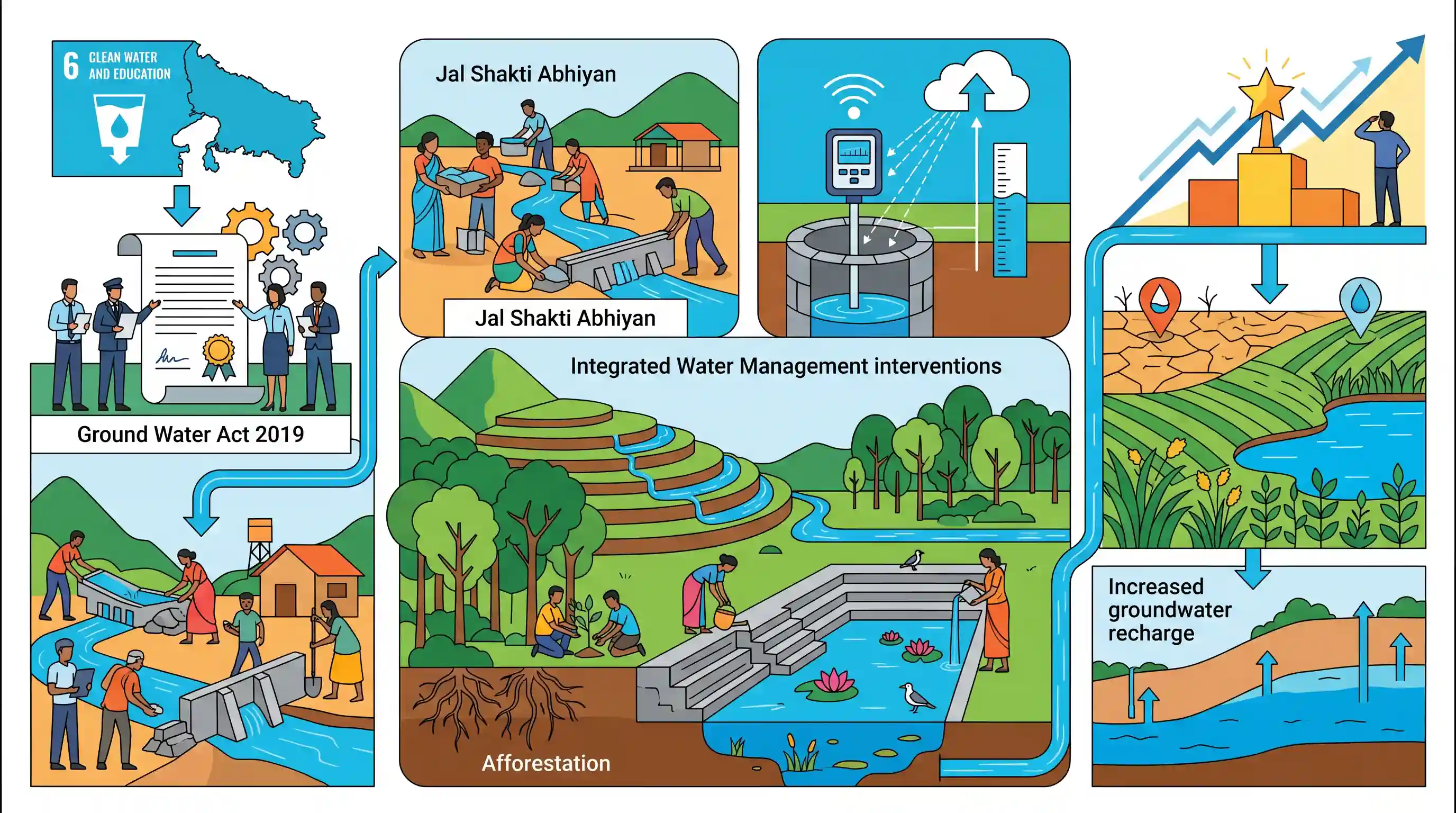
Uttar Pradesh has made significant strides towards achieving Sustainable Development Goal (SDG) 6 (Clean Water and Sanitation) through integrated water management and strict regulatory measures. Through the Ground Water Management and Regulation Act of 2019 and initiatives like Jal Shakti Abhiyan, the state has substantially reduced water-stressed areas and increased groundwater recharge. Interventions include the installation of digital water level recorders, watershed development, afforestation, and the construction of Amrit Sarovars, setting a benchmark for water conservation strategies.
Key Points
- Uttar Pradesh successfully decreased its over-exploited groundwater units from 82 in 2017 to 44 in 2025, while safe blocks expanded from 540 to 563.
- The state enacted the Ground Water Management and Regulation Act of 2019, implementing strict water pricing for commercial users and using collected fees and penalties exclusively for water conservation.
- Real-time monitoring of groundwater levels was enhanced through the installation of 3,511 Digital Water Level Recorders (DWLRs) across the state.
- Integrated water management under Jal Shakti Abhiyan included micro-watershed development, afforestation, construction of check dams, and the creation of 16,630 Amrit Sarovars.
- Total annual groundwater recharge in Uttar Pradesh increased significantly from 69.91 billion cubic meters (BCM) in 2017 to 73.39 BCM in 2025.
Important Terms
Sustainable Development Goal 6 (SDG 6)

The United Nations goal to "ensure availability and sustainable management of water and sanitation for all" by 2030, covering drinking water, hygiene, and water-use efficiency.
UPSC context
Relevant for GS II (Social Justice) and GS III (Environment); key for analyzing India's progress in water governance.
Jal Shakti Abhiyan (JSA)
A national, time-bound mission-mode campaign for water conservation and rainwater harvesting, focusing on groundwater recharge, watershed development, and intensive afforestation through community participation.
UPSC context
GS III (Resource Management); highlights the shift toward mission-mode decentralized water conservation in India.
Amrit Sarovar Mission
A mission launched in 2022 to develop and rejuvenate 75 water bodies in each district of India to ensure local water security and community-driven resource management.
UPSC context
GS III (Conservation/Rural Development); a prime example of scheme convergence (MGNREGA, PMKSY) for ecological restoration.
UP Ground Water Management and Regulation Act, 2019
A legislative framework enacted to protect, control, and regulate groundwater resources in UP, mandating permissions for commercial extraction and establishing institutional committees at the panchayat level.
UPSC context
GS II (Governance) and GS III (Environment); demonstrates state-level legislative action to correct historical neglect of groundwater regulation.
Integrated Water Resources Management (IWRM)
A process promoting the coordinated development and management of water, land, and related resources to maximize welfare sustainably without compromising vital ecosystems.
UPSC context
GS III (Water Resources); the global standard paradigm for managing competing water demands and hydrological sustainability.
Watershed Development
The study and management of a drainage area to conserve soil and water, improve vegetation, and optimize land-use for sustainable agricultural productivity and groundwater recharge.
UPSC context
GS III (Agriculture/Environment); a core strategy for drought-proofing and enhancing rural climate resilience.
Prelims Trap
Groundwater extraction is exclusively governed by a uniform Union law administered by the Central Ground Water Authority.
Water is a State subject (Entry 17). The Centre drafts Model Bills, but individual states enact their own groundwater acts. CGWA regulates via the Environment (Protection) Act, not a dedicated water law.
Static Concepts Connected
What is the Constitutional mechanism for groundwater regulation in India?
- State Subject: Water (including supplies, irrigation, and drainage) falls under Entry 17 of the State List, giving states primary legislative power.
- Union Exception: Entry 56 of the Union List allows the Centre to regulate and develop inter-state rivers and river valleys if Parliament declares it in the public interest.
- CGWA Mandate: The Central Ground Water Authority (CGWA) was constituted under Section 3(3) of the Environment (Protection) Act, 1986, to regulate and control groundwater development.
What are the core parameters of Mission Amrit Sarovar?
- National Target: Launched to construct or rejuvenate at least 75 Amrit Sarovars in every district of the country to overcome the water crisis.
- Physical criteria: Each Sarovar must have a minimum pondage area of 1 acre with a water holding capacity of at least 10,000 cubic meters.
- Funding convergence: The mission operates on a "whole of government" approach, converging MGNREGA, XV Finance Commission Grants, and PMKSY schemes.
Cross-Topic Patterns
Ring-fencing revenues for ecological goals
UP's legal mandate to use commercial water pricing penalties exclusively for conservation mirrors best practices in green taxation and ring-fencing environmental funds, connecting GS3 Environment with GS3 Economy.
IoT and telemetry in resource management
The deployment of 3,511 Digital Water Level Recorders (DWLRs) highlights the growing GS3 syllabus overlap between emerging technologies (IoT/telemetry) and traditional natural resource management.

Expect a GS3 Mains question on decentralized water governance combining Jal Shakti Abhiyan, technology (DWLRs), and state laws.
Linked PYQs · 5
Linked PYQs · 5
- 2018MainsGS1
The ideal solution of depleting ground water resources in India is water harvesting system." How can it be made effective in urban areas?
- 2016MainsGS1
In what way micro-watershed development projects help in water conservation in drought-prone and semi-arid regions of India?
- 2017MainsGS2
To ensure effective implementation of policies addressing water, sanitation and hygiene needs the identification of the beneficiary segments is to be synchronized with the anticipated outcomes." Examine the statement in the context of the WASH scheme.
- 2019MainsGS3
Elaborate the impact of National Watershed Project in increasing agricultural production from water-stressed areas.
- 2020MainsGS3
Suggest measures to improve water storage and irrigation system to make its judicious use under depleting scenario.
