Uttar Pradesh Advances SDG Water Goals Through Resource Management
Source:The Hindu ↗
Why It Matters
Water conservation and regional ecology are prominent areas of UPPSC Prelims exams. This news offers factual data points (blocks reduced, recharge volumes, legal provisions like the 2019 Act, DWLR technology, and Bhujal Saptah dates) which are highly prone to being framed as statement-based questions.
Summary
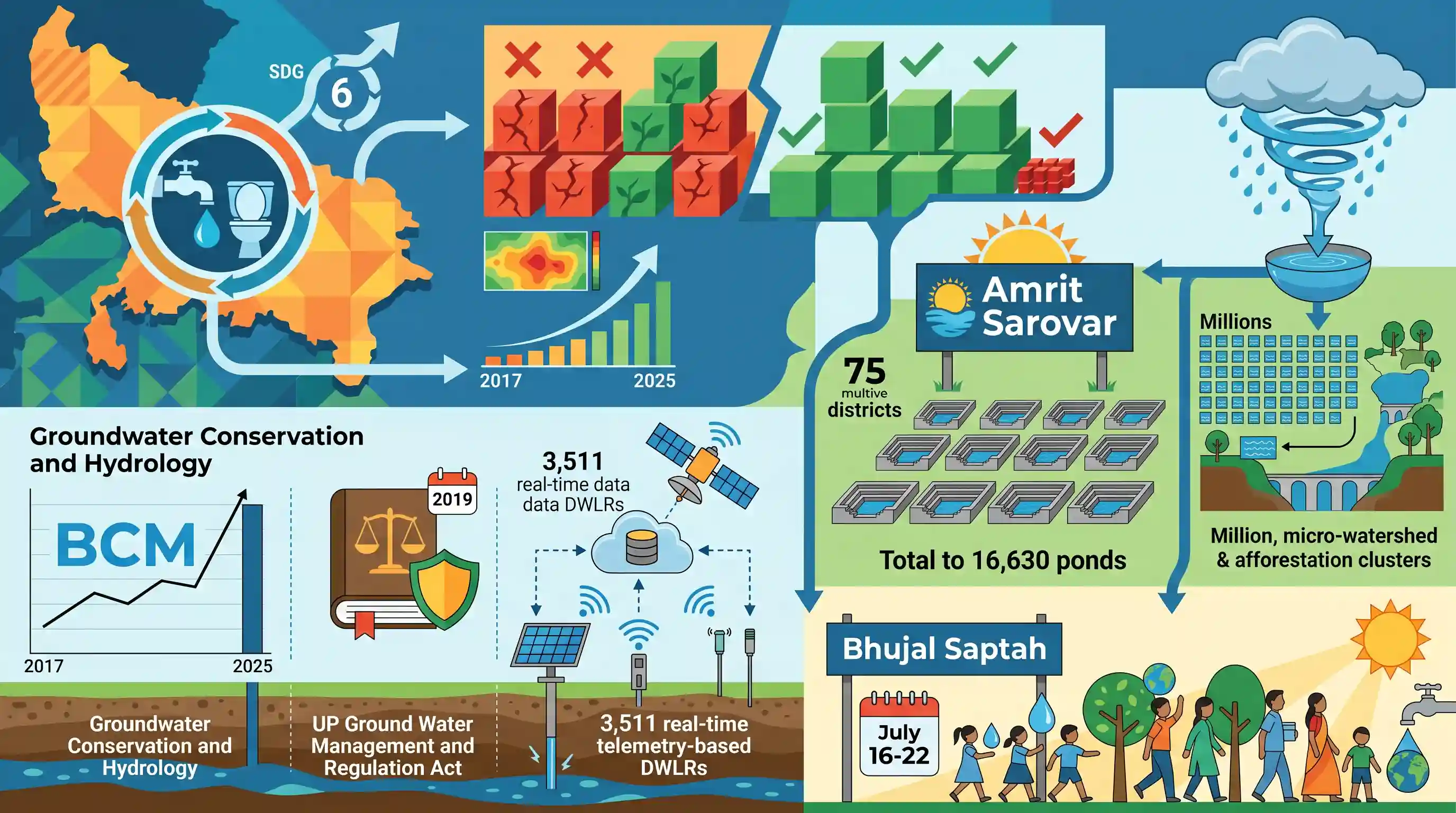
Uttar Pradesh has advanced its SDG-6 (Clean Water and Sanitation) targets through integrated water management. Key achievements between 2017 and 2025 include reducing over-exploited blocks from 82 to 44, increasing safe blocks to 563, and increasing annual groundwater recharge to 73.39 BCM. Backed by the UP Ground Water Management and Regulation Act of 2019, the state deployed 3,511 real-time telemetry-based Digital Water Level Recorders (DWLRs). Furthermore, under the 'Catch the Rain' campaign, UP established 16,630 Amrit Sarovars, developed millions of micro-watersheds, and observes 'Bhujal Saptah' (July 16-22) annually to sensitize the public.
Key Points
- Uttar Pradesh has made significant progress under SDG-6 (Clean Water and Sanitation), reducing over-exploited groundwater blocks from 82 in 2017 to 44 in 2025, and increasing safe blocks from 540 to 563.
- The state has won the prestigious National Water Awards twice due to its integrated water resource management efforts.
- The state enacted the 'UP Ground Water Management and Regulation Act of 2019' to regulate commercial groundwater demand, implement water pricing, enforce NOC conditions, and impose strict penalties.
- UP's Groundwater Department is the only state department in India to install 3,511 Digital Water Level Recorders (DWLRs) for real-time monitoring of groundwater levels.
- Under the Jal Shakti Abhiyan 'Catch the Rain' initiative, the state constructed 16,630 Amrit Sarovars, renovated 27,368 traditional water bodies, developed 1.4+ million micro-watersheds, and planted 10.8 crore trees.
- According to the Groundwater Resource Assessment Report 2025, total annual groundwater recharge in UP grew to 73.39 BCM (an increase of 3.48 BCM since 2017).
- UP organizes 'Bhujal Saptah' (Groundwater Week) annually from July 16 to 22 to raise community awareness.
Important Terms
Ground Water Management and Regulation Act, 2019

A state-level legislation designed to protect, conserve, control, and regulate groundwater resources in Uttar Pradesh, establishing regulatory bodies to manage water quantitatively and qualitatively in over-exploited and stressed areas.
UPSC context
GS Paper 3: Environment and Water Resources. Tests understanding of legislative frameworks for sustainable groundwater management and federal water resource policies.
Jal Shakti Abhiyan: Catch the Rain
An annual national water conservation campaign launched by the Ministry of Jal Shakti to promote decentralized rainwater harvesting structures suitable for local subsoil strata across rural and urban India.
UPSC context
GS Paper 2 & 3: Government Schemes & Water Security. Tests governance strategies, community participation, and decentralized climate adaptation.
Amrit Sarovar Mission
A central water conservation initiative launched in 2022 to construct or rejuvenate at least 75 water bodies (Amrit Sarovars) per district in India, enhancing rural livelihoods, water security, and groundwater levels.
UPSC context
GS Paper 2 & 3: Rural Development & Water Management. Tests multi-ministry scheme convergence, community-led ecological restoration, and asset-creation models.
UP State Groundwater Department
The nodal state administrative department responsible for groundwater resource planning, scientific assessment, monitoring, and issuing extraction permissions under the state’s regulatory frameworks in Uttar Pradesh.
UPSC context
GS Paper 2 & 3: Environment & State Administration. Tests institutional mechanisms for decentralized resource regulation and water crisis management.
Ministry of Jal Shakti
A Union Ministry of India established in 2019 to integrate water resource management under one department, consolidating policies related to drinking water, sanitation, river rejuvenation, and groundwater conservation.
UPSC context
GS Paper 2: Union Government Policies. Tests knowledge of centralized institutional reforms, federal coordination, and governance in water resource management.
Prelims Trap
Groundwater blocks are categorized as 'Critical' or 'Over-exploited' based on the absolute drop in the physical depth of the water table.
CGWB categorizes units using the 'Stage of Groundwater Extraction'—the ratio of annual extraction to net annual availability—not physical water table depth.
Static Concepts Connected
How does the Central Ground Water Board (CGWB) categorize groundwater assessment units?
- Primary metric: Categorization relies on the 'Stage of Groundwater Extraction' (SOE), calculated as the ratio of annual groundwater extraction to net annual availability.
- Key categories: Units are categorized as Safe (SOE ≤70%), Semi-Critical (70-90%), Critical (90-100%), and Over-Exploited (>100%).
- Quality overlay: Units can also be flagged based on significant chemical contamination like arsenic, fluoride, or high salinity.
What is Integrated Water Resources Management (IWRM) under SDG Target 6.5?
- Core philosophy: Promotes coordinated development of water, land, and related resources to maximize economic and social welfare equitably.
- Key pillars: Relies on an enabling policy environment, robust institutional frameworks, and practical management instruments.
- Scale of operation: Emphasizes management at the basin or catchment level rather than administrative boundaries.
Cross-Topic Patterns
Groundwater depletion vs Agricultural trade policy
Power subsidies for irrigation drive groundwater depletion, directly intersecting with WTO negotiations on domestic support and agricultural green box exemptions.
Fiscal federalism and water conservation
Mandatory MGNREGA fund channeling based on CGWB groundwater categories shows how environmental resource conservation is structurally linked to fiscal devolution.

CGWB's categorization criteria combined with MGNREGA's mandatory funding allocations for water-scarce blocks are prime 2026 Prelims material.
Linked PYQs · 3
Linked PYQs · 3
- 2020UPPSC_PRELIMSGS1
According to the Report released by NITI Aayog in December 2019 on 'Sustainable Development Goals India Index 2019-20', the Uttar Pradesh is grouped under which of the following categories ?
- 2022UPPSC_PRELIMSGS1
Which one of the following Watershed Development Projects sponsored by the Central Government of India which aims at enabling the rural population to conserve the water ?
- 2023UPPSC_PRELIMSGS1
A geographical unit that collects, stores and release water is called -
