Uttar Pradesh National Vehicle Scrappage Policy Implementation
Source:et-auto ↗
Why It Matters
Vehicular emissions and ecological policies are core components of UPPSC PCS Prelims (General Science, Environment) and Mains (GS Paper 3, as well as UP-specific GS Papers 5 & 6). Questions on specific state-level targets, tax concessions, environmental schemes, and emissions standards are regularly tested.
Summary
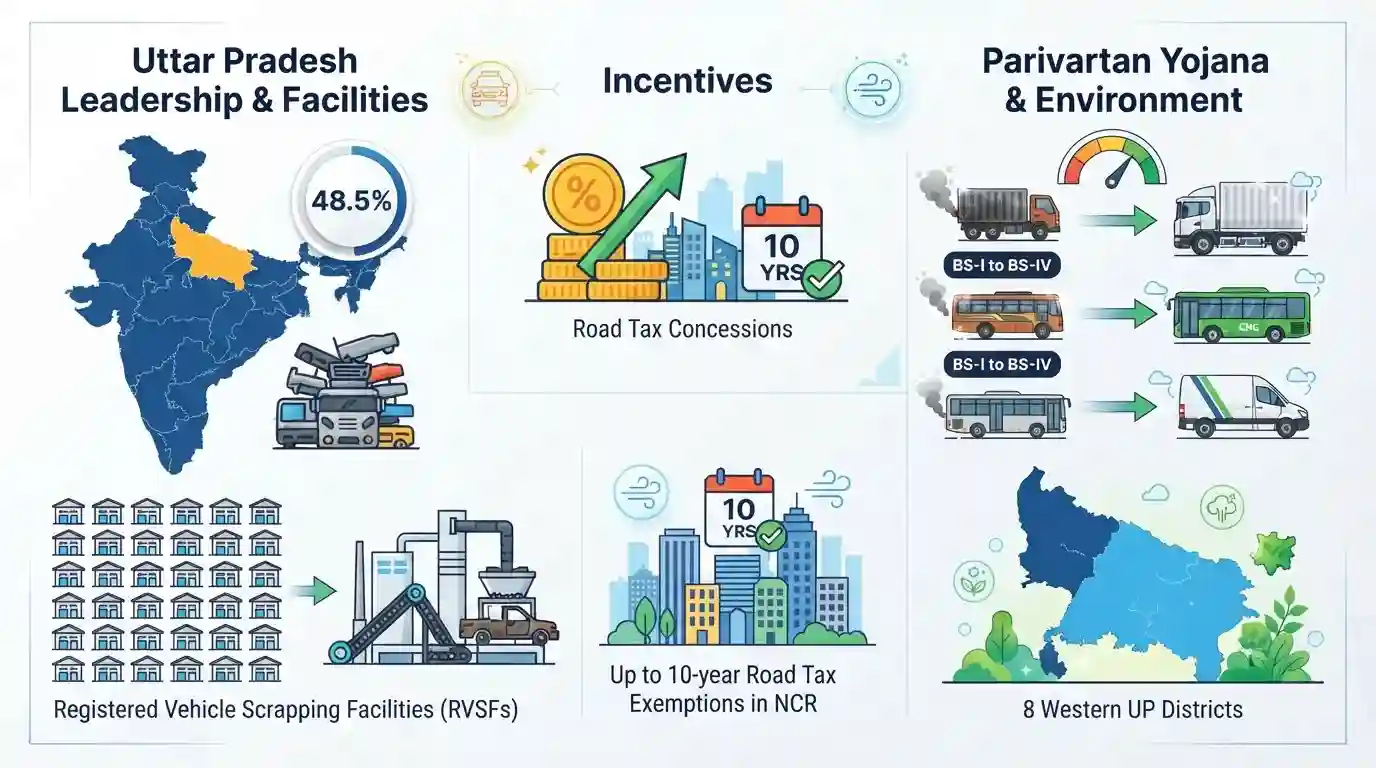
Uttar Pradesh has taken the lead in India's vehicle scrapping initiative, accounting for nearly half (48.5%) of all scrapped vehicles nationwide as of July 2026. The state has operationalized 51 Registered Vehicle Scrapping Facilities (RVSFs) and established attractive tax incentives, including road tax concessions and up to 10-year road tax exemptions in NCR. Furthermore, under the state's Parivartan Yojana, UP is actively replacing older, highly polluting BS-I to BS-IV commercial vehicles with BS-VI, CNG, and electric alternatives in 8 Western UP districts.
Key Points
- Uttar Pradesh has emerged as India's leading state under the national vehicle scrappage programme, contributing nearly 48.5% (over 1.97 lakh) of the more than 4.07 lakh vehicles scrapped nationwide up to July 31, 2026.
- The state currently has 92 licensed Registered Vehicle Scrapping Facilities (RVSFs), of which 51 are actively operational.
- Road tax concessions of up to 15% for non-transport vehicles and 10% for transport vehicles are offered to buyers purchasing new vehicles using a 'Certificate of Deposit' obtained from scrapping old vehicles.
- Within the National Capital Region (NCR) districts, specified owners replacing old commercial trucks and buses can receive up to 100% road tax exemption for up to 10 years.
- Under the Parivartan Yojana, the state government is pushing to replace obsolete BS-I to BS-IV goods vehicles and buses with BS-VI, CNG, and electric vehicles across 8 specific NCR districts in Western Uttar Pradesh.
Important Terms
Parivartan Yojana

A 2026 scheme accelerating the replacement of highly polluting BS-IV or older commercial trucks and buses in the National Capital Region (NCR) with cleaner BS-VI, CNG, or electric vehicles through financial incentives.
UPSC context
GS Paper III (Environment) & GS Paper V/VI (UP GK). Tests knowledge of air pollution mitigation and regional development programs.
National Vehicle Scrappage Policy
A policy launched in 2021 to phase out unfit and polluting vehicles through mandatory fitness tests (after 15 years for commercial and 20 years for private vehicles) and incentives for buying new models.
UPSC context
GS Paper III (Environment & Economy). Tests knowledge of environmental regulations, circular economy, and infrastructure policies.
Registered Vehicle Scrapping Facilities (RVSFs)
Government-licensed and regulated automated centers designed to scientifically dismantle, recycle, and process end-of-life vehicles in an environmentally friendly and sustainable manner.
UPSC context
GS Paper III (Infrastructure & Waste Management). Tests understanding of structured, formal waste management frameworks and environmental compliance.
Certificate of Deposit scheme
A system where a digital Certificate of Deposit (CoD) is issued on the VAHAN portal to vehicle owners scrapping older vehicles, enabling tax concessions, registration fee waivers, and manufacturer discounts on new purchases.
UPSC context
GS Paper III (Economy). Tests understanding of financial and policy incentives designed to promote a circular economy.
Bharat Stage (BS) Emission Standards
Regulatory emission standards instituted by the Central Pollution Control Board in India to control air pollutant output (like PM and NOx) from internal combustion engine vehicles, currently mandating BS-VI compliance.
UPSC context
GS Paper III (Science & Environment). Tests awareness of automotive emission norms, technology transitions, and urban air pollution mitigation.
Prelims Trap
Parivartan Yojana's 100% road tax rebate and EV subsidies apply uniformly to all 75 districts of Uttar Pradesh.
The scheme is strictly targeted at 8 designated Western UP districts within the NCR zone to combat regional pollution, rather than being a state-wide rollout.
Static Concepts Connected
What are the key fitness test timelines under the National Vehicle Scrappage Policy?
- Commercial Vehicles: Commercial vehicles must undergo mandatory automated fitness testing after 15 years; failure to pass results in de-registration.
- Private Vehicles: Private (non-transport) vehicles must undergo fitness testing after 20 years to renew their registration.
- Government Fleet: All vehicles owned by the central/state governments and local bodies older than 15 years face mandatory scrapping.
What is the significance of the transition to Bharat Stage VI (BS-VI) standards?
- Leapfrogging BS-V: India directly skipped BS-V, leapfrogging from BS-IV to BS-VI on April 1, 2020, to expedite emission reductions.
- Sulfur Reduction: BS-VI reduces fuel sulfur content to 10 ppm (from 50 ppm in BS-IV), dramatically lowering harmful particulate matter and NOx emissions.
Cross-Topic Patterns
Federal Synergy in Green Decarbonization
UP's local execution of the Central Scrappage Policy highlights how state transport policies and fiscal concessions act as the primary engines for nationwide decarbonization goals.
Airshed Governance & Regional Transport Policy
Restricting Parivartan Yojana to 8 NCR districts aligns local transport subsidies with the Supreme Court-backed Commission for Air Quality Management (CAQM) airshed-based pollution control strategy.

UPPSC may test Parivartan Yojana's specific target districts (8 NCR districts) or the RVSF tax incentive percentages in UP-specific papers.
Linked PYQs · 4
Linked PYQs · 4
- 2023UPPSC_PRELIMSGS1
Which of the following scheme/s is/are related to Uttar Pradesh? (1) Anuthee Uphar Scheme (2) Matra Shakti Udyamita Scheme (3) Kaushalya Matritva Scheme (4) Stree Nidhi Scheme Select the 'correct' answer using the code given below -
- 2023UPPSC_PRELIMSGS1
Which of the following Scheme/Programme is not the Central Government Programme and it is Uttar Pradesh Government's Programme?
- 2018UPPSC_PRELIMSGS1
Which among the following is the secondary pollutant?
- 2019UPPSC_PRELIMSGS1
Smog is essentially caused by the atmospheric presence of
