Anomalous Cyclogenesis and Winter Weather Patterns in Bay of Bengal
Source:The Hindu ↗
Why It Matters
This article provides an excellent real-world example of anomalous weather events (winter cyclogenesis). It is highly relevant for GS1 Geography (factors affecting cyclone formation, Bay of Bengal climate dynamics) and GS3 Disaster Management/Environment (climate change altering traditional weather cycles).
Summary
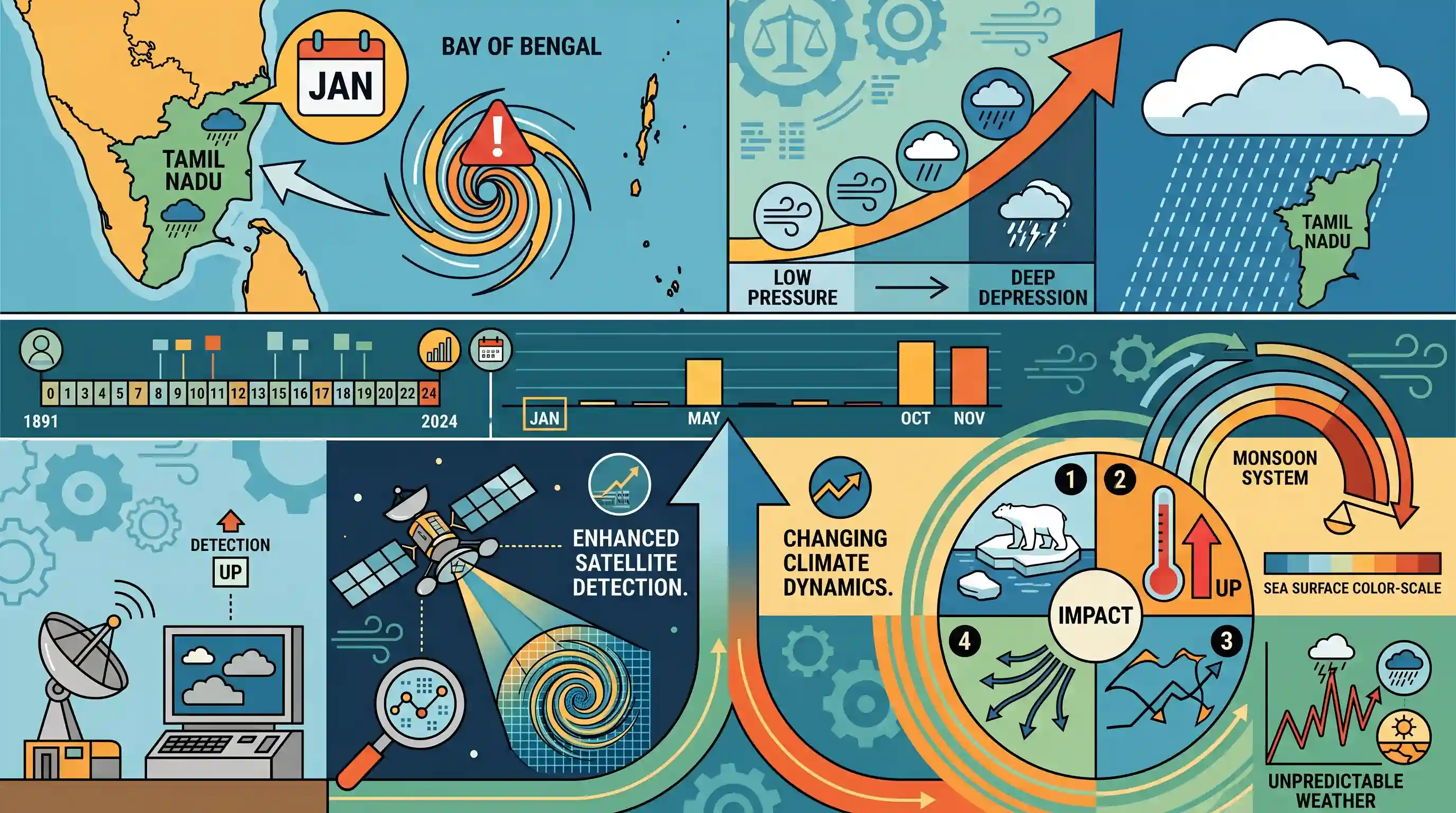
An unusual weather system is brewing over the Bay of Bengal in January, likely to concentrate into a deep depression and trigger heavy rainfall across Tamil Nadu. Historically, cyclogenesis and intense depressions are rare in January due to unfavourable atmospheric conditions. However, data indicates a slight uptick in recent decades. Meteorologists suggest that this apparent increase is influenced by both enhanced satellite detection capabilities and changing climate dynamics altering sea surface temperatures and weather patterns.
Key Points
- A rare weather system is forming over the Bay of Bengal in January, expected to intensify into a deep depression and bring heavy downpours to parts of Tamil Nadu.
- Intense weather systems are highly unusual in January due to unfavourable lower atmospheric conditions; the Bay of Bengal has recorded only 20 such intense systems in January since 1891.
- Typically, January systems form closer to the equator and dissipate before making landfall due to lack of moisture and less favourable sea surface temperatures.
- Of the 11 depression-intensity or higher systems formed since 1961 in January, 5 occurred between 2001 and 2024.
- Experts attribute the increased frequency partly to advanced satellite-based detection and partly to the influence of climate change on changing weather dynamics.
Important Terms
India Meteorological Department (IMD)

India's principal government agency for meteorological observations, weather forecasting, and seismology, functioning under the Ministry of Earth Sciences. It is responsible for naming and issuing warnings for tropical cyclones in the Northern Indian Ocean.
UPSC context
GS Paper 1 (Geography) and GS Paper 3 (Disaster Management); tests knowledge of institutional frameworks for climate monitoring and hazard warnings.
Cyclogenesis
An umbrella term for the atmospheric process of development or strengthening of cyclonic circulation. For tropical cyclones, this requires warm waters, low vertical wind shear, and pre-existing atmospheric disturbances.
UPSC context
GS Paper 1 (Physical Geography); essential for understanding cyclone formation, distribution, and the impact of atmospheric conditions on weather.
Deep Depression
A classification by the IMD for a tropical disturbance where maximum sustained surface wind speeds range from 50 to 61 km/h (28–33 knots). It is a stage before a cyclonic storm.
UPSC context
GS Paper 1 (Geography) and GS Paper 3 (Disaster Management); tests knowledge of storm intensity categories and warning systems.
Regional Meteorological Centre (RMC)
Subordinate administrative and technical offices of the IMD (six in total: Chennai, Guwahati, Kolkata, Mumbai, Nagpur, New Delhi) that provide specialized regional weather services and coordinate localized warnings.
UPSC context
GS Paper 3 (Disaster Management); tests understanding of the decentralized operational structure for weather alerts and disaster mitigation in India.
Sea Surface Temperature (SST)
The water temperature at the ocean's surface, which serves as a primary energy source for cyclones. Temperatures above 26.5°C are typically required to sustain the latent heat necessary for cyclogenesis.
UPSC context
GS Paper 1 (Climatology) and GS Paper 3 (Climate Change); tests understanding of environmental drivers of extreme weather and ocean-atmosphere interactions.
Climate Dynamics
The complex interactions within the climate system that govern weather patterns over time. Changing dynamics, often driven by global warming, can alter seasonal cycles and cyclone frequency.
UPSC context
GS Paper 3 (Environment); tests ability to analyze the impact of climate change on traditional meteorological seasons and regional weather systems.
Prelims Trap
Climate change has shifted the peak tropical cyclone formation season in the Bay of Bengal to January.
Peak cyclogenesis in the Bay of Bengal remains restricted to pre-monsoon and post-monsoon seasons. January systems are extreme, rare anomalies, not a permanent shift.
Static Concepts Connected
What are the essential conditions for tropical cyclogenesis?
- Warm SSTs: Sea surface temperatures >26.5°C to provide a continuous supply of moisture and latent heat.
- Coriolis Force: Sufficient force to create the cyclonic vortex, which is why cyclones rarely form within 5 degrees of the equator.
- Low Wind Shear: Low vertical wind shear allows the storm system to maintain its vertical structure without being torn apart.
Why does Tamil Nadu receive the bulk of its rainfall in winter?
- Rain Shadow Effect: During the Southwest Monsoon, Tamil Nadu lies in the rain shadow region of the Western Ghats, receiving very little precipitation.
- Retreating Monsoon: The Northeast (retreating) monsoon winds pick up moisture as they travel over the Bay of Bengal, striking the Coromandel coast in winter.
Cross-Topic Patterns
Unseasonal cyclones + Urban flooding
Unseasonal precipitation in Chennai exacerbates urban flooding vulnerabilities, directly linking GS1 climatology (atypical cyclones) to GS3 disaster management and municipal planning flaws.
Space tech + Weather data bias
The statistical 'increase' in rare weather events ties back to enhanced space-based observation capabilities like ISRO's INSAT-3DR, showing how improved technology creates historical data bias.

Expect a 2026 prelims statement mixing cyclogenesis conditions (Coriolis force, SSTs) with anomalous winter formations in the Bay of Bengal.
Linked PYQs · 4
Linked PYQs · 4
- 2024MainsGS1
What is sea surface temperature rise? How does it affect the formation of tropical cyclones?
- 2014MainsGS1
Tropical cyclones are largely confined to South China Sea, Bay of Bengal and Gulf of Mexico. Why?
- 2022MainsGS1
Discuss the meaning of colour-coded weather warnings for cyclone prone areas given by India Meteorological Department.
- 2024MainsGS3
Flooding in urban areas is an emerging climate-induced disaster. Discuss the causes of this disaster. Mention the features of two such major floods in the last two decades in India. Describe the policies and frameworks in India that aim at tackling such floods.
