Exclusion of UPI Data from New GDP Series Methodology
Source:Indian Express ↗
Why It Matters
Highlights the critical distinction between financial transaction volume and real economic value addition. It addresses GS3 themes of national income accounting, GDP base year revisions, and the practical challenges of integrating digital payment metrics into macroeconomic statistics.
Summary
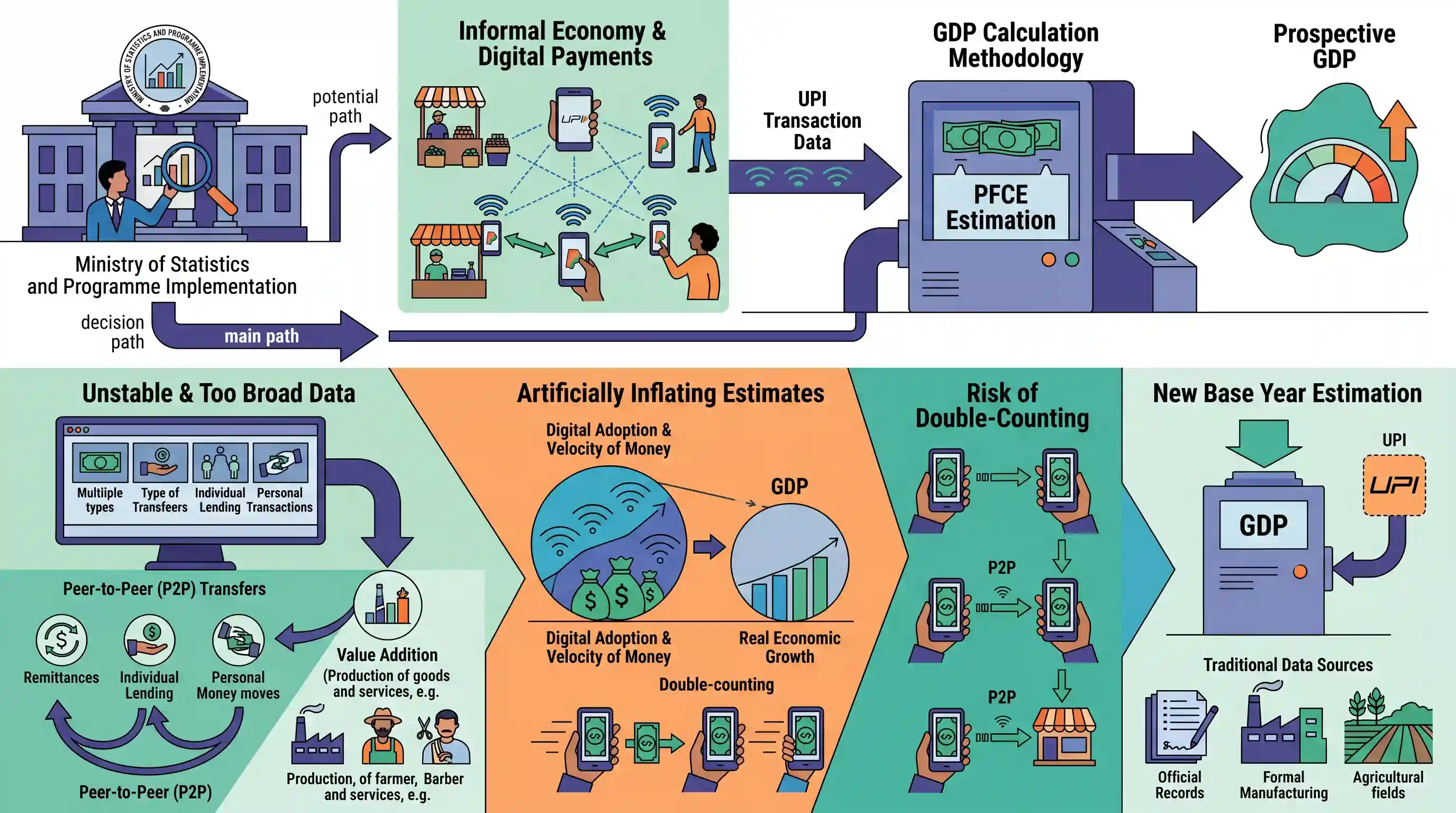
The Ministry of Statistics and Programme Implementation (MoSPI) has decided against using Unified Payments Interface (UPI) transaction data for estimating the new base year for India's Gross Domestic Product (GDP). Although UPI was initially considered a promising tool to capture Private Final Consumption Expenditure (PFCE) and track the informal economy, officials found the data to be 'unstable' and 'too broad.' Specifically, UPI transaction volumes include a massive amount of peer-to-peer (P2P) transfers—such as remittances or lending between individuals—which do not represent the actual production of goods or services (value addition). Additionally, relying on UPI data risks double-counting and artificially inflating economic estimates due to the velocity of money and expanding digital adoption, which outpace real economic growth.
Key Points
- MoSPI is undertaking a base year revision for India's GDP series to better capture current economic realities, including the informal sector.
- UPI transaction data was considered as a potential high-frequency proxy to estimate Private Final Consumption Expenditure (PFCE) and informal economic activity.
- The plan was dropped because UPI data is too broad, capturing peer-to-peer (P2P) transfers (like remittances) that merely move money without creating real economic value addition.
- UPI data is also deemed unstable as a GDP metric; increasing digital adoption and money velocity inflate transaction volumes without necessarily reflecting a rise in real economic output.
- Relying on UPI volumes risks significant double-counting due to single transactions being routed through multiple intermediaries.
Important Terms
Unified Payments Interface (UPI)

A real-time, instant payment system developed by NPCI that enables mobile-based inter-bank fund transfers through a single identifier (UPI ID) without requiring bank account details.
UPSC context
GS Paper 3: Indian Economy and Digital Public Infrastructure (DPI); essential for understanding financial inclusion and digital payment trends.
Ministry of Statistics and Programme Implementation (MoSPI)
The nodal ministry for statistical and planning services in India, responsible for estimating national income aggregates like GDP through its National Statistical Office (NSO).
UPSC context
GS Paper 3: Economic Development and Planning; critical for questions on India’s statistical machinery and national account revisions.
National Payments Corporation of India (NPCI)
An umbrella organization established by the RBI and Indian Banks' Association to operate retail payment and settlement systems in India, including UPI, RuPay, and IMPS.
UPSC context
GS Paper 3: Banking and Financial Institutions; tests knowledge of the institutional framework governing India’s digital payment ecosystem.
Private Final Consumption Expenditure (PFCE)
The total spending by resident households and non-profit institutions on final goods and services for consumption, accounting for over 50% of India's GDP.
UPSC context
GS Paper 3: GDP Components; vital for analyzing domestic demand and the health of the household sector.
Gross Value Added (GVA)
A measure of economic output that calculates the value of goods and services produced after deducting the cost of intermediate inputs like raw materials.
UPSC context
GS Paper 3: National Income Accounting; tests the ability to differentiate between sector-level production and aggregate market-price GDP.
Base Year
A specific reference year used for comparing economic indicators like GDP and CPI over time, periodically updated to reflect structural changes in the economy.
UPSC context
GS Paper 3: Economic Growth; relevant for understanding how inflation is adjusted to calculate real growth rates.
Prelims Trap
Peer-to-peer (P2P) transfers via UPI are included in India's GDP calculation as they reflect private final consumption expenditure.
P2P transfers are purely 'transfer payments'. They merely move money between individuals without producing new goods or services, meaning there is zero economic value addition.
Static Concepts Connected
What are the components of GDP under the Expenditure Method?
- Formula breakdown: Calculated as GDP = C + I + G + (X-M). 'C' is Private Final Consumption Expenditure (PFCE), forming the largest share of India's GDP.
- Strict exclusions: Transfer payments (remittances, pensions) and purely financial transactions (shares, P2P lending) are excluded because no new goods or services are produced.
What is the Velocity of Money and its relationship with GDP?
- Core definition: It is the average frequency with which a single unit of currency changes hands to purchase domestically produced goods and services in a given time period.
- Distortion risk: Rising digital transaction volumes often reflect an increased velocity of money rather than a proportionate increase in real economic output or value addition.
Cross-Topic Patterns
Payment Formalization vs Real Output
A massive surge in digital payments (UPI) indicates higher financial inclusion and money velocity, but UPSC often tests the nuance that this doesn't automatically equate to real GDP growth.
Base Year Revisions & Informal Sector
MoSPI's shift from the 2011-12 base year seeks new high-frequency proxies for the informal sector, a critical syllabus theme post-GST and pandemic shocks.

Expect a 2026 Prelims question linking National Income basics (transfer payments, double-counting) with digital economy metrics like UPI.
Linked PYQs · 5
Linked PYQs · 5
- 2021MainsGS3
Explain the difference between computing methodology of India's Gross Domestic Product (GDP) before the year 2015 and after the year 2015.
- 2020MainsGS3
Define potential GDP and explain its determinants. What are the factors that have been inhibiting India from realizing its potential GDP?
- 2017PrelimsGS1
Which of the following is a most likely consequence of implementing the 'Unified Payments Interface (UPI)'?
- 2018PrelimsGS1
With reference to digital payments, consider the following statements: 1. BHIM app allows the user to transfer money to anyone with a UPI-enabled bank account. 2. While a chip-pin debit card has four factors of authentication, BHIM app has only two factors of authentication. Which of the statements given above is/are correct?
- 2015PrelimsGS1
With reference to Indian economy, consider the following statements : 1. The rate of growth of Real Gross Domestic Product has steadily increased in the last decade. 2. The Gross Domestic Product at market prices (in rupees) has steadily increased in the last decade. Which of the statements given above is/are correct?
