Impact of Unseasonal Rains on Onion Cultivation and Farm Distress
Source:The Hindu ↗
Why It Matters
The article provides a real-world case study on the cascading impacts of climate change (unseasonal rains) on cropping patterns, agricultural supply chains, and farmer incomes. It highlights the practical need for price deficit schemes (like Bhavantar Yojana) and crop insurance, directly relevant to GS3 topics on agricultural pricing, subsidies, and farm distress.
Summary
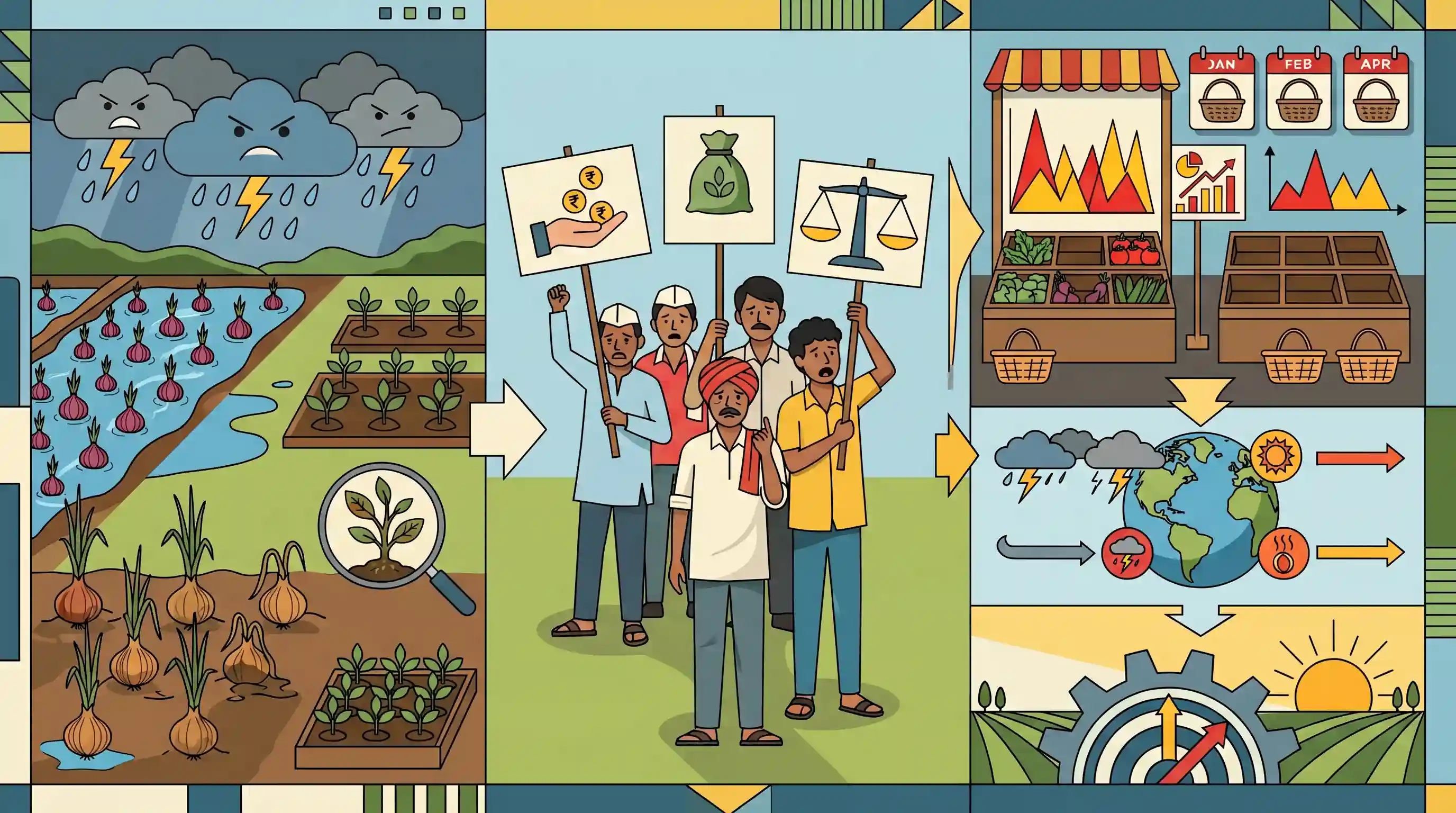
Unseasonal rains across Maharashtra have wreaked havoc on rabi onion cultivation, destroying nurseries and triggering widespread 'mar rog' (damping-off disease). In response, farmers have launched indefinite protests demanding immediate state intervention, including compensation, free seeds, and the implementation of the Bhavantar Yojana to cover the deficit between market prices and production costs. The disruption to the winter sowing cycle threatens a severe supply crunch and potential price volatility between January and April, highlighting the growing vulnerability of Indian agriculture to extreme weather events and the pressing need for robust price stabilization mechanisms.
Key Points
- Unseasonal rains and excessive moisture in Maharashtra have severely damaged rabi onion nurseries, leading to outbreaks of 'mar rog' (damping-off disease).
- Farmers have launched indefinite protests demanding crop compensation, free seeds, and uninterrupted daytime electricity for agriculture.
- A key demand is the implementation of the Bhavantar Yojana (Price Deficit Financing Scheme) to compensate farmers when wholesale prices fall below the Minimum Retail Price (MRP).
- The destruction of nurseries and delayed sowing threaten a massive onion supply shortage between January and April, likely causing retail price spikes.
- Rising input costs for seeds, fertilizers, and labor, combined with climate-induced crop failures, are severely deepening agricultural distress in the region.
Important Terms
Bhavantar Bhugtan Yojana

A price deficiency payment scheme where the government compensates farmers for the difference between the Minimum Support Price (MSP) and the actual market selling price or a model price.
UPSC context
GS Paper III (Agriculture); tests understanding of alternative price support mechanisms that mitigate price volatility without necessitating physical government procurement.
Swabhimani Shetkari Sanghatana
A prominent farmer's union in Maharashtra, led by Raju Shetti, that advocates for remunerative prices and better policies for crops like sugarcane, onions, and milk through agitations.
UPSC context
GS Paper II (Pressure Groups); relevant for analyzing agrarian movements and their influence on state-level agricultural policy and politics.
Maharashtra State Onion Growers' Association
An organization representing onion farmers in Maharashtra that negotiates with state and central governments for compensation, fair procurement practices, and transparent market operations in APMCs.
UPSC context
GS Paper II (Pressure Groups); illustrates the role of sector-specific interest groups in agricultural marketing and farmer welfare advocacy.
Mar Rog (Damping-off)
A Marathi term for fungal diseases like damping-off or Fusarium wilt that cause seedlings to rot and collapse, often exacerbated by waterlogged soil from unseasonal rains.
UPSC context
GS Paper III (Agriculture - Pests and Diseases); highlights the physical impact of climate change and unseasonal weather patterns on nursery-stage agricultural productivity.
NAFED (National Agricultural Cooperative Marketing Federation of India)
An apex cooperative organization under the Ministry of Agriculture that manages the procurement and buffer stocking of essential commodities like onions to stabilize prices.
UPSC context
GS Paper III (Agricultural Marketing); tests knowledge of institutional mechanisms for market intervention, buffer stocks, and price stabilization.
Prelims Trap
"Bhavantar Yojana involves the physical procurement of crops by state agencies at Minimum Support Price."
Price Deficit Financing schemes compensate farmers for the difference between the market price and support price; they explicitly do not involve physical procurement.
Static Concepts Connected
What are the core features of a Price Deficit Financing Scheme (e.g., Bhavantar)?
- Direct Compensation: Pays registered farmers the direct cash difference between the actual market price and the state-determined support price (MSP).
- No Physical Procurement: Unlike traditional MSP operations, it does not involve physical procurement by the government, significantly saving on storage and logistical costs.
- Market Integration: It aims to prevent distress sales during supply gluts while keeping the physical commodity flowing through private market channels.
How do Kharif and Rabi onion crops differ in India's agricultural cycle?
- Production Share: Rabi onions are the primary crop, contributing 60-70% of India's annual onion production, harvested mainly between March and May.
- Storage Capability: Rabi onions possess a lower moisture content than Kharif onions, giving them a longer shelf life suitable for national buffer stocking.
- Consumption Role: Kharif onions hit the market in late autumn, acting as immediate consumption crops to ease lean-season price spikes before the next Rabi harvest.
Cross-Topic Patterns
Agflation and RBI Monetary Policy
Climate-induced food supply shocks (like onion price spikes) drive retail inflation (CPI), severely constraining the RBI's ability to lower interest rates due to sticky food inflation.
Operation Greens & NAFED Intervention
Recurrent onion supply crunches invoke Operation Greens, making NAFED's role in market intervention, buffer stocking, and TOP (Tomato, Onion, Potato) price stabilization crucial for GS-3 Agriculture.

Expect a 2026 Prelims question testing the storage capabilities of Rabi vs Kharif onions alongside price deficit financing mechanisms.
Linked PYQs · 4
Linked PYQs · 4
- 2024MainsGS3
Elucidate the importance of buffer stocks for stabilizing agricultural prices in India. What are the challenges associated with the storage of buffer stock? Discuss.
- 2022MainsGS3
What are the main bottlenecks in upstream and downstream process of marketing of agricultural products in India?
- 2016MainsGS3
Given the vulnerability of Indian agriculture to vagaries of nature, discuss the need for crop insurance and bring out the salient features of the Pradhan Mantri Fasal Bima Yojana (PMFBY).
- 2017MainsGS3
How do subsidies affect the cropping pattern, crop diversity and economy of farmers? What is the significance of crop insurance, minimum support price and food processing for small and marginal farmers?
