UNSC Consultations on Indo-Pak Tensions and Cross Border Terrorism
Source:Indian Express ↗
Why It Matters
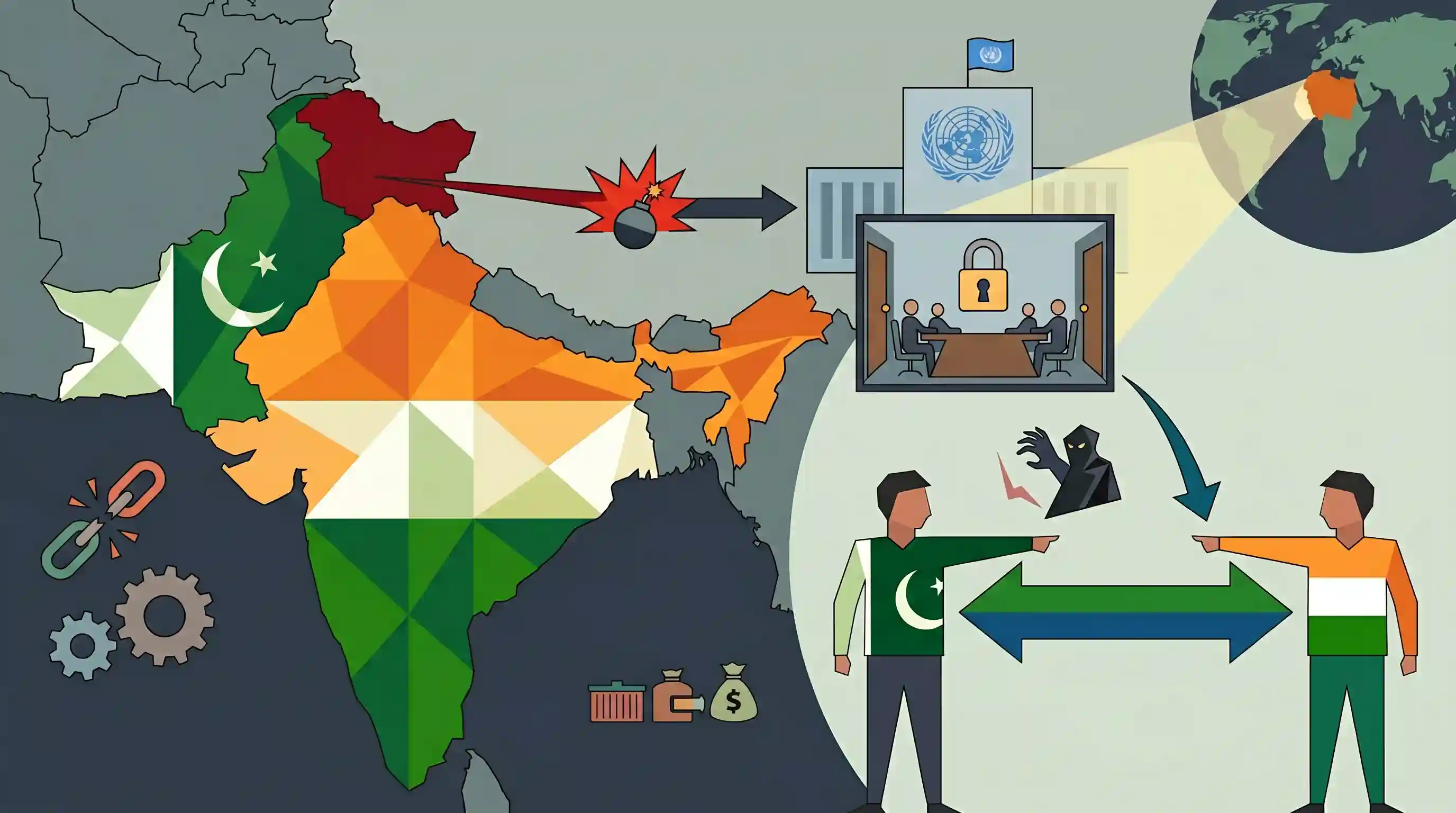
UNSC closed consultations on Indo-Pak tensions touch upon core aspects of India's foreign policy—specifically its firm stance against the internationalization of the Kashmir issue and its ongoing fight against cross-border terrorism. This is directly relevant to GS Paper 2 (International Relations) and GS Paper 3 (Internal Security).
Summary
A recent terror attack in Pahalgam, Jammu and Kashmir, has led to heightened tensions between India and Pakistan. In response to the escalating situation, the United Nations Security Council (UNSC) decided to hold closed consultations. This move brings the Kashmir issue and cross-border terrorism into the international spotlight, conflicting with India's long-standing diplomatic position that all Indo-Pak disputes must be resolved bilaterally without third-party intervention. The development highlights the continuing challenge of state-sponsored terrorism to India's internal security and its broader geopolitical ramifications.
Key Points
- A terror attack in Pahalgam, Jammu and Kashmir, has triggered a significant escalation in bilateral tensions between India and Pakistan.
- The United Nations Security Council (UNSC) scheduled closed consultations to discuss the rising tensions, drawing international attention to the situation.
- UNSC involvement challenges India's traditional diplomatic stance that disputes with Pakistan over Kashmir are strictly bilateral issues that should not be internationalized.
- The incident underscores the persistent threat of cross-border terrorism and its implications for internal security and regional stability in South Asia.
Important Terms
Simla Agreement

A 1972 bilateral treaty between India and Pakistan mandating that all disputes be resolved through direct negotiations, effectively rejecting third-party mediation in Jammu and Kashmir.
UPSC context
GS-II: International Relations; it is the cornerstone of India's 'bilateralism' policy and legal defense against international interference.
United Nations Security Council (UNSC)
The primary UN organ responsible for international peace; it consists of 5 permanent (P5) and 10 rotating non-permanent members.
UPSC context
GS-II: International Institutions; tests knowledge of India's bid for permanent membership and the Council's mandate in regional conflicts.
UN Charter
The foundational treaty of the UN; Chapter VI deals with peaceful dispute settlement, while Chapter VII allows for binding actions like sanctions or force.
UPSC context
GS-II: International Law; distinguishes between recommendatory (Chapter VI) and mandatory (Chapter VII) resolutions affecting national sovereignty.
Bilateralism
The diplomatic practice of conducting affairs between two sovereign states directly, without the involvement of international organizations or third-party mediators.
UPSC context
GS-II: India and its Neighborhood; reflects India's preferred strategy to prevent the 'internationalization' of the Kashmir issue.
Closed Consultations
Informal, private meetings of UNSC members that produce no official record or binding resolution, often used to exchange views on sensitive security situations.
UPSC context
GS-II: International Institutions; tests understanding of UN procedural nuances and how countries use 'informal' settings for perception-shaping.
Cross-border Terrorism
State-sponsored or supported insurgent activities originating from one country to carry out attacks in another; India's primary challenge to regional peace.
UPSC context
GS-III: Internal Security; fundamental to India's 'no talks with terror' policy and its diplomatic outreach at global forums.
Prelims Trap
The Comprehensive Convention on International Terrorism (CCIT) is a binding UN treaty currently in force.
India proposed the CCIT in 1996, but it remains a draft. It has not been adopted because member states cannot agree on a universal definition of terrorism.
Static Concepts Connected
Which key agreements mandate bilateralism in India-Pakistan relations?
- Simla Agreement 1972: Bound both countries to settle their differences by peaceful means through bilateral negotiations, effectively rejecting third-party mediation including the UN.
- Lahore Declaration 1999: Reiterated the commitment to the Simla Agreement framework and established essential confidence-building measures regarding their nuclear arsenals.
How do UNSC closed consultations differ from formal open meetings?
- Closed Consultations: Private, informal sessions held among the 15 UNSC members. No official public record, verbatim transcripts, or press broadcasts are produced.
- Formal Outcomes: Unlike open meetings, closed consultations do not result in binding resolutions, though they may yield a non-binding Presidential Statement or press element.
Cross-Topic Patterns
State-sponsored terror & FATF
India increasingly leverages multilateral economic pressure mechanisms, such as the FATF greylist, to complement its internal border security posture against state-sponsored terror financing from Pakistan.
Delayed CCIT & UNSC Reforms
The UN's inability to finalize the CCIT since 1996 highlights global governance deficits, directly bolstering India's longstanding demand for comprehensive UN and Security Council reforms.

Expect a multi-statement Prelims question in 2026 mixing the Simla Agreement's bilateral clauses with the CCIT's definitional deadlock.
Linked PYQs · 4
Linked PYQs · 4
- 2024MainsGS2
‘Terrorism has become a significant threat to global peace and security.’ Evaluate the effectiveness of the United Nations Security Council's Counter Terrorism Committee (CTC) and its associated bodies in addressing and mitigating this threat at the international level.
- 2016MainsGS2
Increasing cross-border terrorist attacks in India and growing interference in the internal affairs of several member-states by Pakistan are not conducive for the future of SAARC (South Asian Association for Regional Cooperation)." Explain with suitable examples.
- 2015MainsGS2
Terrorist activities and mutual distrust have clouded India-Pakistan relations. To what extent the use of soft power like sports and cultural exchanges could help generate goodwill between the two countries? Discuss with suitable examples.
- 2023MainsGS3
Winning of 'Hearts and Minds' in terrorism-affected areas is an essential step in restoring the trust of the population. Discuss the measures adopted by the Government in this respect as part of the conflict resolution in Jammu and Kashmir.
