Civil Military Relations and Agnipath Scheme Controversy
Source:Indian Express ↗
Why It Matters
The article touches upon critical aspects of GS-2 (Parliamentary functioning and executive accountability) and GS-3 (Defence reforms and national security). It provides a real-world example of how defence policies (like the Agnipath scheme) are formulated, the friction between civil administration and military leadership, and the role of Parliament in holding the executive accountable.
Summary
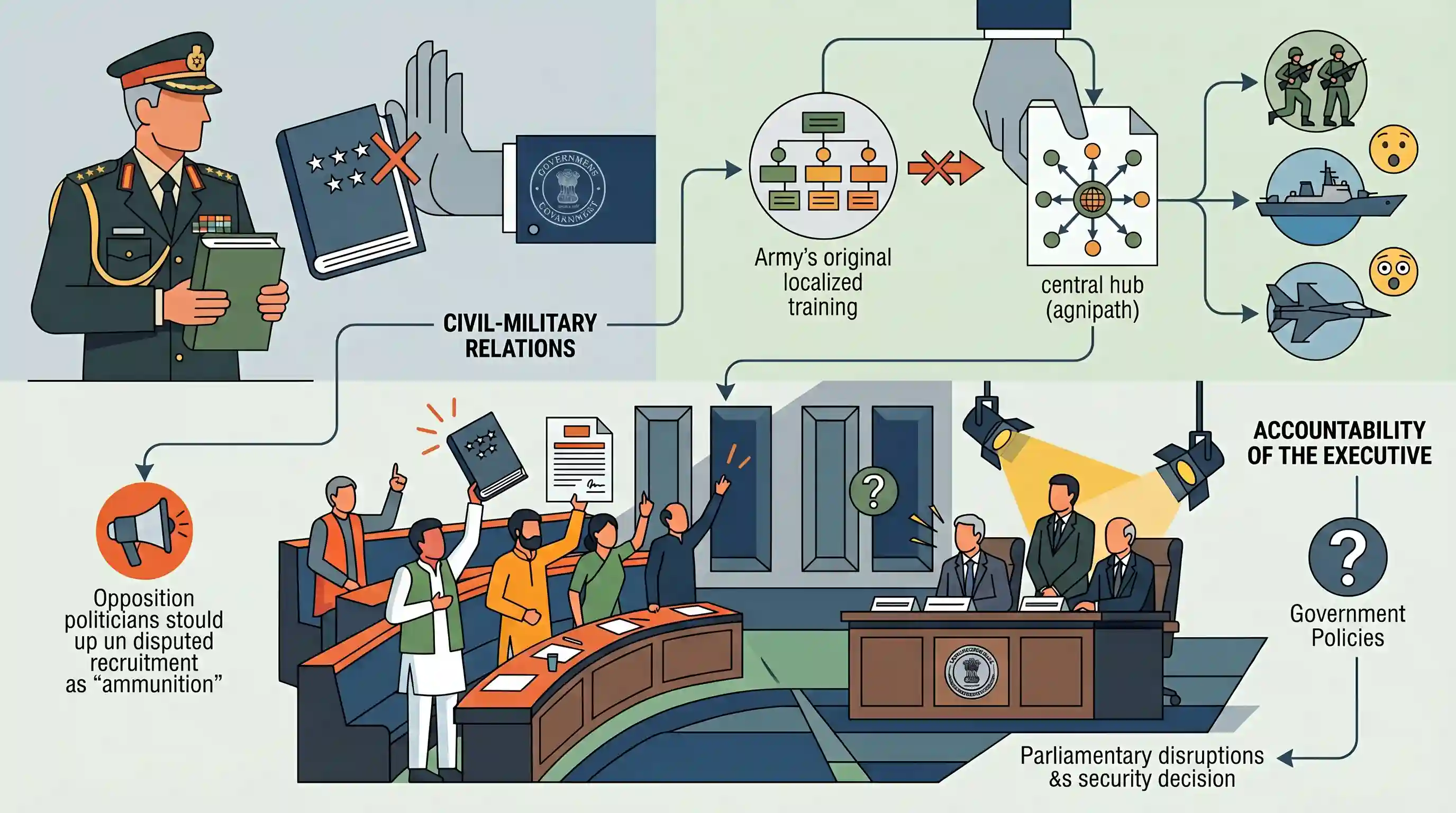
The publication of former Army Chief General M.M. Naravane's memoir, "Four Stars of Destiny," has been stalled pending a Defence Ministry review. Excerpts from the book indicate that the Agnipath military recruitment scheme was a significant departure from the Army's original "Tour of Duty" proposal, and was implemented across all three services much to the surprise of the Navy and Air Force. The revelations provided political ammunition to the opposition, leading to disruptions in Parliament over the executive's unilateral decision-making and lack of consultation. The episode underscores issues related to civil-military relations, transparency, and parliamentary accountability in national security matters.
Key Points
- Former Army Chief General M.M. Naravane's memoir, "Four Stars of Destiny", has faced publication delays pending a review by the Defence Ministry and the PMO.
- Excerpts from the book revealed that the Army's original "Tour of Duty" proposal was significantly altered into the tri-service "Agnipath scheme", taking the Navy and Air Force by surprise.
- The government reduced the retention rate of Agniveers to 25%, deviating from the Army's initial recommendation of retaining 75% of the recruits.
- Opposition parties used these revelations to challenge the government's lack of consultation, leading to political face-offs and the stalling of Parliamentary proceedings.
- The controversy highlights complex civil-military dynamics, specifically concerning pre-publication clearance of memoirs by retired military officials and the executive's accountability for major defence policies.
Important Terms
Agnipath Scheme

A transformative recruitment model for the Indian Armed Forces where youth (Agniveers) serve for four years. It aims to modernize forces, lower the age profile, and reduce the defense pension bill.
UPSC context
GS Paper II (Govt Policies) and GS Paper III (Security). Tests understanding of defense reforms and their socio-economic impacts.
Tour of Duty
The original concept proposed by the Indian Army for a short-term (3-year) voluntary service for civilians to experience military life without making it a lifelong career.
UPSC context
GS Paper III (Internal Security). Relevant for tracing the evolution and conceptual origins of current defense recruitment policies.
Civil-Military Relations
The interaction between a state's political leadership and its military institutions. In India, it emphasizes civilian supremacy and institutional synergy between the MoD and Service Headquarters.
UPSC context
GS Paper II (Governance) and Paper IV (Ethics). Tests knowledge of democratic oversight and the balance of power in national security.
Parliamentary Accountability
The constitutional mandate (Article 75) where the executive is responsible to the legislature. Mechanisms include Question Hour, Zero Hour, and Standing Committees to scrutinize government decisions.
UPSC context
GS Paper II (Polity). Focuses on the functioning of Parliament and checks and balances over the executive branch.
Ministry of Defence (MoD)
The nodal ministry charged with coordinating and supervising all agencies and functions of the government relating directly to national security and the Indian Armed Forces.
UPSC context
GS Paper II (Governance). Relevant for understanding the organizational structure and administrative control of India's defense sector.
Prelims Trap
The Agnipath scheme recruits youth for all ranks, including commissioned officers across the three services.
Agnipath is exclusively for Personnel Below Officer Rank (PBOR). Commissioned officers continue to be recruited through traditional entries like NDA and CDS.
Static Concepts Connected
How does Article 33 restrict the fundamental rights of armed forces personnel?
- Parliamentary Power: Parliament can by law restrict or abrogate fundamental rights of armed forces, police, and intelligence agencies. State legislatures cannot make such laws.
- Core Purpose: The restrictions aim to ensure the proper discharge of their duties and the maintenance of absolute discipline among the ranks.
- Legal Immunity: Laws made under Article 33 (e.g., the Army Act) cannot be challenged in any court on the ground of contravention of any fundamental right.
What legal framework governs post-retirement disclosures by security officials?
- Official Secrets Act: The OSA 1923 applies for life, criminalizing the unauthorized disclosure of classified operational information or sensitive civil-military deliberations.
- CCS Pension Rules: A 2021 amendment restricts retired intelligence and security officials from publishing domain-related information without clearance, under threat of pension withdrawal.
- Military Grey Area: Unlike serving personnel, there is no consolidated statutory law exclusively governing memoir publications by retired military officers, creating a legal grey area.
Cross-Topic Patterns
Defense Budget: Capital vs Revenue expenditure
Agnipath was fundamentally driven by the need to reduce the ballooning defense pension bill (revenue expenditure) to free up funds for capital acquisition and military modernization.
Parliamentary oversight of defense policies
Disruptions over the memoir highlight GS-2 themes of parliamentary oversight on defense policies, echoing historical transparency debates like the classified Henderson Brooks-Bhagat report on the 1962 war.

Expect a 2026 Prelims question mixing Agnipath's PBOR-only applicability with Article 33 and the Official Secrets Act.
Linked PYQs · 2
Linked PYQs · 2
- 2021MainsGS2
To what extent, in your view, the Parliament is able to ensure accountability of the executive in India?
- 2020MainsGS2
Recent amendments to the Right to Information Act will have profound impact on the autonomy and independence of the Information Commission". Discuss.
