World Meteorological Organization Report on Global Temperature Rise
Source:Indian Express ↗
Why It Matters
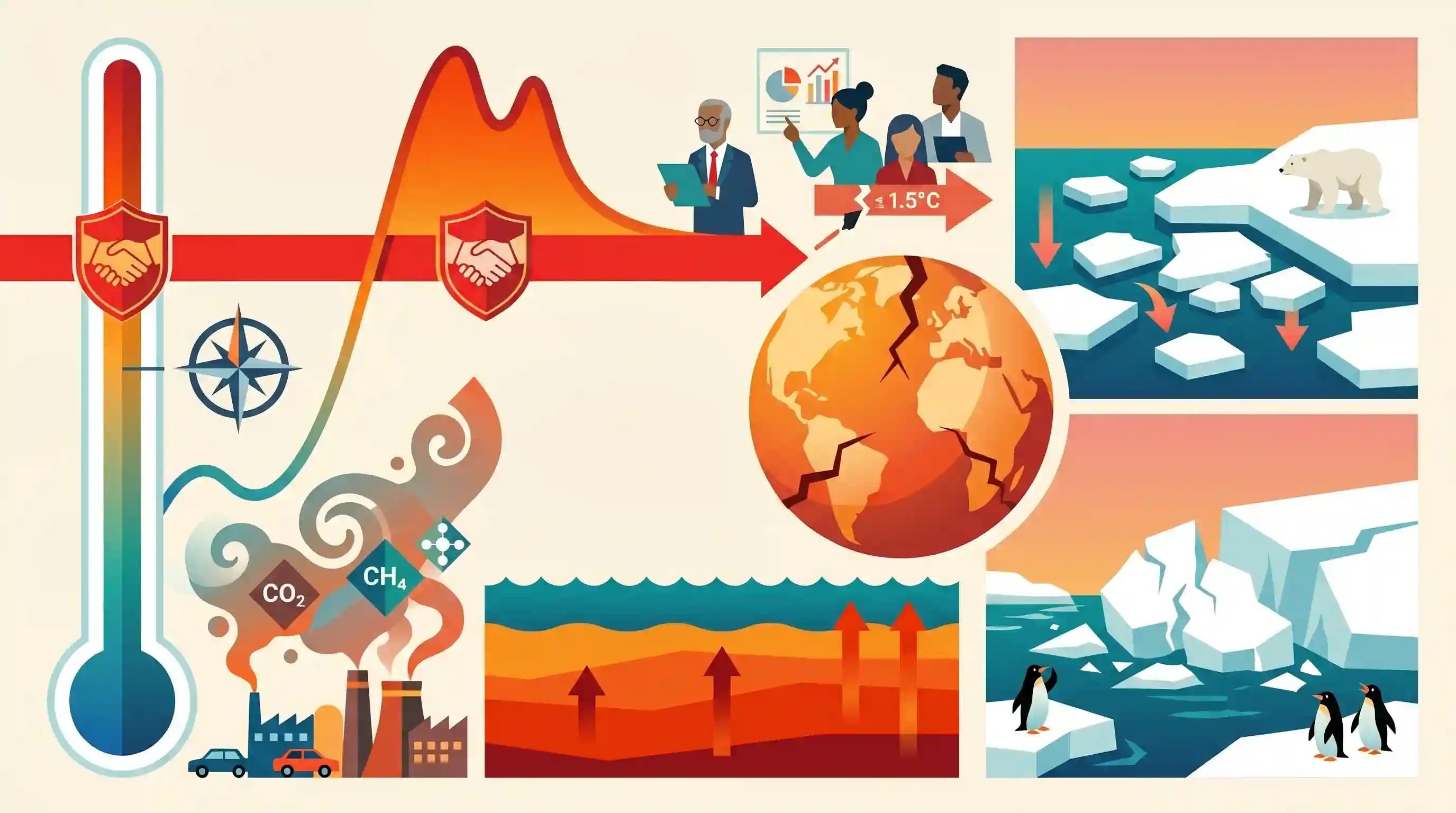
The WMO findings are crucial for both Prelims and Mains (GS-1 Geography and GS-3 Environment). The acknowledgement of likely overshooting the 1.5°C Paris Agreement limit shapes the contemporary discourse around global climate commitments, greenhouse gas mitigation strategies, and the tangible impacts of global warming like polar ice melting and ocean heating.
Summary
The World Meteorological Organization (WMO) projects 2025 to be one of the top three warmest years on record, driven by near-surface temperatures 1.42°C above pre-industrial levels. This follows 2024, the hottest year ever recorded (1.55°C above average). The warming is accompanied by continuous increases in greenhouse gas concentrations and ocean heat content, as well as unprecedented declines in Arctic and Antarctic sea ice extents. WMO leadership cautions that temporarily overshooting the critical 1.5°C global warming limit outlined in the Paris Agreement is becoming inevitable.
Key Points
- Between January and August 2025, global near-surface temperatures were 1.42°C above the pre-industrial average, making 2025 likely to be in the top three warmest years ever recorded.
- The year 2024 remains the hottest on record, where temperatures peaked at 1.55°C above pre-industrial levels.
- Sea ice extents have plummeted: the Arctic saw its lowest extent after the winter freeze, and Antarctic ice tracked significantly below average all year.
- Rising trends persist in heat-trapping greenhouse gas concentrations and ocean heat content, exacerbating long-term climate shifts.
- WMO Secretary-General Celeste Saulo warned that it is now "virtually impossible" to meet the Paris Agreement goal of limiting warming to 1.5°C without temporarily overshooting that target.
Important Terms
Paris Agreement

A 2015 legally binding international treaty under the UNFCCC aiming to limit global temperature rise to well below 2°C, and preferably to 1.5°C, compared to pre-industrial levels.
UPSC context
GS-III: Environmental Conservation and International Treaties; essential for understanding global climate governance and India's NDCs.
World Meteorological Organization (WMO)
A specialized agency of the United Nations responsible for international cooperation on atmospheric science, climatology, hydrology, and geophysics.
UPSC context
GS-II: Important International Institutions; frequently cited for climate data and early warning systems.
1.5°C Global Warming Threshold
The specific global warming limit identified in the Paris Agreement to avoid catastrophic climate impacts, measured as a multi-decade average above the 1850–1900 baseline.
UPSC context
GS-III: Climate Change; tests understanding of climate tipping points and international mitigation targets.
Ocean Heat Content (OHC)
The amount of heat energy stored in the oceans, indicating global warming's long-term trend as oceans absorb over 90% of the Earth's excess heat.
UPSC context
GS-I: Geography (Oceanography) and GS-III: Environment; a critical indicator of climate change and thermal expansion.
Pre-industrial levels
The reference period, typically 1850–1900, representing global temperatures before significant human-induced greenhouse gas emissions began altering the climate.
UPSC context
GS-III: Environment; fundamental baseline for assessing the severity of current and future global warming.
State of the Global Climate Report
WMO's flagship annual publication providing a detailed assessment of climate indicators like temperature, greenhouse gases, and sea-level rise to support global policy-making.
UPSC context
GS-III: Environment; high-relevance report for Prelims data points and Mains arguments on climate urgency.
Prelims Trap
The Paris Agreement's 1.5°C target was officially breached when 2024 recorded temperatures 1.55°C above pre-industrial levels.
A single year (or temporary) overshoot above 1.5°C does NOT mean the Paris target is officially lost. The target refers to a multi-decade climate average, not an isolated annual spike.
Static Concepts Connected
What is the Ice-Albedo Feedback loop?
- The Mechanism: Melting highly reflective white ice exposes darker ocean water, which absorbs more solar radiation instead of reflecting it.
- Polar Amplification: This creates a positive feedback loop, leading to 'polar amplification' where the Arctic warms significantly faster than the global average.
- Global Consequences: It disrupts planetary atmospheric circulation, including jet streams, leading to extreme weather events in mid-latitudes.
Why is Ocean Heat Content (OHC) a critical climate metric?
- Primary Heat Sink: Oceans act as massive climate buffers, absorbing over 90% of the excess anthropogenic heat trapped by greenhouse gases.
- Thermal Expansion: Rising OHC warms the water, causing it to expand. This thermal expansion is a major driver of global sea-level rise, alongside melting glaciers.
- Reliable Indicator: It is a more reliable and steady indicator of long-term global warming than surface temperatures, which fluctuate due to El Niño/La Niña cycles.
Cross-Topic Patterns
Arctic Warming + Indian Monsoon anomalies
Diminishing Arctic sea ice alters global atmospheric teleconnections. Warming in the Arctic enhances moisture transport anomalies, which research links to extreme late-season rainfall and monsoon erraticism in the Indian subcontinent.
Ocean Heat Content + Cyclone Intensification
Rising Ocean Heat Content (OHC) does not just mean warmer seas; it provides the latent energy driving the recent trend of rapid cyclone intensification in the traditionally calmer Arabian Sea.

Expect a 2026 multi-statement question blending the WMO's climate report findings with the specific mechanics of Ocean Heat Content (OHC).
Linked PYQs · 4
Linked PYQs · 4
- 2022MainsGS3
Discuss global warming and mention its effects on the global climate. Explain the control measures to bring down the level of greenhouse gases which cause global warming, in the light of the Kyoto Protocol, 1997.
- 2025MainsGS3
Write a review on India's climate commitments under the Paris Agreement (2015) and mention how these have been further strengthened in COP26 (2021). In this direction, how has the first Nationally Determined Contribution intended by India been updated in 2022?
- 2023MainsGS3
The Intergovernmental Panel on Climate Change (IPCC) has predicted a global sea level rise of about one metre by AD 2100. What would be its impact in India and the other countries in the Indian Ocean region?
- 2025PrelimsGS1
Consider the following statements : Statement I: Scientific studies suggest that a shift is taking place in the Earth's rotation and axis. Statement II: Solar flares and associated coronal mass ejections bombarded the Earth's outermost atmosphere with tremendous amount of energy. Statement III : As the Earth's polar ice melts, the water tends to move towards the equator. Which one of the following is correct in respect of the above statements?
