Amarnath Yatra Security Apparatus and Surveillance Technology
Source:Indian Express ↗
Why It Matters
This article highlights the evolving nature of internal security management in conflict-prone regions like Jammu & Kashmir. It demonstrates how modern tech-enabled surveillance (RFID, QR-codes, geo-tracking) is integrated with traditional military deployment to secure mass religious/tourist gatherings against asymmetric threats from non-state actors.
Summary
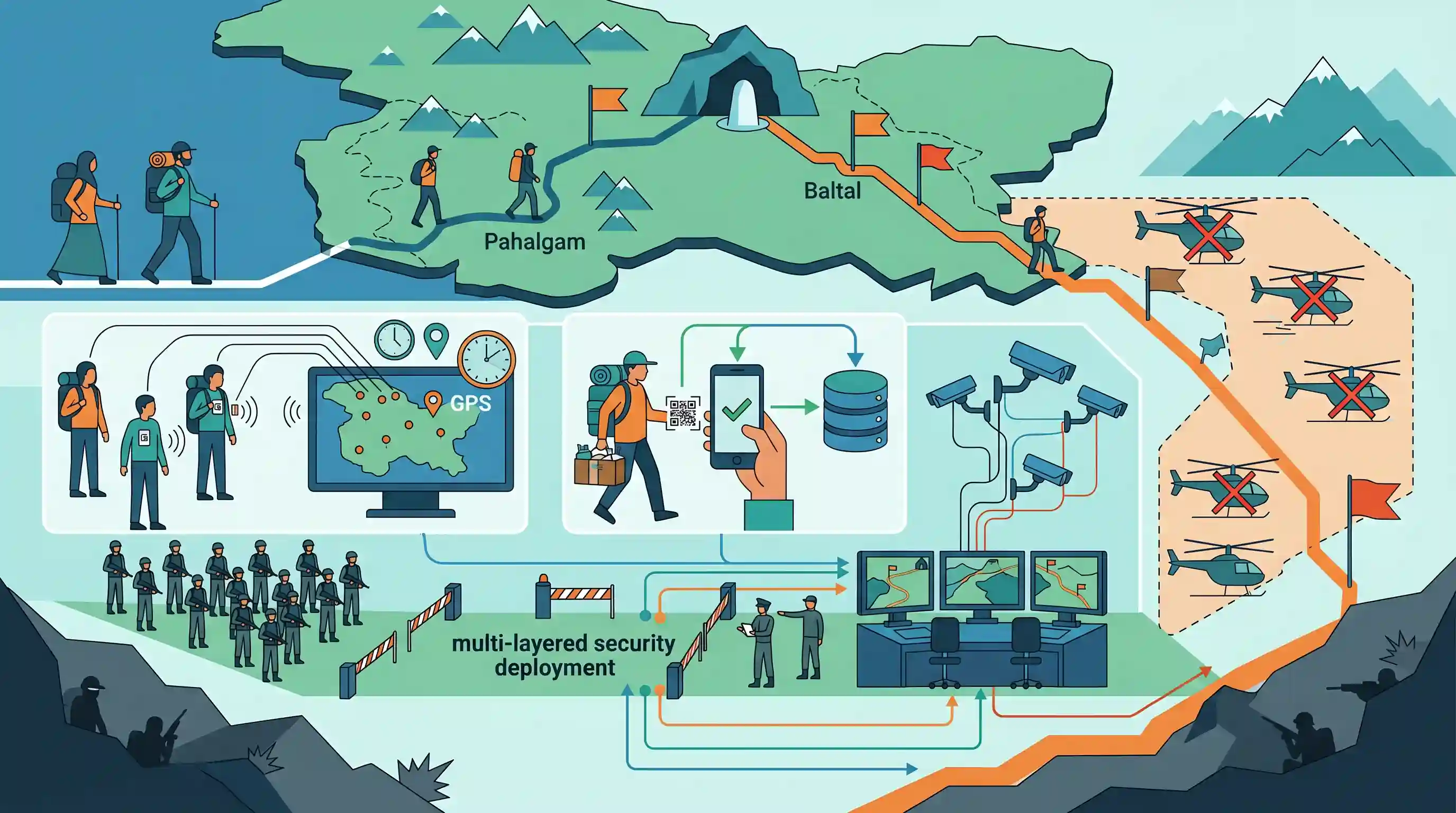
The annual Amarnath Yatra has commenced in Jammu & Kashmir under unprecedented, multi-layered security deployment. The massive security exercise features extensive technological integration, including RFID tags for real-time tracking, tamper-proof QR code-based IDs for local service providers, and a complete CCTV network. Due to security protocols, both pilgrimage routes (Pahalgam and Baltal) have been declared 'no-fly zones,' resulting in the suspension of helicopter services. This high-level security apparatus is a response to persistent terror threats in the region and past incidents targeting tourists.
Key Points
- Unprecedented, multi-layered security arrangements have been implemented for the Amarnath Yatra, J&K's largest annual security exercise, to safeguard nearly 5,000 pilgrims in the initial batch alone.
- Technological surveillance features prominently, including the use of Radio Frequency Identification (RFID) tags for vehicles, pilgrims, and service providers, real-time CCTV monitoring, and tamper-proof QR code-based ID cards for service providers (like pony operators) issued by the J&K Police.
- The entire airspace along the two pilgrimage routes has been designated as a 'no-fly zone' as a security measure, leading the Shri Amarnath Shrine Board (SASB) to suspend helicopter services to the cave shrine for the second consecutive year.
- Pilgrims utilize two primary geographical routes: the traditional, arduous 3-day Pahalgam-Chandanwari-Amarnath trek, and the shorter 14-km Sonamarg-Baltal-Amarnath trek which allows same-day returns.
- The stringent security measures are a direct response to security assessments and past terror attacks, such as the previous incident targeting tourists in the Baisaran valley of Pahalgam.
Important Terms
Shri Amarnath Shrine Board (SASB)

A statutory body constituted under J&K law in 2000, responsible for managing, organizing, and ensuring facilities and security coordination for the annual Amarnath Yatra pilgrimage.
UPSC context
GS Paper I (Culture) and Paper III (Security), testing statutory body administration of large-scale pilgrimage events.
Central Reserve Police Force (CRPF)
India's largest Central Armed Police Force (CAPF) under the Ministry of Home Affairs, serving as the premier national agency for internal security and counter-insurgency operations.
UPSC context
GS Paper III (Internal Security), testing the role and mandates of Central Armed Police Forces in regional stability.
J&K Police
The local law enforcement agency of Jammu and Kashmir, serving as the frontline first responder in counter-terrorism, local intelligence, and law-and-order management.
UPSC context
GS Paper III (Internal Security), testing state-level police dynamics and counter-insurgency cooperation in border regions.
RFID Tracking System
A radio frequency-based tracking mechanism utilizing mandatory digital tags issued to pilgrims to monitor real-time movement, manage crowds, and coordinate emergency responses.
UPSC context
GS Paper III (Technology in Security), testing the integration of modern digital tools to secure high-risk public events.
Baltal and Pahalgam Routes
The two main trekking pathways to the Amarnath Cave; Pahalgam is the longer, gradual traditional route, whereas Baltal is the shorter, steeper, and more challenging route.
UPSC context
GS Paper I (Geography) and Paper III (Security), testing terrain geography and security planning along critical border corridors.
Prelims Trap
The Shri Amarnathji Shrine Board (SASB) is an executive body under the Union Ministry of Home Affairs.
SASB is a statutory body established by the J&K State Legislature in 2000, and is chaired ex-officio by the Lieutenant Governor of J&K.
Static Concepts Connected
What are the key glacial tributaries of the Jhelum River in the Kashmir Valley?
- Lidder River: Originates from Kolahoi Glacier, flows through Pahalgam, and forms a major right-bank tributary of the Jhelum.
- Sindh River: Originates from Machoi Glacier near Zoji La, flows past Baltal and Sonamarg, and joins Jhelum near Shadipora.
How do chemical weathering processes create limestone structures like the Amarnath Cave?
- Carbonation process: Rainwater mixes with carbon dioxide to form carbonic acid, which chemically dissolves the calcium carbonate in Mesozoic limestone.
- Joint control: Percolating acidic water targets fractures and joint systems in the rock, widening them over geological time into natural caverns.
Cross-Topic Patterns
Pilgrimage tourism vs carrying capacity
Mass religious gatherings in ecologically fragile Himalayan zones like J&K test the balance between regional economic growth, disaster preparedness, and environmental carrying capacity.
Asymmetric threats and smart policing
Using RFID, real-time tracking, and QR codes during the Yatra demonstrates the shifting focus toward technology-first solutions to counter Over-Ground Workers and hybrid terrorism.

J&K physical geography (Lidder/Sindh rivers, Zoji La) paired with statutory bodies like SASB likely to feature in Prelims 2026.
Linked PYQs · 3
Linked PYQs · 3
- 2023MainsGS3
The use of unmanned aerial vehicles (UAVs) by our adversaries across the borders to ferry arms/ammunitions, drugs, etc., is a serious threat to the internal security. Comment on the measures being taken to tackle this threat.
- 2021MainsGS3
Analyse the multidimensional challenges posed by external state and non-state actors, to the internal security of India. Also discuss measures required to be taken to combat these threats.
- 2019MainsGS3
The banning of 'Jamaat-e-Islami' in Jammu and Kashmir brought into focus the role of over-ground workers (OGWs) in assisting terrorist organizations. Examine the role played by OGWs in assisting terrorist organizations in insurgency affected areas. Discuss measures to neutralize influence of OGWs.
