Microplastics and Regulatory Gaps in Packaged Drinking Water
Source:The Hindu ↗
Why It Matters
The intersection of environmental pollution (microplastics), public health (endocrine disruptors, PFAS), and governance (FSSAI/BIS standards) makes this a highly relevant topic for UPSC. It highlights the hidden costs of modern consumption habits and the need for dynamic regulatory frameworks to manage emerging health threats and plastic waste.
Summary
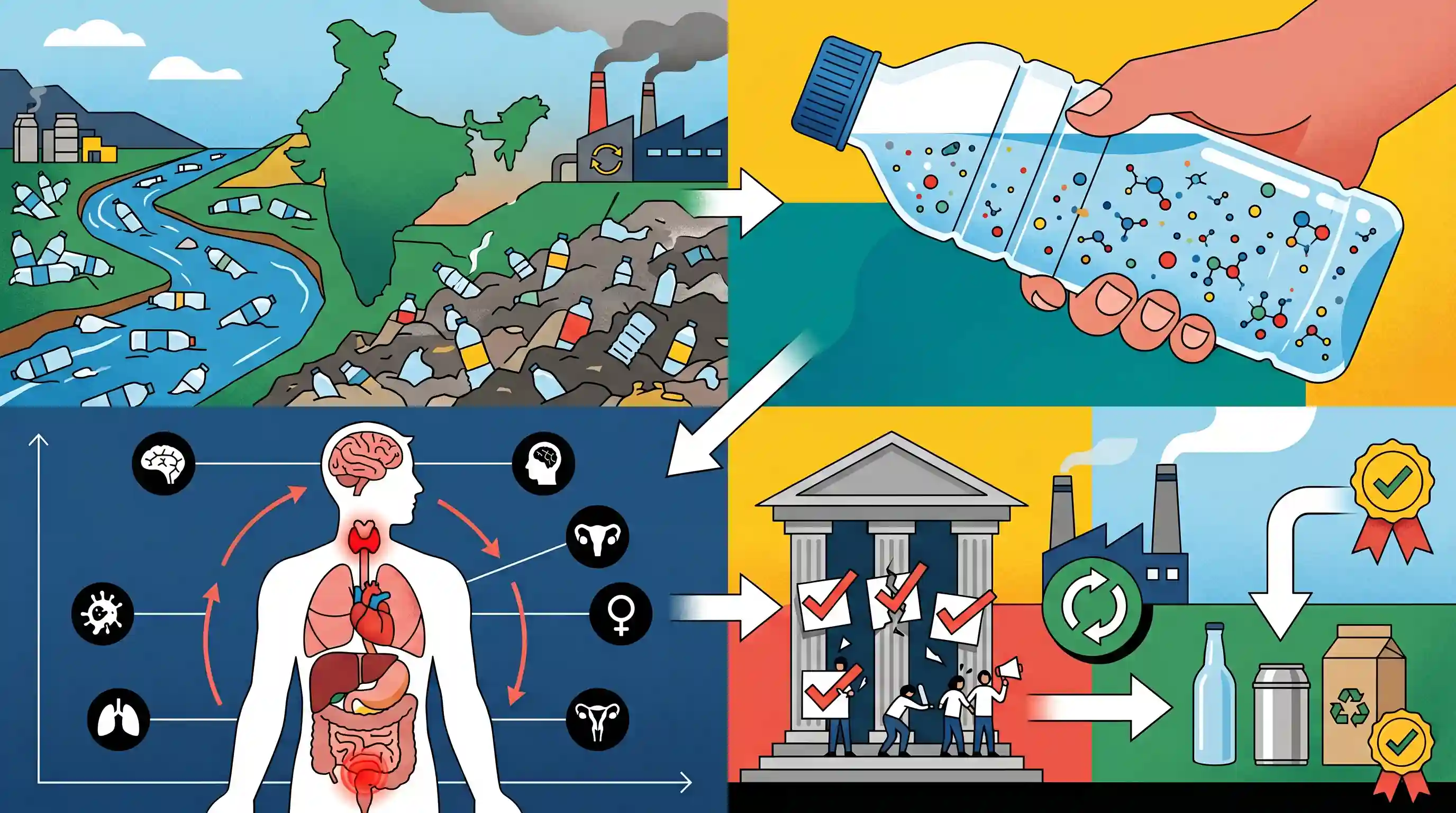
The article critically examines the health and environmental risks associated with bottled water in India, challenging the perception of its safety. It highlights the alarming presence of microplastics, nanoplastics, and leached chemicals like PFAS and BPA in packaged water, which can cause severe long-term health issues including endocrine disruption. The author points out significant gaps in current regulatory frameworks under FSSAI and BIS, which fail to monitor these emerging contaminants. Furthermore, the lifecycle of plastic bottles contributes heavily to the solid waste crisis, emphasizing the need for updated quality standards, stricter Extended Producer Responsibility (EPR) compliance, and a shift towards sustainable packaging.
Key Points
- Packaged drinking water is increasingly found to contain microplastics and nanoplastics, posing risks of cellular damage and endocrine disruption.
- Chemicals such as PFAS (per- and polyfluoroalkyl substances) and bisphenol A (BPA) can leach from plastic packaging into the water, leading to bioaccumulation.
- Current Indian regulatory standards by FSSAI and BIS primarily test for microbial and basic chemical parameters, lacking specific limits for microplastics and modern chemical leachates.
- The massive consumption of bottled water exacerbates the solid waste management crisis, as single-use plastic bottles contribute heavily to environmental pollution.
- Addressing the issue requires updating water safety standards, enforcing Extended Producer Responsibility (EPR), and promoting sustainable alternatives to plastic packaging.
Important Terms
Food Safety and Standards Act, 2006

The consolidated primary law regulating food safety in India. It established the FSSAI and replaced multiple older laws to ensure science-based standards and wholesome food for human consumption.
UPSC context
GS Paper 2: Governance/Laws; GS Paper 3: Food Security. Tests understanding of the regulatory framework governing the food supply chain.
FSSAI (Food Safety and Standards Authority of India)
A statutory body under the Ministry of Health and Family Welfare. It sets food safety standards, licenses food businesses, and recently classified packaged water as a 'Highest Risk Food Category'.
UPSC context
GS Paper 2: Statutory and Regulatory bodies. Critical for topics on public health and food quality monitoring.
BIS (Bureau of Indian Standards)
The National Standards Body of India under the Ministry of Consumer Affairs. It provides quality certifications (ISI mark) and technical specifications for packaged drinking water (e.g., IS:14543).
UPSC context
GS Paper 2: Regulatory bodies. Important for standard-setting and consumer protection frameworks in India.
Plastic Waste Management (Amendment) Rules, 2024
Legislation governing plastic waste, with 2024 amendments tightening 'biodegradable' labeling and mandating that manufacturers ensure their products do not leave microplastics behind during degradation.
UPSC context
GS Paper 3: Environment & Pollution. Vital for waste management, circular economy, and pollution control policies.
Extended Producer Responsibility (EPR)
A policy mandate where producers are responsible for the entire lifecycle of their products, specifically for the collection, recycling, and final disposal of post-consumer waste.
UPSC context
GS Paper 3: Environment/Solid Waste Management. Tests knowledge of the 'polluter pays' principle and circular economy mechanisms.
Microplastics
Solid plastic particles less than 5mm in diameter. They are persistent environmental pollutants that enter the food chain and were recently discovered in human tissues like blood and lungs.
UPSC context
GS Paper 3: Environment/Science & Tech. Concerns ecological health, bioaccumulation, and emerging contaminants in food/water.
Prelims Trap
FSSAI safety standards mandate strict maximum residue limits for microplastics and PFAS in packaged drinking water.
Current FSSAI and BIS standards test for microbial and basic chemical parameters but notably lack specific thresholds for emerging contaminants like microplastics and PFAS.
Static Concepts Connected
What are endocrine-disrupting chemicals (EDCs) like BPA and PFAS?
- Mechanism: Chemicals that mimic, block, or interfere with natural hormones in the body's endocrine system.
- Common Sources: Found in polycarbonate plastics, epoxy resins (BPA), and water-resistant or non-stick commercial products (PFAS).
- Bioaccumulation: They are persistent chemicals that do not break down easily, accumulating over time to cause reproductive and developmental disorders.
What is Extended Producer Responsibility (EPR) under India's Plastic Waste Rules?
- Core Mandate: Makes producers, importers, and brand owners (PIBOs) legally responsible for the end-of-life management of their plastic packaging.
- Key Mechanism: Mandates specific recycling targets and allows the trading of EPR certificates to ensure market-driven compliance.
Cross-Topic Patterns
Forever chemicals & Stockholm Convention
PFAS are globally scrutinized "forever chemicals". Their ongoing assessment and listing under the Stockholm Convention on Persistent Organic Pollutants (POPs) connects domestic water safety to international environmental law.
Urban flooding & PET bottles
Single-use plastic bottles exemplify India's municipal solid waste crisis, frequently clogging storm-water drains and acting as a primary structural driver for seasonal urban flooding in megacities.

A 2026 Prelims question linking 'forever chemicals' (PFAS/BPA), endocrine disruption, and India's EPR or FSSAI limits is highly likely.
Linked PYQs · 5
Linked PYQs · 5
- 2019PrelimsGS1
Why is there a great concern about the 'microbeads' that are released into environment?
- 2024PrelimsGS1
With reference to perfluoroalkyl and polyfluoroalkyl substances (PFAS) that are used in making many consumer products, consider the following statements : 1. PFAS are found to be widespread in drinking water, food and food packaging materials. 2. PFAS are not easily degraded in the environment. 3. Persistent exposure to PFAS can lead to bioaccumulation in animal bodies. Which of the statements given above are correct?
- 2018PrelimsGS1
Consider the following statements: 1. The Food Safety and Standards Act, 2006 replaced the Prevention of Food Adulteration Act, 1954. 2. The Food Safety and Standards Authority of India (FSSAI) is under the charge of Director General of Health Services in the Union Ministry of Health and Family Welfare. Which of the statements given above is/are correct?
- 2017PrelimsGS1
Consider the following statements: 1. The Standard Mark of Bureau of Indian Standards (BIS) is mandatory for automotive tyres and tubes. 2. AGMARK is a quality Certification Mark issued by the Food and Agriculture Organisation (FAO). Which of the statements given above is/are correct?
- 2018MainsGS3
What are the impediments in disposing the huge quantities of discarded solid wastes which are continuously being generated? How do we remove safely the toxic wastes that have been accumulating in our habitable environment?
