Agro climatic zone based agricultural planning and crop roadmaps
Source:Indian Express ↗
Why It Matters
The strategic shift toward agro-climatic zone-based planning addresses structural issues in Indian agriculture by aligning cropping patterns with ecological suitability, ensuring better yields and climate resilience. The article also provides concrete examples of agricultural export success (Basmati rice) and key safety net schemes (PM-Kisan, PMFBY, MSP), which are recurring themes in GS3 Mains and Prelims.
Summary
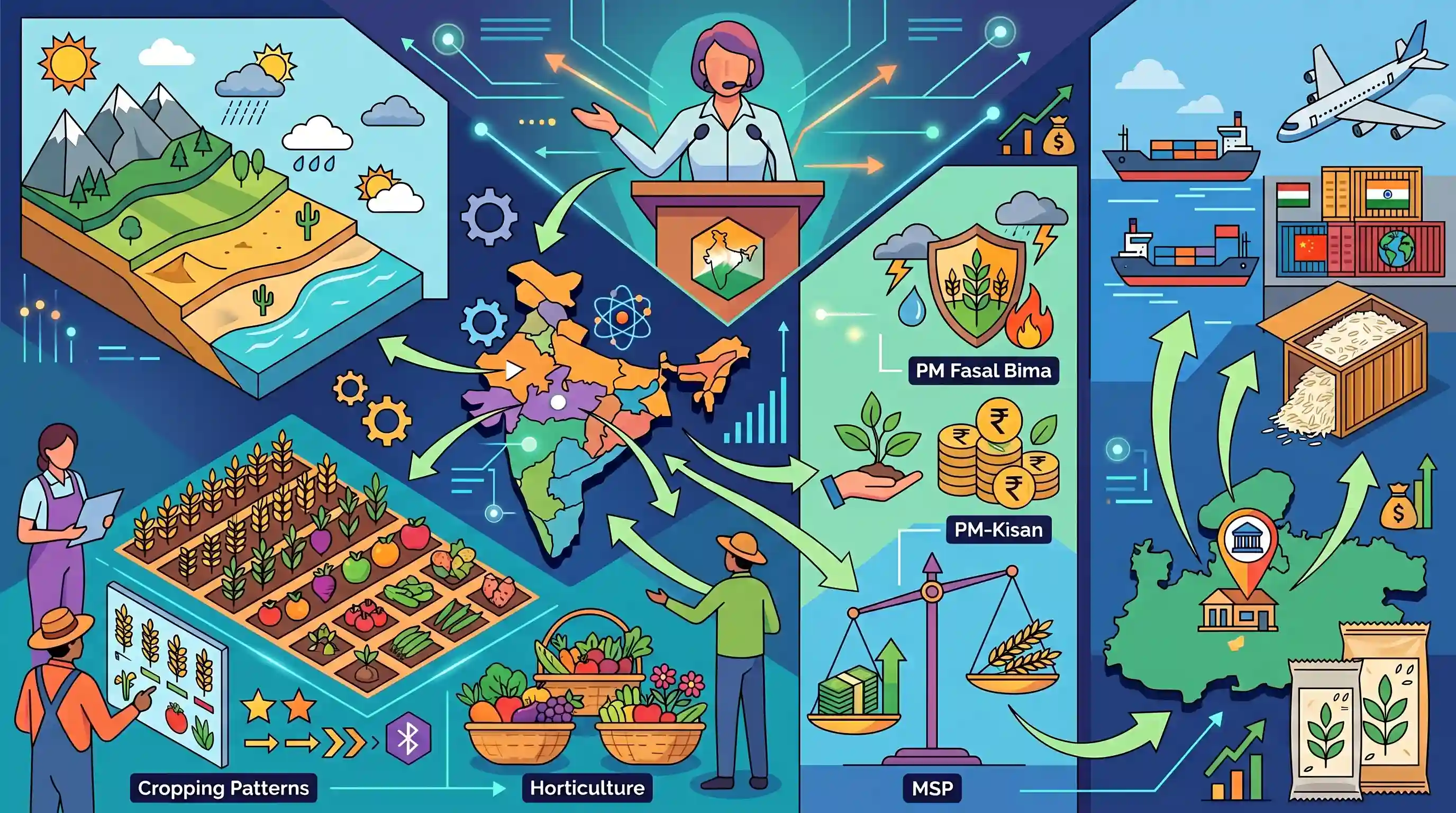
Union Agriculture Minister Shivraj Singh Chouhan announced at the Unnat Krishi Mahotsav in Madhya Pradesh that the Centre is developing state-wise agricultural roadmaps tailored to specific agro-climatic zones. These scientific frameworks will guide farmers on optimal cropping patterns, high-yield seeds, and horticulture. The event also highlighted the impact of central schemes like PM-Kisan, PM Fasal Bima Yojana, and rising MSPs, alongside Madhya Pradesh's success in agricultural exports, particularly basmati rice from Raisen.
Key Points
- The Centre is developing state-wise, data-backed agricultural roadmaps based on regional agro-climatic conditions to optimize farming outcomes.
- These roadmaps will prescribe suitable crops, horticultural varieties, pulse crops, and high-yield seeds for specific zones.
- An initial roadmap for four Madhya Pradesh districts (Raisen, Dewas, Sehore, and Vidisha) was unveiled at the 'Unnat Krishi Mahotsav' farm fair.
- The government reinforced its commitment to agricultural welfare through initiatives like PM-Kisan (Rs 6,000/year), PM Fasal Bima Yojana, and regular increases in Minimum Support Price (MSP).
- Agricultural export success was highlighted, noting that Raisen district alone exports basmati rice to 47 countries.
Important Terms
PM-KISAN (Pradhan Mantri Kisan Samman Nidhi)

A Central Sector Scheme providing ₹6,000 annual income support in three equal installments to all landholding farmer families across India via Direct Benefit Transfer.
UPSC context
GS III: Agriculture/Subsidies. Tests knowledge of direct income support mechanisms and digital welfare delivery.
Pradhan Mantri Fasal Bima Yojana (PMFBY)
A government-backed crop insurance scheme providing financial protection against yield losses from natural calamities, pests, or diseases, with capped premiums (2% Kharif, 1.5% Rabi).
UPSC context
GS III: Agriculture/Insurance. Tests risk mitigation strategies and agricultural credit stabilization.
Minimum Support Price (MSP)
A price safety net where the government guarantees procurement of 22 mandated crops to protect farmers from market price volatility and ensure food security.
UPSC context
GS III: Economics/Agriculture. Tests price discovery, procurement policy, and its impact on cropping patterns.
Agro-Climatic Zones
A land unit defined by major climate characteristics (rainfall, temperature) suitable for specific crops. India is divided into 15 such zones for regional planning.
UPSC context
GS I: Geography/GS III: Agriculture. Tests scientific land-use planning and climate-resilient farming.
Agricultural Roadmaps
Scientific, data-backed blueprints designed for states and districts to provide end-to-end guidance on optimal crops, seeds, and market linkages based on regional conditions.
UPSC context
GS III: Government Policies. Tests decentralized, science-led interventions and cooperative federalism in agriculture.
Prelims Trap
"Madhya Pradesh holds the Geographical Indication (GI) tag for Basmati rice exports."
MP grows and exports aromatic rice, but APEDA restricts the official Basmati GI tag to seven states/UTs in the Indo-Gangetic Plains to preserve its heritage. MP is excluded.
Static Concepts Connected
How are Agro-Climatic Zones delineated in India?
- Origin: Introduced by the Planning Commission in 1989 (7th Five-Year Plan) to optimize regional agricultural planning.
- Criteria: Based on major climates, soil types, rainfall, temperature, and water availability.
- Total Zones: India is divided into 15 broad agro-climatic zones (e.g., Western Himalayan, Lower Gangetic Plain).
What are the premium structures under PM Fasal Bima Yojana?
- Kharif Crops: Farmers pay a maximum premium of 2% of the sum insured.
- Rabi Crops: Capped at 1.5% to encourage winter crop insurance coverage.
- Commercial / Horticulture: Fixed at a maximum of 5% for annual commercial and horticultural crops.
Cross-Topic Patterns
MSP procurement vs. Resource Mapping
MSP's historical bias towards paddy and wheat contradicts agro-climatic roadmaps, heavily skewing natural cropping patterns and exacerbating groundwater depletion in semi-arid zones.
Expansion of PM-Kisan scope
Initially for small/marginal farmers (up to 2ha), PM-Kisan was expanded to all landholding farmers, reflecting a shift towards universal income-support models over targeted input subsidies.

Expect a 2026 multi-statement question linking agro-climatic zones, MSP-induced crop distortions, and APEDA's Basmati GI restrictions.
Linked PYQs · 5
Linked PYQs · 5
- 2023MainsGS3
Explain the changes in cropping pattern in India in the context of changes in consumption pattern and marketing conditions.
- 2018MainsGS3
What do you mean by Minimum Support Price (MSP)? How will MSP rescue the farmers from the low income trap?
- 2016MainsGS3
Given the vulnerability of Indian agriculture to vagaries of nature, discuss the need for crop insurance and bring out the salient features of the Pradhan Mantri Fasal Bima Yojana (PMFBY).
- 2019PrelimsGS1
The economic cost of food grains to the Food Corporation of India is Minimum Support Price and bonus (if any) paid to the farmers plus
- 2018PrelimsGS1
Consider the following: 1. Areca nut 2. Barley 3. Coffee 4. Finger millet 5. Groundnut 6. Sesamum 7. Turmeric The Cabinet Committee on Economic Affairs has announced the Minimum Support Price for which of the above?
