Sengar approaches Supreme Court seeking bail in custodial death case
Source:The Hindu ↗
Why It Matters
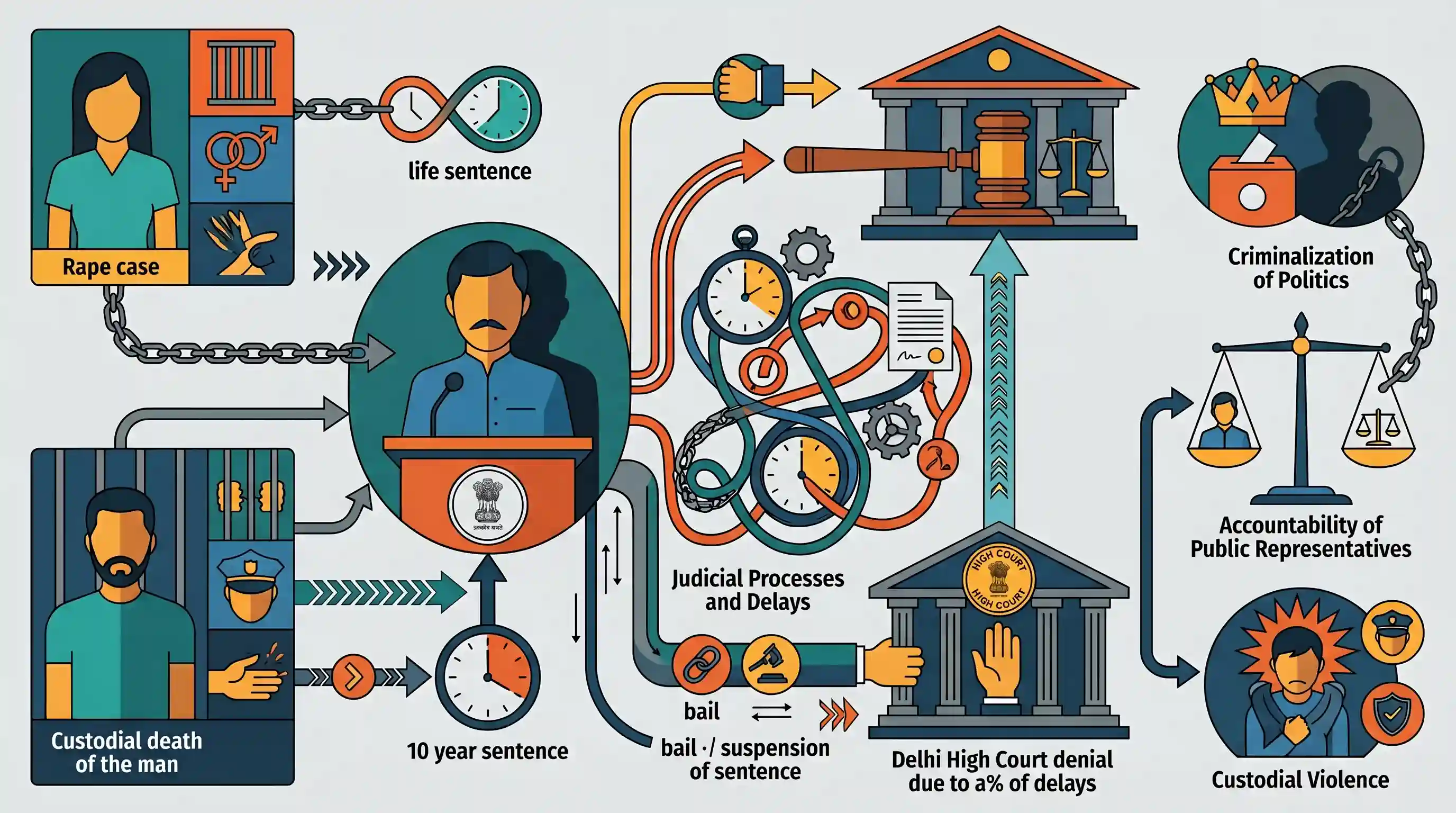
This case exemplifies the deep-rooted issues of political influence within the criminal justice system, shedding light on trial delays deliberately caused by powerful individuals and the severe problem of custodial violence. It also connects to the disqualification of elected representatives upon conviction.
Summary
The Supreme Court will hear the bail plea of expelled MLA Kuldeep Singh Sengar regarding the custodial death of the Unnao rape survivor's father. Sengar was previously sentenced to 10 years' imprisonment for culpable homicide. The Delhi High Court had declined to suspend his sentence, noting that trial delays were largely caused by his own legal tactics. Sengar is also serving a life sentence in the main rape case, bringing attention to the intersection of political influence, trial delays, and custodial violence in the criminal justice system.
Key Points
- The Supreme Court is set to hear a bail plea by expelled BJP leader Kuldeep Singh Sengar regarding his 10-year conviction in the custodial death case of the Unnao rape survivor's father.
- A trial court previously sentenced Sengar to 10 years of rigorous imprisonment for culpable homicide not amounting to murder, though he was acquitted of the murder charge.
- The Delhi High Court had earlier refused to suspend Sengar's sentence, attributing trial delays directly to the multiple applications filed by him.
- Sengar is concurrently challenging his conviction and life sentence in the primary Unnao rape case, highlighting the complex legal battles and judicial delays involving politically influential figures.
Important Terms
Criminalization of Politics

The involvement of individuals with criminal backgrounds or pending criminal cases in the electoral process and holding positions of political power.
UPSC context
GS Paper II: Polity/Governance. Tests understanding of electoral reforms, the crime-politics nexus, and the threat to democratic integrity.
Custodial Death
The death of an individual while in the custody of police or judicial authorities, often resulting from torture, negligence, or excessive force.
UPSC context
GS Paper II & IV: Human Rights/Ethics. Relates to Article 21, police reforms, and landmark D.K. Basu case guidelines.
Representation of the People Act, 1951
The primary law governing elections in India, including the qualifications and automatic disqualification of legislators upon conviction for specific offenses.
UPSC context
GS Paper II: Parliament/Elections. Significant for understanding disqualification rules (Section 8) and the Lily Thomas judgment.
Judicial Delay
The prolonged time taken to resolve legal cases, often caused by high pendency, judge vacancies, and tactical delays by litigants.
UPSC context
GS Paper II: Judiciary. Concerns justice delivery, the 'justice delayed is justice denied' principle, and the need for structural reforms.
Supreme Court of India
The highest court in India, serving as the final appellate authority and the ultimate protector of Fundamental Rights under the Constitution.
UPSC context
GS Paper II: Indian Constitution. Core topic regarding the judiciary's powers, judicial review, and the separation of powers.
Culpable Homicide
A legal classification of killing where the perpetrator intends to cause death or fatal injury, but without the specific premeditation of murder.
UPSC context
GS Paper II: Criminal Justice System. Relevant for understanding legal nuances in high-profile criminal cases involving public figures.
Prelims Trap
Convicted lawmakers can retain their seats if they appeal to a higher court within three months of conviction.
The Supreme Court struck down Section 8(4) of the RPA in the 2013 Lily Thomas case, making disqualification for a sentence of ≥2 years immediate.
Static Concepts Connected
What are the rules for disqualifying convicted legislators under the RPA?
- Section 8(3) Rule: Lawmakers sentenced to at least two years' imprisonment are automatically disqualified and remain so for six years after their release.
- Lily Thomas Judgment: Struck down the three-month appeal window, meaning disqualification takes immediate effect upon conviction unless a higher court stays the conviction itself.
What are the procedural mandates for handling custodial deaths?
- NHRC 24-hour Rule: Law enforcement agencies must report every instance of a custodial death or rape to the National Human Rights Commission within 24 hours of occurrence.
- Magisterial Inquiry: Under the law (formerly Section 176(1A) CrPC), a judicial magistrate must conduct a mandatory inquiry into cases of death, disappearance, or rape in police custody.
Cross-Topic Patterns
Speedy Trial vs. Delay Tactics
While a speedy trial is an Article 21 right (Hussainara Khatoon), courts deny bail or sentence suspension if the accused deliberately manufactures trial delays through frivolous applications.
Criminalization of Politics & Special Courts
SC-directed Special Courts for MPs/MLAs aim to curb political influence in trials, yet politically connected accused still exploit systemic procedural bottlenecks to stall justice.

Expect a prelims statement mixing RPA 1951 disqualification criteria (Section 8) with the effects of appellate conviction stays.
Linked PYQs · 2
Linked PYQs · 2
- 2019MainsGS2
On what grounds a people's representative can be disqualified under the Representation of Peoples Act, 1951? Also mention the remedies available to such person against his disqualification.
- 2021MainsGS2
Though the Human Rights Commissions have contributed immensely to the protection of human rights in India, yet they have failed to assert themselves against the mighty and powerful. Analyzing their structural and practical limitations, suggest remedial measures.
