POCSO Act Interpretation and Public Servant Status
Source:The Hindu ↗
Why It Matters
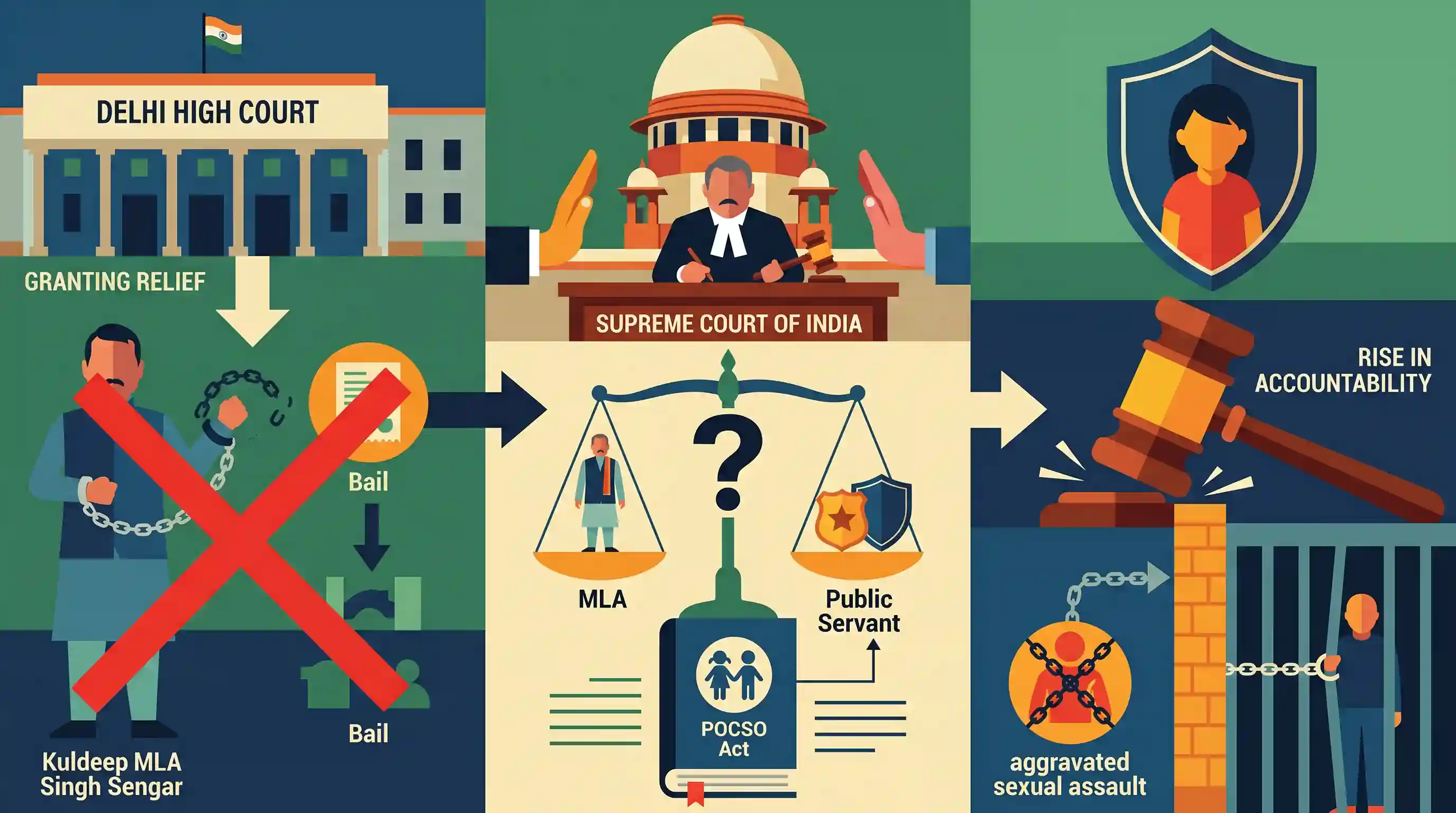
This case is important for its legal interpretation of the POCSO Act and the definition of a 'public servant'. Establishing whether elected legislators fall under this definition impacts their legal accountability, especially concerning crimes against vulnerable groups (aggravated sexual assault). It also underscores the appellate jurisdiction of the Supreme Court in overseeing bail and sentence-suspension jurisprudence in grave criminal offenses.
Summary
The Supreme Court has set aside a Delhi High Court order that granted bail and suspended the life sentence of former BJP MLA Kuldeep Singh Sengar in the 2017 Unnao rape case. Remanding the matter for a fresh hearing, the Supreme Court is set to examine a broader legal question: whether a Member of the Legislative Assembly (MLA) qualifies as a 'public servant' under the Protection of Children from Sexual Offences (POCSO) Act. The Delhi High Court had previously ruled that an MLA does not hold a dominant position or fall under the 'public servant' definition of the Act. Reversing this interpretation would allow legislators to be charged with 'aggravated sexual assault', ensuring stricter accountability.
Key Points
- The Supreme Court stayed the Delhi High Court's order that had granted bail and suspended the sentence of former MLA Kuldeep Singh Sengar in the 2017 Unnao rape case.
- The SC directed the Delhi High Court to hear the suspension of sentence issue afresh, ensuring all parties including the victim's counsel are heard.
- A critical legal issue being examined by the Supreme Court is whether an MLA can be classified as a 'public servant' under Section 5(c) of the POCSO Act.
- If deemed a public servant, a legislator accused of sexual assault could face harsher penalties under the 'aggravated sexual assault' category for exploiting a dominant position.
Important Terms
Protection of Children from Sexual Offences (POCSO) Act, 2012

A 2012 gender-neutral law enacted to protect individuals under 18 from sexual abuse and exploitation, mandating child-friendly reporting, investigation, and speedy trials through Special Courts.
UPSC context
GS Paper II: Social Justice; tests knowledge of legislative measures for protecting vulnerable sections.
Public Servant
Legal status usually defined under IPC Section 21; the Supreme Court is reviewing if MLAs/MPs qualify under POCSO to hold legislators accountable for 'aggravated' crimes.
UPSC context
GS Paper II: Governance and Judiciary; concerns statutory interpretation and the accountability of elected representatives.
Aggravated Penetrative Sexual Assault
A severe category of offence under Section 5 of the POCSO Act involving authority figures (e.g., police, public servants), carrying harsher minimum penalties including life imprisonment or death.
UPSC context
GS Paper II: Social Justice; tests understanding of specialized criminal law provisions for child safety.
Supreme Court of India
India's apex court and final interpreter of the Constitution; it exercises original, appellate, and advisory jurisdictions to ensure the rule of law and protect fundamental rights.
UPSC context
GS Paper II: Judiciary; essential for topics on judicial review, appellate powers, and constitutional protection.
Central Bureau of Investigation (CBI)
The premier central investigative agency under the Ministry of Personnel, responsible for investigating high-profile corruption, economic offences, and complex crimes of national importance.
UPSC context
GS Paper II: Statutory/Regulatory Bodies; focuses on federalism and the role of central agencies in criminal justice.
Prelims Trap
Members of Parliament and MLAs are explicitly defined as 'public servants' under Section 21 of the Indian Penal Code.
IPC Section 21 does not explicitly list MPs or MLAs. Their status as public servants is established under the Prevention of Corruption Act and judicial interpretation, not explicit IPC text.
Static Concepts Connected
How is a 'public servant' defined under Indian criminal law?
- IPC Section 21: Lists specific categories like judges, military officers, and government employees, but does not explicitly name Members of Parliament or MLAs.
- Prevention of Corruption Act: Broadens the scope significantly to include anyone holding an office authorized or required to perform a public duty.
- Judicial stance: The SC affirmed MPs/MLAs are public servants under PCA (Sita Soren case, 2024), but whether this broader definition imports into POCSO is currently under review.
What makes an offense 'aggravated' under the POCSO Act?
- Position of Trust: Applies when the offender is a public servant, police officer, armed forces member, teacher, or relative exploiting their dominant position over the child.
- Enhanced Penalty: Attracts stringent minimum sentencing of 20 years to life imprisonment, or the death penalty (the latter introduced via the 2019 POCSO Amendment).
Cross-Topic Patterns
Parliamentary privilege vs. criminal liability
The shift from the P.V. Narasimha Rao judgment to Sita Soren shows a clear judicial trend: stripping legislative immunity for criminal acts, now extending beyond corruption to sexual offenses.
Borrowed definitions in special laws
Special statutes like POCSO often rely on the 1860 IPC for core definitions. As governance evolves, these static borrowed clauses trigger significant constitutional interpretation battles at the Supreme Court.

Expect a 2026 prelims question contrasting 'Public Servant' definitions in IPC vs PCA, testing the Sita Soren judgment's wider application.
Linked PYQs · 3
Linked PYQs · 3
- 2023MainsGS2
Explain the constitutional perspectives of Gender Justice with the help of relevant Constitutional Provisions and case laws.
- 2025MainsGS2
The National Commission for Protection of Child Rights has to address the challenges faced by children in the digital era. Examine the existing policies and suggest measures the Commission can initiate to tackle the issue.
- 2020MainsGS2
There is a need for simplification of procedure for disqualification of persons found guilty of corrupt practices under the Representation of Peoples Act". Comment.
