India Africa economic partnership deepens through digital DPI
Source:The Hindu ↗
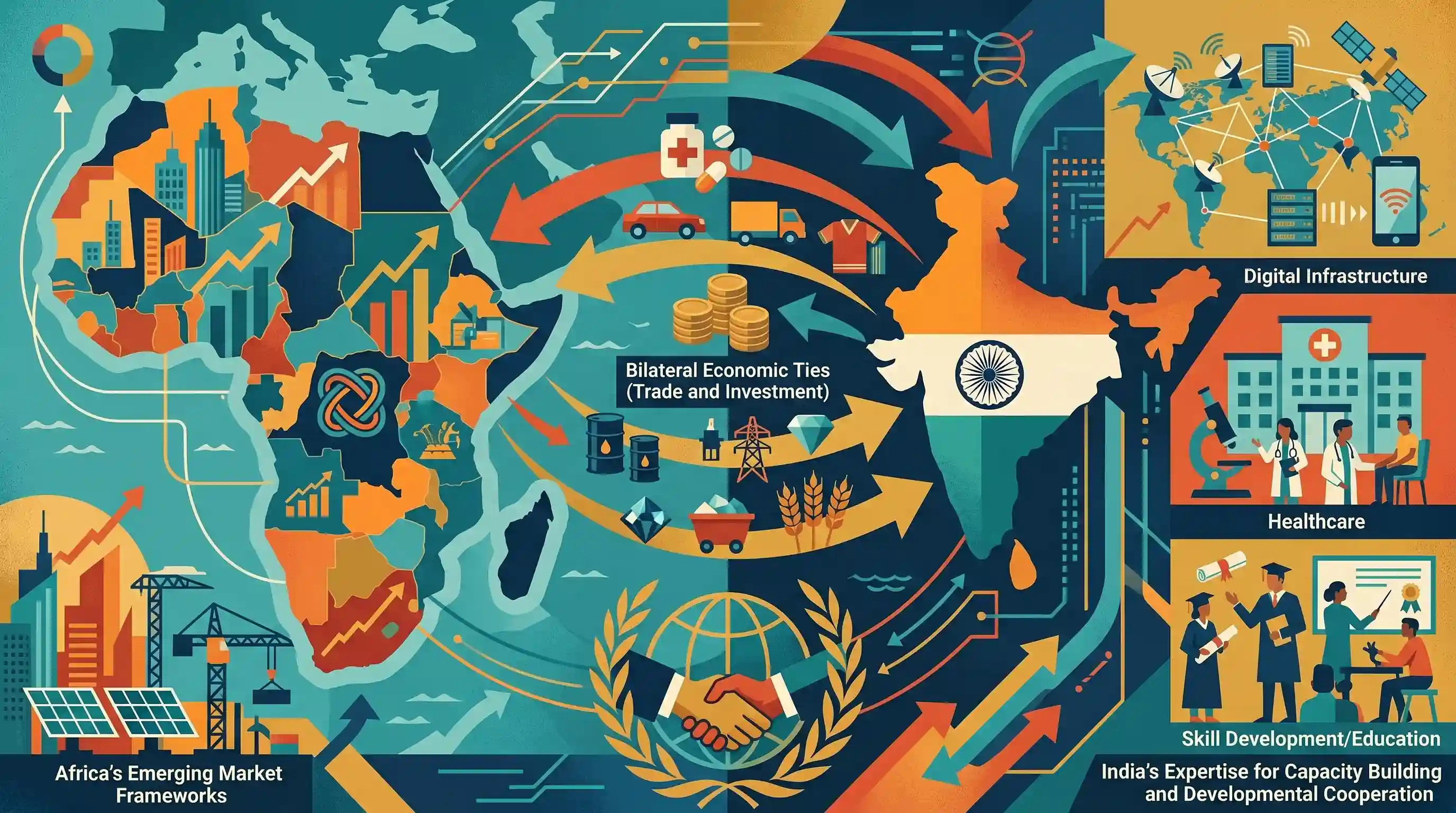
Why It Matters
Africa is a key geopolitical and economic partner for India. Understanding the nuances of India's economic diplomacy, trade policies (like DFTP), and developmental partnerships in Africa is crucial for GS2 International Relations, particularly in the context of South-South cooperation and balancing China's influence.
Summary
The article discusses the vast potential for deepening economic ties between India and Africa, highlighting mutual benefits rooted in trade, investment, and developmental cooperation. It emphasizes that leveraging Africa's emerging market frameworks, alongside India's expertise in sectors like digital infrastructure, healthcare, and capacity building, is critical for achieving robust economic growth and reinforcing Global South solidarity.
Key Points
- Africa's evolving economic landscape, driven by its demographic dividend and the African Continental Free Trade Area (AfCFTA), offers significant trade and investment opportunities for India.
- India's developmental cooperation in Africa emphasizes capacity building, healthcare, agriculture, digital public infrastructure, and lines of credit.
- Private sector investment and deepening bilateral trade are foundational to counterbalancing other geopolitical actors and ensuring mutual growth.
- Strengthening India-Africa ties is central to advancing the collective economic and strategic interests of the Global South on international platforms.
Important Terms
African Continental Free Trade Area (AfCFTA)

A trade agreement among 54 African Union nations creating a single continental market for goods and services to boost intra-African trade and economic integration.
UPSC context
GS Paper II & III; crucial for understanding Africa's economic trajectory and India's trade opportunities within the world's largest free-trade zone.
Duty Free Tariff Preference (DFTP) Scheme
India's unilateral, non-reciprocal scheme providing duty-free and preferential market access to 98.2% of product categories from Least Developed Countries (LDCs) since 2008.
UPSC context
GS Paper II & III; a key policy tool for South-South cooperation and India's developmental partnership with African LDCs.
African Union (AU)
A 55-member continental body of African states that recently became a permanent G20 member during India's 2023 presidency, representing African political and economic interests.
UPSC context
GS Paper II; significant for studying multilateral groupings and India's advocacy for inclusive global governance and African representation.
Global South
A geopolitical term for developing and underdeveloped nations in Asia, Africa, and Latin America, sharing historical experiences of colonialism and current developmental challenges.
UPSC context
GS Paper II; central to India's foreign policy as a leader of developing nations and its "Voice of Global South" initiative.
Prelims Trap
"India's Duty-Free Tariff Preference (DFTP) scheme is an exclusive trade agreement for African nations."
DFTP is a unilateral scheme by India for ALL Least Developed Countries (LDCs) globally, not just African nations. Currently, 33 of the beneficiary LDCs happen to be in Africa.
Static Concepts Connected
What is the Duty Free Tariff Preference (DFTP) scheme?
- Origin: Initiated by India in 2008 following the WTO's Hong Kong Ministerial Declaration (2005) to assist developing economies.
- Coverage: Grants duty-free access on 98.2% of India's total tariff lines to globally recognized Least Developed Countries (LDCs).
- Significance: Demonstrates South-South solidarity by integrating LDCs into the global trading system without demanding reciprocal market access.
What are India's primary developmental assistance tools in Africa?
- Lines of Credit (LoCs): Concessional loans provided via EXIM Bank for infrastructure and capacity-building projects, without the aggressive collateral conditions seen in other bilateral lending.
- ITEC Program: The Indian Technical and Economic Cooperation (ITEC) program is a fully funded bilateral assistance initiative focusing on skill development for professionals.
- DPI Sharing: Offering open-source digital public infrastructure (like MOSIP for foundational digital ID) to foster co-development rather than mere technology transfer.
Cross-Topic Patterns
DPI as a Geopolitical Counterweight
India's export of open-source Digital Public Infrastructure (UPI, MOSIP) serves as a strategic counter to China's debt-heavy Belt and Road Initiative (BRI), offering scalable, sovereign alternatives to the Global South.
Energy Security via African Minerals
India-Africa economic ties are increasingly intersecting with the clean energy transition, as India seeks resilient supply chains for critical minerals (cobalt, lithium) from resource-rich African geographies to fuel its EV ambitions.

Expect a 2026 Prelims multi-statement question linking India's Duty-Free Tariff Preference (DFTP) scheme with its DPI outreach.
Linked PYQs · 3
Linked PYQs · 3
- 2025MainsGS2
India-Africa digital partnership is achieving mutual respect, co-development and long-term institutional partnerships. Elaborate.
- 2021MainsGS2
If the last few decades were of Asia's growth story, the next few are expected to be of Africa's.” In the light of this statement, examine India's influence in Africa in recent years.
- 2015MainsGS2
Increasing interest of India in Africa has its pros and cons. Critically examine.
