Public procurement reforms drive domestic innovation and startups
Source:The Hindu ↗
Why It Matters
Public procurement reforms are a critical policy tool for the government to stimulate economic growth, promote transparency, and support domestic innovation. Understanding the intersection of government spending (GeM, GFR) and industrial policy (Make in India) is vital for GS2 (Governance) and GS3 (Economy/S&T).
Summary
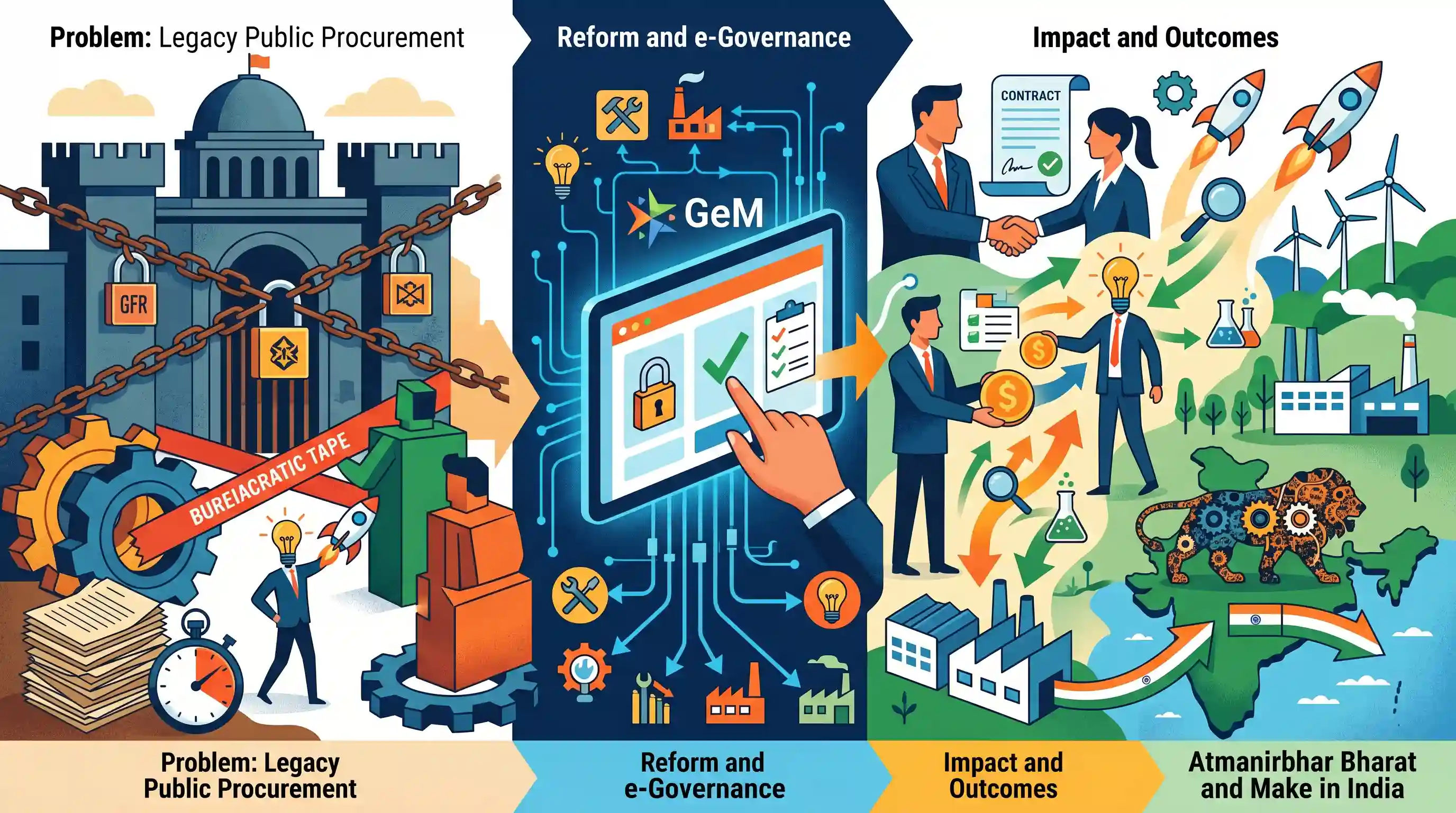
The article highlights the transformative potential of overhauling India's public procurement system to foster domestic innovation. With government purchasing forming a large segment of the GDP, legacy policies like the General Financial Rules (GFR) have historically favored established firms by demanding extensive prior experience and high turnover, thereby locking out agile startups. The piece advocates for procurement reforms, such as easing entry barriers, prioritizing outcome-based contracting, and expanding the use of the Government e-Marketplace (GeM). By functioning as an early adopter and reliable buyer, the government can effectively stimulate research and development, empower startups, and accelerate the realization of Make in India and Atmanirbhar Bharat.
Key Points
- Public procurement accounts for a substantial portion of India's GDP, providing massive leverage to shape industrial policy and drive economic growth.
- Legacy procurement frameworks like the General Financial Rules (GFR) often stipulate rigid prior turnover and experience criteria, unintentionally excluding startups and MSMEs.
- Strategic reforms, including leveraging the Government e-Marketplace (GeM) and adopting outcome-based contracting, can transform the state into a crucial early adopter of novel indigenous technologies.
- Aligning procurement practices with national campaigns like Make in India and Atmanirbhar Bharat is essential to stimulate domestic R&D and foster a robust innovation ecosystem.
Important Terms
Public Procurement

Process by which government bodies purchase goods/services from the private sector using public funds. It accounts for ~20-22% of India’s GDP, acting as a powerful lever for industrial policy.
UPSC context
GS Paper 3 (Economy); tests understanding of industrial policy, fiscal transparency, and state market-shaping.
General Financial Rules (GFR)
Executive instructions by the Ministry of Finance governing public finance management. Recent revisions (like GFR 2017/2025) aim to ease entry barriers for startups and R&D-intensive firms.
UPSC context
GS Paper 2 (Governance); critical for administrative transparency, accountability, and financial reforms.
Government e-Marketplace (GeM)
A contactless, paperless, and cashless online portal launched in 2016 for end-to-end procurement of common-use goods and services by government departments, ministries, and PSUs.
UPSC context
GS Paper 2 (e-Governance); highlights digital transformation and efficiency in public spending.
Atmanirbhar Bharat
A 2020 policy mission for self-reliance based on five pillars: Economy, Infrastructure, System, Demography, and Demand. It emphasizes "Vocal for Local" and domestic value chain strengthening.
UPSC context
GS Paper 3 (Economy); core theme for questions on self-sufficiency and post-pandemic recovery.
Make in India
A flagship program launched in 2014 to transform India into a global manufacturing hub. It focuses on 27 sectors to boost investment, foster innovation, and build world-class infrastructure.
UPSC context
GS Paper 3 (Industrial Growth); relevant for manufacturing, FDI, and Ease of Doing Business.
MSMEs (Micro, Small, and Medium Enterprises)
Enterprises classified by investment and turnover limits. They contribute ~30% to India's GDP and are vital for inclusive growth and employment in semi-urban areas.
UPSC context
GS Paper 3 (Economy); central to discussions on industrial policy, employment, and exports.
Prelims Trap
"Global Tender Enquiries (GTE) are completely banned in India to promote the Atmanirbhar Bharat initiative."
Global Tender Enquiries (GTE) are not banned universally. They are merely disallowed for government procurements valued up to ₹200 crore to protect MSMEs.
Static Concepts Connected
What are the core features and mandates of the Government e-Marketplace (GeM)?
- Nodal Agency: Administered by the Ministry of Commerce and Industry as a Special Purpose Vehicle (SPV).
- Mandatory Usage: Under Rule 149 of the General Financial Rules (GFR), procuring common-use goods/services via GeM is mandatory for all Central Ministries.
- Startup Exemptions: Exempts DPIIT-recognized startups from prior experience, prior turnover criteria, and Earnest Money Deposits (EMD) to boost participation.
How does the Public Procurement Order 2017 classify local suppliers?
- Class-I Supplier: Suppliers whose goods/services have equal to or more than 50% local content. They receive maximum purchase preference.
- Class-II Supplier: Suppliers with local content between 20% and 50%. They are eligible to bid but enjoy lower purchase preference.
- Non-local Supplier: Suppliers with less than 20% local content. They are generally excluded from participating in preferred domestic tenders.
Cross-Topic Patterns
Public Procurement & WTO GPA constraints
India is an observer, not a signatory, to the WTO Agreement on Government Procurement (GPA). This allows India to legally retain domestic preferential policies like Make in India without violating WTO commitments.
E-governance curbing bureaucratic rent-seeking
GeM exemplifies how disintermediation via technology reduces bureaucratic discretion and rent-seeking in public contracts, acting as a practical case study for GS-4 (Probity in Governance) and GS-2 (E-Governance).

Expect a Prelims question combining GeM's mandatory nature under GFR, DPIIT startup exemptions, and the ₹200 crore GTE limit.
Linked PYQs · 3
Linked PYQs · 3
- 2023MainsGS3
What is the status of digitalization in the Indian economy? Examine the problems faced in this regard and suggest improvements.
- 2023MainsGS2
e-governance, as a critical tool of governance, has ushered in effectiveness, transparency and accountability in governments. What inadequacies hamper the enhancement of these features ?
- 2024MainsGS2
e-governance is not just about the routine application of digital technology in service delivery process. It is as much about multifarious interactions for ensuring transparency and accountability. In this context evaluate the role of the 'Interactive Service Model' of e-governance.
