Agricultural Productivity Enhancement on Forest Rights Act Lands
Source:The Hindu ↗
हे का महत्त्वाचे आहे
The article bridges the gap between legal rights implementation (FRA, 2006) and economic empowerment (agricultural productivity, credit access, and livelihood security for tribal communities), aligning closely with GS3 (Inclusive Growth and Agriculture) and GS2 (Welfare Schemes).
सारांश
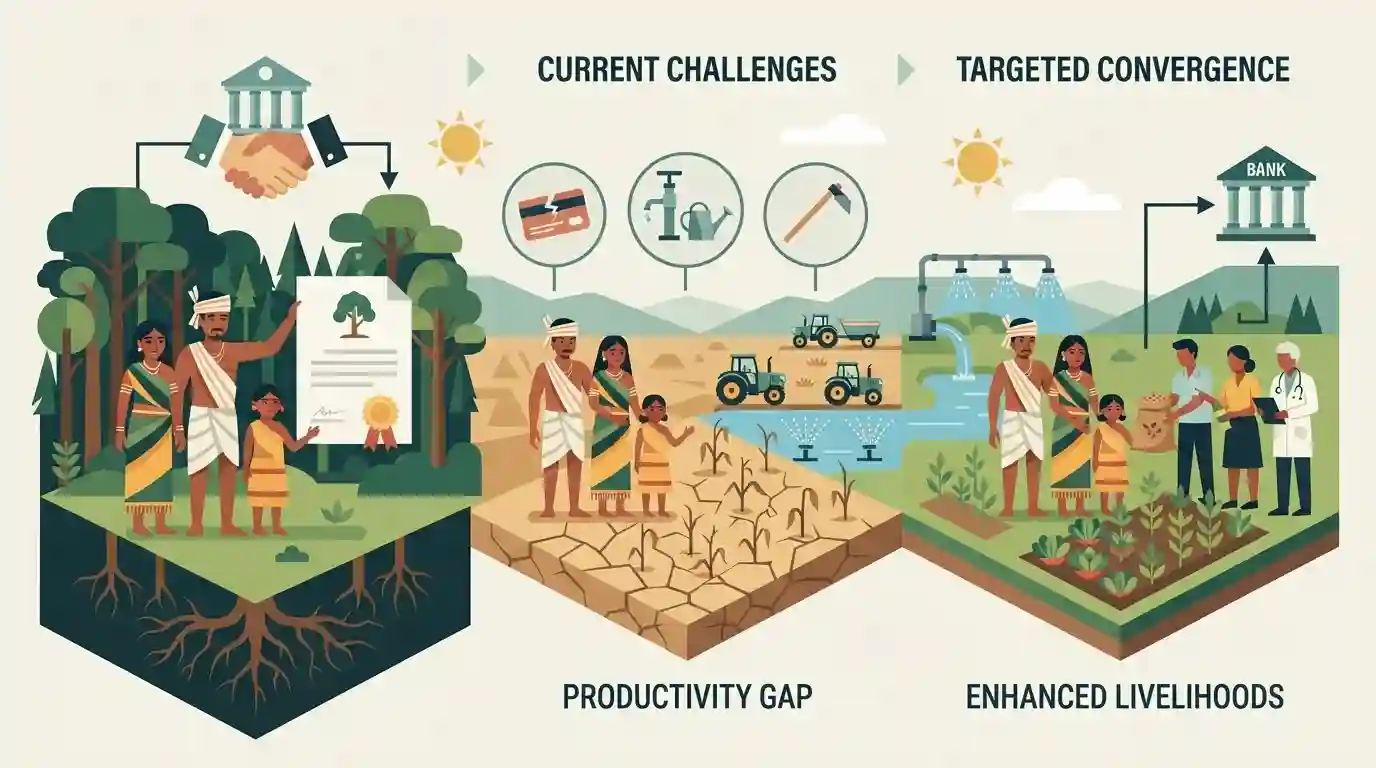
The article discusses the economic and agricultural potential of lands distributed under the Forest Rights Act (FRA), 2006. It highlights that while title deeds (IFRs) have provided legal security to tribal and forest-dwelling communities, the lack of credit, irrigation, and agricultural support limits their productivity. It advocates for targeted convergence between forest rights and agricultural development schemes to uplift marginal farmers and enhance rural livelihoods.
मुख्य मुद्दे
- The Forest Rights Act (FRA), 2006, recognizes individual and community forest rights, granting land titles (Individual Forest Rights or IFRs) to marginalized forest-dwelling communities.
- Despite receiving land titles, the agricultural potential of FRA lands remains underutilized due to lack of institutional credit, irrigation infrastructure, market linkages, and extension services.
- Unlocking the agricultural productivity of FRA lands requires targeted policy interventions, including convergence with agricultural schemes (like PM-KISAN, NABARD support, and irrigation programs) and secure tenure support.
- Empowering forest-dwellers economically through sustainable agricultural practices on FRA lands can significantly enhance tribal livelihoods while ensuring ecological conservation.
महत्त्वाच्या संज्ञा
Scheduled Tribes and Other Traditional Forest Dwellers (Recognition of Forest Rights) Act, 2006 (FRA)

A landmark legislation enacted in 2006 to recognize and vest forest rights and occupation in forest land in forest-dwelling Scheduled Tribes and Other Traditional Forest Dwellers, correcting historical injustices.
UPSC context
UPSC GS Paper 2 (Governance/Vulnerable Sections) and GS Paper 3 (Environment/Inclusive Growth). Evaluates tribal rights, forest conservation, and livelihood security.
पूर्वपरीक्षा सापळा
Individual Forest Rights (IFR) holders under the FRA can automatically access institutional agricultural credit and Kisan Credit Cards just like revenue-land farmers.
Possessing an Individual Forest Rights (IFR) title does not automatically make the land revenue land or grant eligibility for all agricultural credit schemes like Kisan Credit Cards without specific policy convergence.
संबंधित स्थिर संकल्पना
What are the key provisions and ceilings under the Scheduled Tribes and Other Traditional Forest Dwellers (FRA), 2006?
- Area Limit: Statutory Ceiling: Limits individual forest rights (IFRs) for self-cultivation and habitation to a maximum of 4 hectares per eligible household.
- Beneficiaries: Eligible Groups: Recognizes rights of forest-dwelling Scheduled Tribes (FDSTs) and Other Traditional Forest Dwellers (OTFDs) who have resided in forests for 75 years prior to Dec 13, 2005.
- Gram Sabha Role: Authority: Gram Sabha is designated as the nodal statutory body to initiate and process claims for forest rights recognition before higher committee approval.
आंतर-विषय नमुने
FRA Implementation vs Agricultural Inter-ministerial Convergence
FRA implementation is overseen by the Ministry of Tribal Affairs (MoTA), while agricultural credit and subsidies fall under the Ministry of Agriculture. Effective rural development requires breaking departmental silos via convergence frameworks.
Land Title Security vs Institutional Credit Access
Granting land titles under FRA without formal revenue classification creates a legal limbo, preventing tribal landowners from accessing formal banking collateral and institutional credit.

FRA land titles + credit exclusion + scheme convergence is a prime candidate for a multi-statement Prelims question or Mains GS-2/3.
संबंधित PYQ · 2
संबंधित PYQ · 2
- 2025MainsGS3
Explain the factors influencing the decision of the farmers on the selection of high value crops in India.
- 2023MainsGS2
“Development and welfare schemes for the vulnerable, by its nature, are discriminatory in approach.” Do you agree? Give reasons for your answer.
