India-Angola Bilateral Relations and Critical Minerals Cooperation
Source:The Hindu ↗
Why It Matters
Understanding India's outreach to resource-rich African nations like Angola is crucial for GS-2 (International Relations) and GS-3 (Energy Security). It highlights India's evolving strategy from traditional trade to technology sharing (DPI) and securing critical minerals for future industries.
Summary
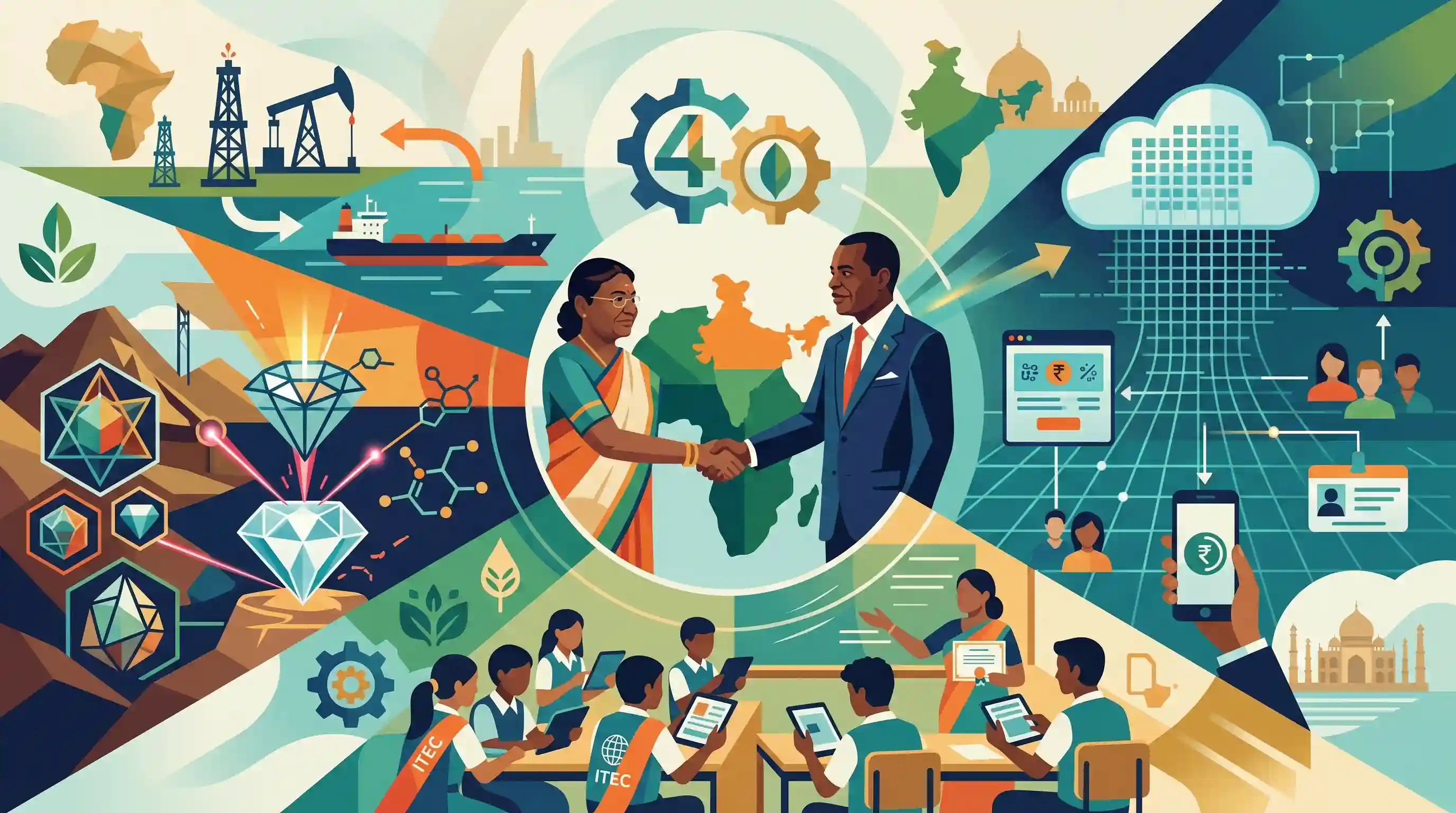
President Droupadi Murmu's historic visit to Angola aims to diversify and strengthen the 40-year-old bilateral relationship beyond its traditional reliance on oil. While India remains Angola's second-largest trading partner and oil importer, the new diplomatic push focuses on exploring critical minerals, diamond processing, and sharing India's Digital Public Infrastructure (DPI). The partnership underscores India's strategic outreach to Africa, emphasizing energy security, technological cooperation, and capacity building through initiatives like the ITEC programme.
Key Points
- President Droupadi Murmu completed the first-ever visit by an Indian President to Angola, coinciding with Angola's 50th Independence Day and 40 years of bilateral diplomatic ties.
- India is Angola's second-largest trading partner, with oil imports constituting roughly 90% of the bilateral trade.
- The leaders identified new areas of cooperation including critical minerals exploration, diamond processing, electric vehicles (EVs), and defence production.
- India proposed sharing its Digital Public Infrastructure (DPI) to boost financial inclusion and e-commerce in Angola, alongside offering infrastructure expertise like the Vande Bharat trains.
Important Terms
ITEC programme

A bilateral assistance scheme launched in 1964 providing technical training and capacity building to developing nations. It is a key soft power tool administered by India’s Ministry of External Affairs for South-South cooperation.
UPSC context
GS Paper II (International Relations); tests understanding of India’s development partnership model and outreach to Africa.
Digital Public Infrastructure (DPI)
Open, interoperable digital systems—like Aadhaar, UPI, and DigiLocker—enabling societal-scale service delivery. India shares this 'India Stack' with partners like Angola to promote e-governance, financial inclusion, and digital sovereignty.
UPSC context
GS Paper II/III (Governance/Tech); tests digital diplomacy and the export of India’s technology for global developmental goals.
Critical Minerals
Essential minerals like lithium, cobalt, and rare earths required for high-tech industries and green energy. India targets exploration in mineral-rich countries like Angola to diversify supply chains and support its Critical Mineral Mission.
UPSC context
GS Paper III (Economy/Resources); tests awareness of energy security, supply chain resilience, and strategic resource diplomacy.
Vande Bharat
India's indigenously designed semi-high-speed trains representing the 'Make in India' initiative. President Murmu’s offer to supply these to Angola highlights India’s transition to an exporter of advanced infrastructure and rail solutions.
UPSC context
GS Paper III (Infrastructure); tests indigenous manufacturing success and its role in enhancing India’s strategic and economic footprint abroad.
Diamond Processing
The downstream sector involving cutting and polishing raw diamonds. This synergy allows India (polishing leader) and Angola (raw producer) to bypass intermediaries, enhancing trade efficiency and value-chain integration.
UPSC context
GS Paper II (Bilateral Relations); tests knowledge of sectoral trade diversification and the optimization of global commodity value chains.
Energy Security
Ensuring reliable and affordable energy supply for national growth. Angola serves as India’s second-largest African crude supplier, making it central to India’s strategy of diversifying oil imports away from the Middle East.
UPSC context
GS Paper III (Economy); tests strategic planning for resource self-reliance and geopolitical risk management in energy procurement.
Prelims Trap
Angola, a major African oil supplier to India, is an active member of OPEC.
Angola officially withdrew from OPEC in January 2024 over production quota disputes. Any statement listing it as an active member is false.
Static Concepts Connected
Which countries border Angola, and what is its strategic maritime location?
- Land borders: Democratic Republic of the Congo (DRC) to the north/northeast, Zambia to the east, and Namibia to the south.
- Maritime boundary: It possesses a significant western coastline along the Atlantic Ocean, vital for maritime shipping and offshore oil exports.
- Cabinda exclave: An oil-rich Angolan exclave separated from the mainland territory by a narrow strip of the DRC.
What is the Indian Technical and Economic Cooperation (ITEC) programme?
- Launch & Purpose: Launched in 1964, it is an institutionalized bilateral assistance program fully funded by the Government of India.
- Core focus: It emphasizes capacity building, skill development, and professional training for partner countries in the Global South.
- Strategic value: It serves as a critical pillar of India's development partnership and soft-power diplomacy in Africa.
Cross-Topic Patterns
Critical minerals supplement traditional oil
India is shifting its African diplomacy from traditional hydrocarbon reliance toward securing critical minerals essential for its domestic EV ecosystem and renewable energy targets.
DPI as India's soft-power currency
Exporting Digital Public Infrastructure (DPI) to African nations offers a low-cost, high-impact soft-power alternative to China's hard-infrastructure Belt and Road Initiative (BRI).

Expect a multi-statement Prelims question combining Angola's 2024 OPEC exit, its Atlantic borders, and its critical mineral reserves.
Linked PYQs · 3
Linked PYQs · 3
- 2025MainsGS2
India-Africa digital partnership is achieving mutual respect, co-development and long-term institutional partnerships. Elaborate.
- 2025MainsGS2
"Energy security constitutes the dominant kingpin of India's foreign policy, and is linked with India's overarching influence in Middle Eastern countries.” How would you integrate energy security with India's foreign policy trajectories in the coming years?
- 2023PrelimsGS1
In the recent years Chad, Guinea, Mali and Sudan caught the international attention for which one of the following reasons common to all of them?
