TVK Shift Towards Negotiated Settlement in Cauvery Dispute
Source:Indian Express ↗
આ શા માટે મહત્વનું છે
The Cauvery water dispute is a classic example of inter-state conflicts in India, touching upon federalism, resource management, and regional politics. Understanding the shift from legal confrontation to political dialogue offers insights into alternative dispute resolution mechanisms and the evolving nature of cooperative federalism in addressing sensitive inter-state issues.
સારાંશ
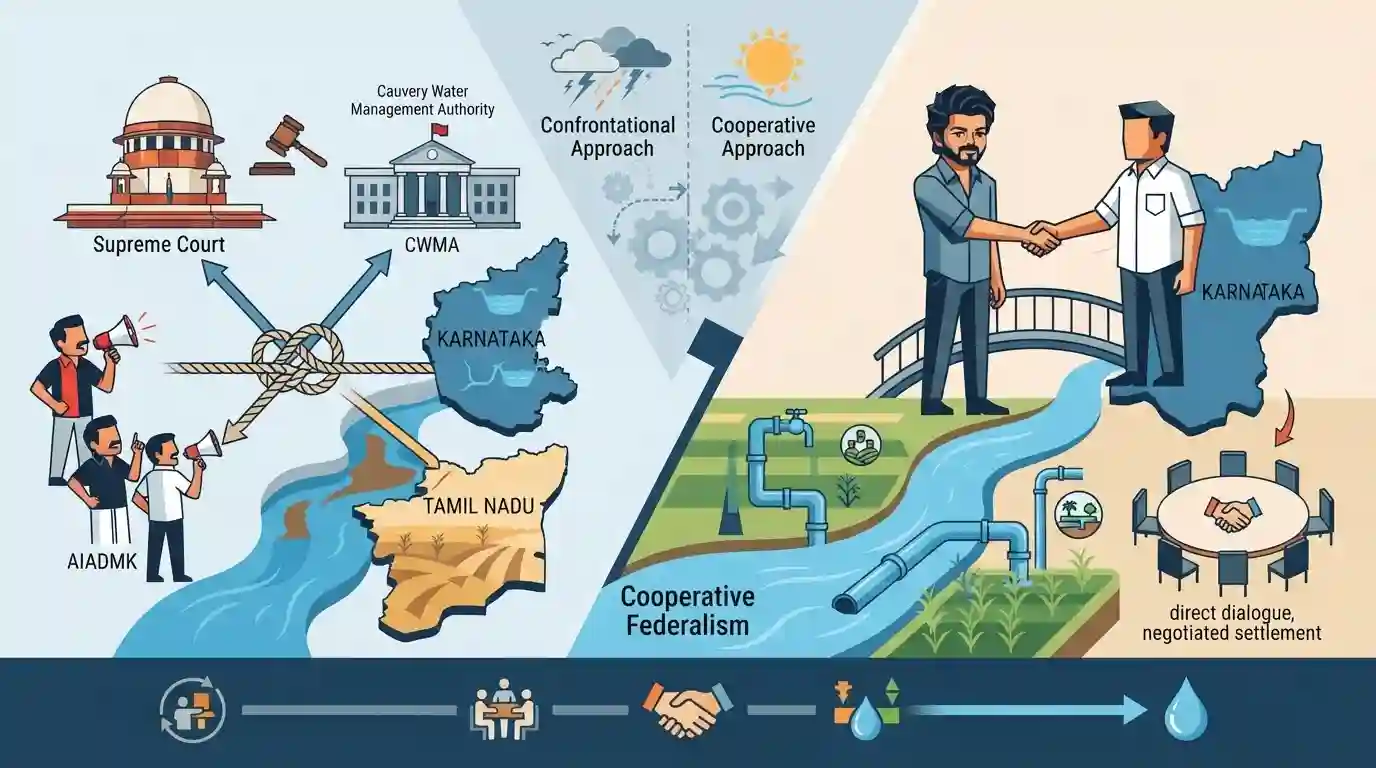
The article discusses the political stance of Thalapathy Vijay's newly formed Tamilaga Vettri Kazhagam (TVK) regarding the longstanding Cauvery water dispute between Tamil Nadu and Karnataka. Unlike the established Dravidian parties (DMK and AIADMK) which primarily rely on legal mechanisms like the Supreme Court and the Cauvery Water Management Authority to address the issue, Vijay advocates for a negotiated settlement through direct dialogue with Karnataka. This approach emphasizes maintaining amicable relations with neighboring states for the sake of regional stability and mutual benefit. The article contrasts this strategy with the historical confrontational approach and explores the potential political ramifications in the context of state rights, cooperative federalism, and the electoral strategies of both regional and national parties.
મુખ્ય મુદ્દા
- Tamil Nadu actor-turned-politician Vijay's TVK party advocates for dialogue with Karnataka on the Cauvery water dispute, a departure from the confrontational approach of mainstream Dravidian parties.
- The TVK's inaugural conference in Villupuram emphasized avoiding hostility with neighbors to foster regional unity and smooth governance.
- Dravidian majors DMK and AIADMK traditionally rely on legal avenues, particularly the Supreme Court and CWMA, to resolve water sharing and project disputes like the Mekedatu dam.
- Vijay's stance prioritizes political negotiation over legal battles, signaling a fresh approach to regional diplomacy and inter-state relations.
- The AIADMK has criticized Vijay's approach as inexperienced, defending the necessity of legal recourse to protect state rights on the Cauvery issue.
- The article highlights the broader political implications of the Cauvery dispute, including electoral calculations for national parties like Congress and BJP in both Tamil Nadu and Karnataka.
મહત્વપૂર્ણ શબ્દો
Tamilaga Vettri Kazhagam (TVK)

A regional political party in Tamil Nadu founded by actor Thalapathy Vijay, which advocates for direct dialogue over litigation to resolve the inter-state Cauvery water dispute.
UPSC context
Relates to GS Paper 2 (State Politics); illustrates the role of regional parties in shaping cooperative federalism and inter-state relations.
Cauvery Water Management Authority (CWMA)
A statutory, quasi-judicial body established by the Centre in 2018 to ensure the implementation of the Supreme Court's modified Cauvery Water Disputes Tribunal award.
UPSC context
Key for GS Paper 2 (Dispute Redressal Mechanisms). Tests knowledge of statutory bodies managing inter-state river resources.
Cauvery Water Disputes Tribunal
An adjudicatory body constituted in 1990 under the Inter-State River Water Disputes Act, 1956, to resolve water-sharing conflicts among Karnataka, Tamil Nadu, Kerala, and Puducherry.
UPSC context
Vital for GS Paper 2 (Inter-State Relations, Article 262), illustrating statutory dispute redressal mechanisms in Indian federalism.
Dravida Munnetra Kazhagam (DMK)
A major regional political party in Tamil Nadu that has historically relied on legal avenues and tribunals rather than negotiated settlements to secure the state's Cauvery water rights.
UPSC context
Relevant to GS Paper 2 (State Politics), highlighting how regional party strategies and electoral politics influence inter-state dispute resolution.
Supreme Court
The apex judicial body of India. In inter-state river conflicts, it often intervenes via Article 136 (Special Leave Petition), despite Article 262 barring its original jurisdiction over such disputes.
UPSC context
Important for GS Paper 2 (Judiciary) regarding constitutional provisions, Article 262, and limitations of judicial intervention in water disputes.
પ્રિલિમ્સ ટ્રેપ
The Supreme Court exercises original and exclusive jurisdiction over inter-state river water disputes under Article 131 of the Indian Constitution.
While Article 131 gives the SC original jurisdiction in inter-state disputes, Article 262 allows Parliament to bar this jurisdiction for water disputes. The SC hears water disputes via Special Leave Petitions (Article 136), not Article 131.
સંલગ્ન સ્થિર ખ્યાલો
What are the constitutional provisions for resolving inter-state water disputes under Article 262?
- Parliamentary Power: Empowers Parliament to legislate for the adjudication of disputes relating to the use, distribution, or control of waters of any inter-state river or river valley.
- Jurisdictional Bar: Allows Parliament to exclude the jurisdiction of the Supreme Court or any other court over such water disputes.
- Statutory Framework: Enacted the Inter-State Water Disputes Act, 1956, enabling the creation of ad-hoc tribunals for dispute resolution.
How does Article 263 facilitate inter-state dispute resolution?
- Presidential Authority: Empowers the President to establish an Inter-State Council to investigate, discuss, and advise on disputes between states.
- Advisory Nature: Unlike judicial tribunals, the Council is purely advisory and acts as a platform for political dialogue and cooperative federalism.
આંતર-વિષય પેટર્ન
Climate Vulnerability + Riparian Disputes
Erratic monsoons and climate-induced water stress render rigid, historically calculated volumetric water-sharing formulas obsolete, necessitating flexible, negotiated political solutions rather than static legal decrees.
Hydropolitics + Regional Sub-nationalism
Water disputes are frequently instrumentalized for sub-national identity mobilization, making any shift toward bilateral state-level dialogue a test of cooperative federalism.

Mains 2026 may evaluate the limits of Article 262 judicial tribunals versus Article 263 cooperative dialogue in chronic hydropolitical disputes.
સંલગ્ન PYQ · 2
સંલગ્ન PYQ · 2
- 2015MainsGS2
The concept of cooperative federalism has been increasingly emphasized in recent years. Highlight the drawbacks in the existing structure and the extent to which cooperative federalism would answer the shortcomings.
- 2019MainsGS2
From the resolution of contentious issues regarding distribution of legislative powers by the courts, 'Principle of Federal Supremacy' and 'Harmonious Construction' have emerged. Explain.
