United States Section 301 Tariffs and Bilateral Trade Negotiations
Source:Indian Express ↗
Why It Matters
Demonstrates the increasing use of non-trade issues (such as forced labour and manufacturing capacity) to justify unilateral protectionist tariffs. This challenges the multilateral WTO framework and directly impacts India's export competitiveness, highlighting the need for robust bilateral negotiations and domestic policy reforms.
Summary
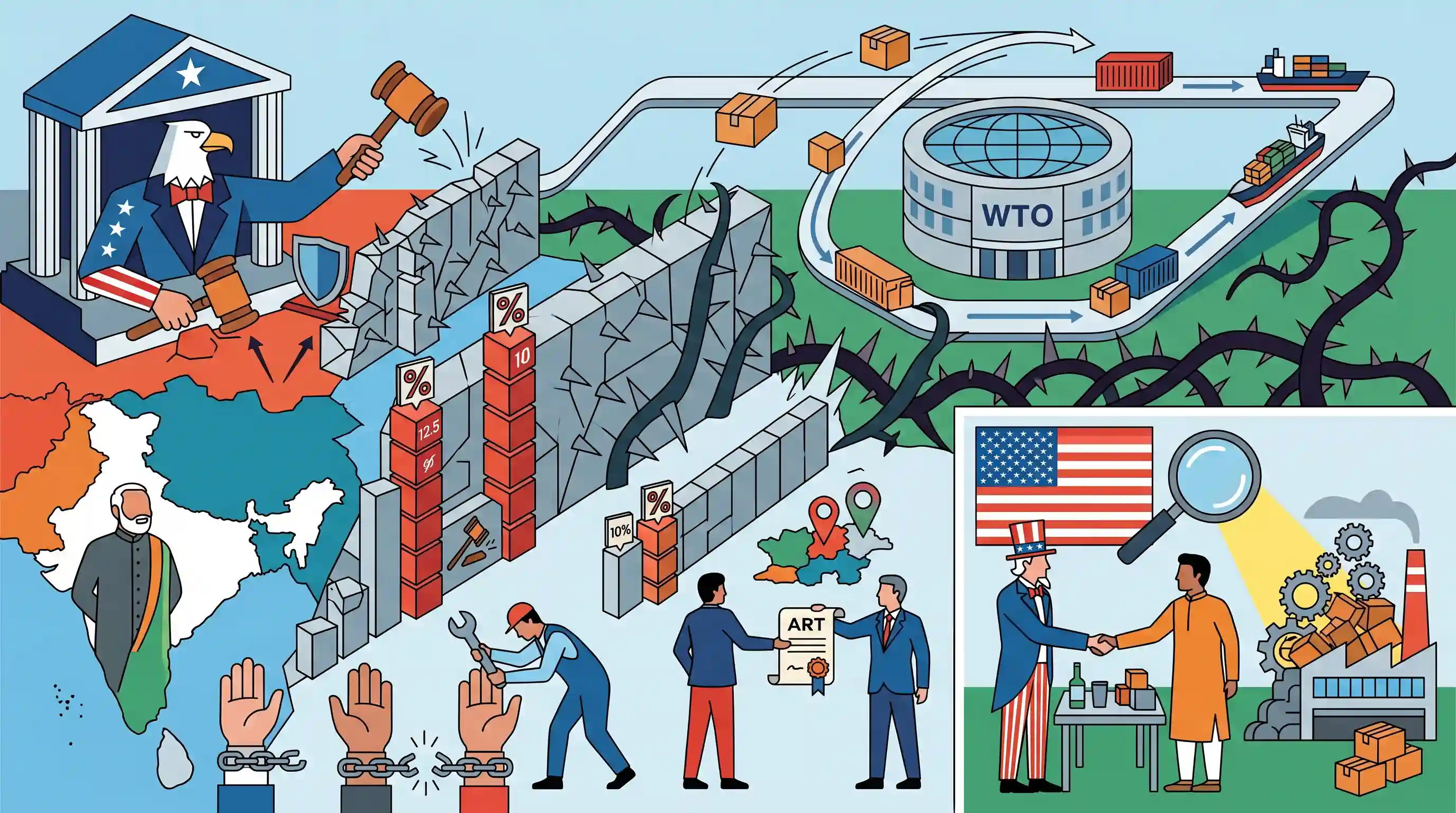
The United States has proposed a 12.5% tariff on imports from India and 53 other countries, citing their failure to enact legal prohibitions against goods produced with forced labour. A reduced 10% tariff is proposed for six nations that have committed to addressing the issue and signed an Agreement on Reciprocal Trade (ART). These actions, undertaken by the USTR under Section 301 of the Trade Act of 1974, replace earlier reciprocal tariffs invalidated by the US Supreme Court. While India is in ongoing bilateral trade talks with the US to mitigate the impact, it also faces a separate USTR investigation over alleged excess manufacturing capacity. These unilateral measures reflect a growing US trend of bypassing the WTO framework, raising concerns about rising protectionism linked to non-trade issues.
Key Points
- The US proposed a 12.5% tariff on India and 53 other nations for lacking legal prohibitions on importing goods produced using forced labour.
- A lower 10% tariff rate is offered to six countries (including Pakistan, Canada, and the EU) that signed an Agreement on Reciprocal Trade (ART) and showed commitment to tackling forced labour imports.
- These tariffs are initiated under Section 301 of the US Trade Act of 1974, replacing previous reciprocal tariffs that were struck down by the US Supreme Court.
- India is currently engaged in bilateral trade talks with the US to navigate these proposed tariffs and safeguard its export interests.
- Simultaneously, the USTR has launched another investigation against 16 countries, including India, alleging excess manufacturing capacity.
- The US is increasingly utilizing unilateral trade tools like Section 301, effectively bypassing the World Trade Organization (WTO) and escalating global protectionism.
Important Terms
Section 301 of the Trade Act of 1974

A US law empowering the Trade Representative to investigate and take unilateral action, including tariffs, against foreign trade practices deemed unfair or burdensome to US commerce.
UPSC context
GS-II (International Relations) and GS-III (Economy); tests knowledge of unilateral trade tools vs. multilateral WTO frameworks.
United States Trade Representative (USTR)
A US government agency responsible for developing trade policy, conducting negotiations, and enforcing trade laws through investigations like those targeting forced labour or excess capacity.
UPSC context
GS-II; central body in India-US trade diplomacy and disputes.
Agreement on Reciprocal Trade (ART)
A bilateral framework where countries commit to enforcing specific standards (such as forced labour prohibitions) in exchange for preferential or reduced US tariff rates.
UPSC context
GS-III; illustrates non-trade issues (labour standards) being integrated into bilateral trade agreements.
Structural Excess Capacity
A situation where an industry's production potential exceeds domestic and global demand, often due to subsidies, resulting in trade surpluses and market distortions.
UPSC context
GS-III; core issue in global trade wars and US-India industrial friction.
World Trade Organization (WTO)
The international body governing global trade rules; its principles are often tested by unilateral tariffs that exceed 'bound' duty rates.
UPSC context
GS-II; foundational for understanding the rules-based international order and its current challenges.
Prelims Trap
Section 301 tariffs are a retaliatory trade remedy officially authorized by the WTO's dispute settlement mechanism.
Section 301 is a US domestic law used to unilaterally impose tariffs. It actively bypasses the multilateral WTO dispute settlement framework rather than being authorized by it.
Static Concepts Connected
What is the WTO's Most-Favoured-Nation (MFN) principle?
- Core Principle: A WTO member must treat all other members equally; a trade favour granted to one must be extended to all members.
- Exceptions: Free Trade Agreements (FTAs) and special access preferences for developing countries (like the Generalized System of Preferences) are permitted exceptions.
- Threat from ARTs: Agreements on Reciprocal Trade (ARTs) demand tit-for-tat bilateral terms, directly undermining the non-discriminatory, multilateral equality that MFN guarantees.
How do Non-Tariff Barriers (NTBs) function in modern trade?
- Definition: Trade restrictions that do not involve traditional customs duties, such as quotas, import licensing, or sanitary and phytosanitary (SPS) measures.
- Weaponisation: Developed nations increasingly use strict domestic labour, environmental, or human rights standards to legally block cheaper imports from developing economies.
Cross-Topic Patterns
Labour standards & EU CBAM linkage
The US forced-labour tariff mirrors the EU's Carbon Border Adjustment Mechanism (CBAM). Both represent a trend of developed nations weaponising domestic ESG and non-trade issues as disguised non-tariff barriers.
Excess capacity & anti-dumping measures
The US investigation into 'excess manufacturing capacity' links to global concerns over China dumping subsidized solar modules and steel, though India is increasingly getting caught in the crossfire.

Expect a 2026 Mains question on developed nations weaponising non-trade issues (labour/climate) as non-tariff barriers bypassing the WTO.
Linked PYQs · 2
Linked PYQs · 2
- 2018MainsGS2
What are the key areas of reform if the WTO has to survive in the present context of "Trade War', especially keeping in mind the interest of India?
- 2025MainsGS3
What are the challenges before the Indian economy when the world is moving away from free trade and multilateralism to protectionism and bilateralism? How can these challenges be met?
