Lok Sabha Defeats Constitutional Amendment Bill for Womens Quota
Source:The Hindu ↗
Why It Matters
The defeat of a constitutional amendment bill is a rare and significant procedural event that underscores the workings of Article 368. Furthermore, it brings to the forefront the enduring federal friction regarding delimitation—balancing the democratic principle of equal representation ("one person, one vote") against penalizing states with effective demographic management. It also directly affects the timeline for achieving gender parity in political representation.
Summary
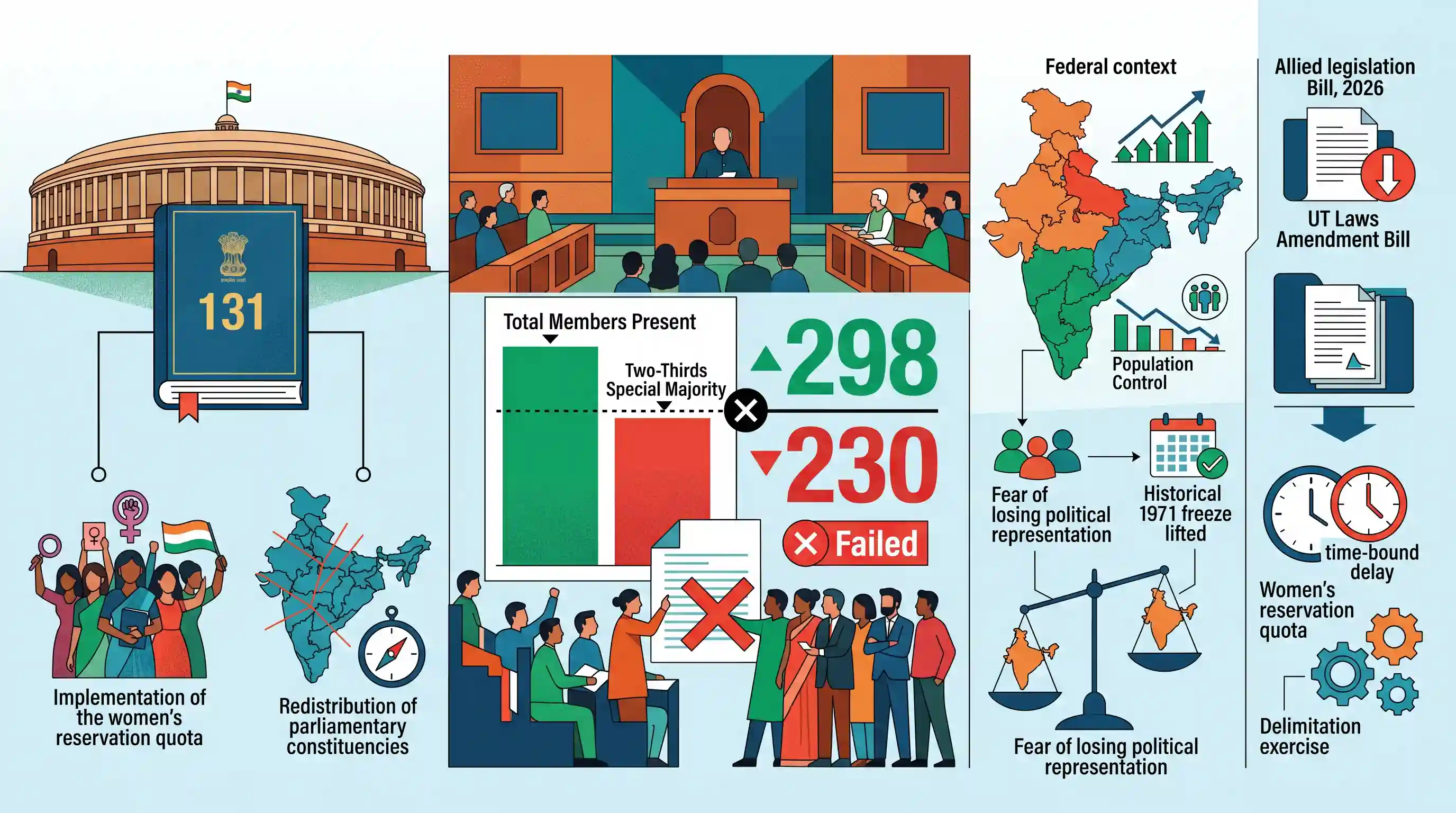
The Constitution (131st Amendment) Bill, 2026, which sought to redistribute parliamentary constituencies based on the 2011 Census to implement the women's reservation quota, was defeated in the Lok Sabha. A united Opposition blocked the legislation, causing it to fall short of the required two-thirds special majority (298 for, 230 against). The opposition, particularly from southern states, feared losing political representation as a penalty for successful population control since the 1971 Census freeze. Consequently, allied legislation including the Delimitation Bill, 2026, were withdrawn, stalling both the impending delimitation exercise and the time-bound implementation of women's reservation.
Key Points
- The Constitution (131st Amendment) Bill, 2026, aimed at redistributing Lok Sabha seats based on the 2011 Census to enable women's reservation, was defeated in the Lok Sabha.
- The Bill failed to achieve the special majority required under Article 368, securing 298 votes in favor and 230 against, falling short of the two-thirds requirement.
- Opposition members, especially from southern states, opposed the delimitation exercise over fears of reduced parliamentary representation due to their successful population control measures since the 1971 Census.
- Home Minister Amit Shah argued that freezing delimitation violates the principle of "one person, one vote, one value" and rejected demands to delink women's reservation from the delimitation process.
- Following the defeat of the constitutional amendment, allied bills including the Delimitation Bill, 2026, were withdrawn by the government.
Important Terms
Constitution (131st Amendment) Bill, 2026

A proposed 2026 legislation to increase Lok Sabha seats to 850 and delink women's reservation from the post-2026 census, enabling immediate implementation using 2011 data.
UPSC context
GS Paper II: Constitution/Amendments. Tests knowledge of Article 368, special majority, and federal seat allocation logic post-1971 freeze.
Nari Shakti Vandan Adhiniyam
Officially the Constitution (106th Amendment) Act, 2023, it mandates 33% reservation for women in Lok Sabha and State Assemblies, initially conditional upon a post-Act census and delimitation.
UPSC context
GS Paper II: Social Justice/Women. Tests understanding of gender-based electoral reforms and the legal hurdles in time-bound implementation.
Delimitation Commission
An independent body (Article 82) tasked with redrawing electoral boundaries to ensure constituencies have roughly equal population, maintaining the 'One Person, One Vote' principle.
UPSC context
GS Paper II: Statutory Bodies. Tests knowledge of the Commission’s powers, its binding orders, and the census-linked seat readjustment process.
Delimitation Bill, 2026
A 2026 proposal to repeal the 2002 Act, providing for a new Commission to redistribute seats based on the latest published (2011) census figures.
UPSC context
GS Paper II: Representation of People Act/Parliament. Tests the procedural steps of seat reallocation and the legislative-executive interplay in electoral redrawing.
Union Territories Laws (Amendment) Bill, 2026
Legislation seeking to align the governance frameworks of Delhi, Puducherry, and Jammu & Kashmir with national changes in delimitation and women’s legislative quotas.
UPSC context
GS Paper II: Federalism/Union Territories. Tests specific constitutional provisions for UT legislatures (Articles 239AA, 239A) and their unique representation status.
Prelims Trap
Women's reservation under the 106th Amendment Act takes effect immediately upon receiving Presidential assent.
Article 334A explicitly conditions the commencement of the women's quota on the publication of a fresh Census and the completion of a subsequent delimitation exercise.
Static Concepts Connected
What is the Delimitation Commission and its constitutional status?
- Constitutional basis: Under Article 82, Parliament enacts a Delimitation Act after every Census to establish the Commission.
- Immunity from review: The Commission's orders have the force of law and cannot be questioned in any court.
- No legislative modification: Copies of its orders are laid before the Lok Sabha and State Assemblies, but they cannot effect any modifications to them.
Which constitutional amendments govern the freeze on Lok Sabha seats?
- 42nd Amendment (1976): Froze the allocation of Lok Sabha seats to states at 1971 Census levels until the year 2000 to promote family planning.
- 84th Amendment (2001): Extended the 1971 population-based freeze on the total number of seats until the first Census taken after the year 2026.
- 87th Amendment (2003): Permitted the territorial readjustment of constituencies within states based on the 2001 Census, without changing the total number of seats.
Cross-Topic Patterns
Finance Commission vs. Delimitation
The 15th and 16th Finance Commissions used 'Demographic Performance' to reward southern states for population control, aiming to mitigate the exact federal penalty that purely population-based delimitation threatens to impose.
Local vs National Women's Quotas
While Panchayati Raj institutions (Article 243D) implemented a 33% women's reservation independently, Lok Sabha and Assembly quotas (Article 334A) are procedurally chained to the politically volatile delimitation exercise.

Delimitation freeze, federal representation, and women's quota linkage forms a high-probability GS2 Mains question for 2026.
Linked PYQs · 4
Linked PYQs · 4
- 2024PrelimsGS1
As per Article 368 of the Constitution of India, the Parliament may amend any provision of the Constitution by way of : 1. Addition 2. Variation 3. Repeal Select the correct answer using the code given below:
- 2022PrelimsGS1
Consider the following statements: 1. A bill amending the Constitution requires a prior recommendation of the President of India. 2. When a Constitution Amendment Bill is presented to the President of India, it is obligatory for the President of India to give his/her assent. 3. A Constitution Amendment Bill must be passed by both the Lok Sabha and the Rajya Sabha by a special majority and there is no provision for joint sitting. Which of the statements given above are correct?
- 2024PrelimsGS1
How many Delimitation Commissions have been constituted by the Government of India till December 2023?
- 2023MainsGS2
Discuss the contribution of civil society groups for women's effective and meaningful participation and representation in state legislatures in India.
