United Nations: 80 Years of Multilateralism and Reform Debates
Source:Indian Express ↗
Why It Matters
As 2025 marks the 80th anniversary of the United Nations, it becomes a high-probability topic for UPSC. Understanding the foundational history, the UN Charter, the structure of its principal organs (like the UNSC and UNGA), and the ongoing debates over institutional reform and multilateral effectiveness is critical for Prelims (factual questions) and Mains GS-2 (analytical questions on global governance and India's role/demand for UNSC reforms).
Summary
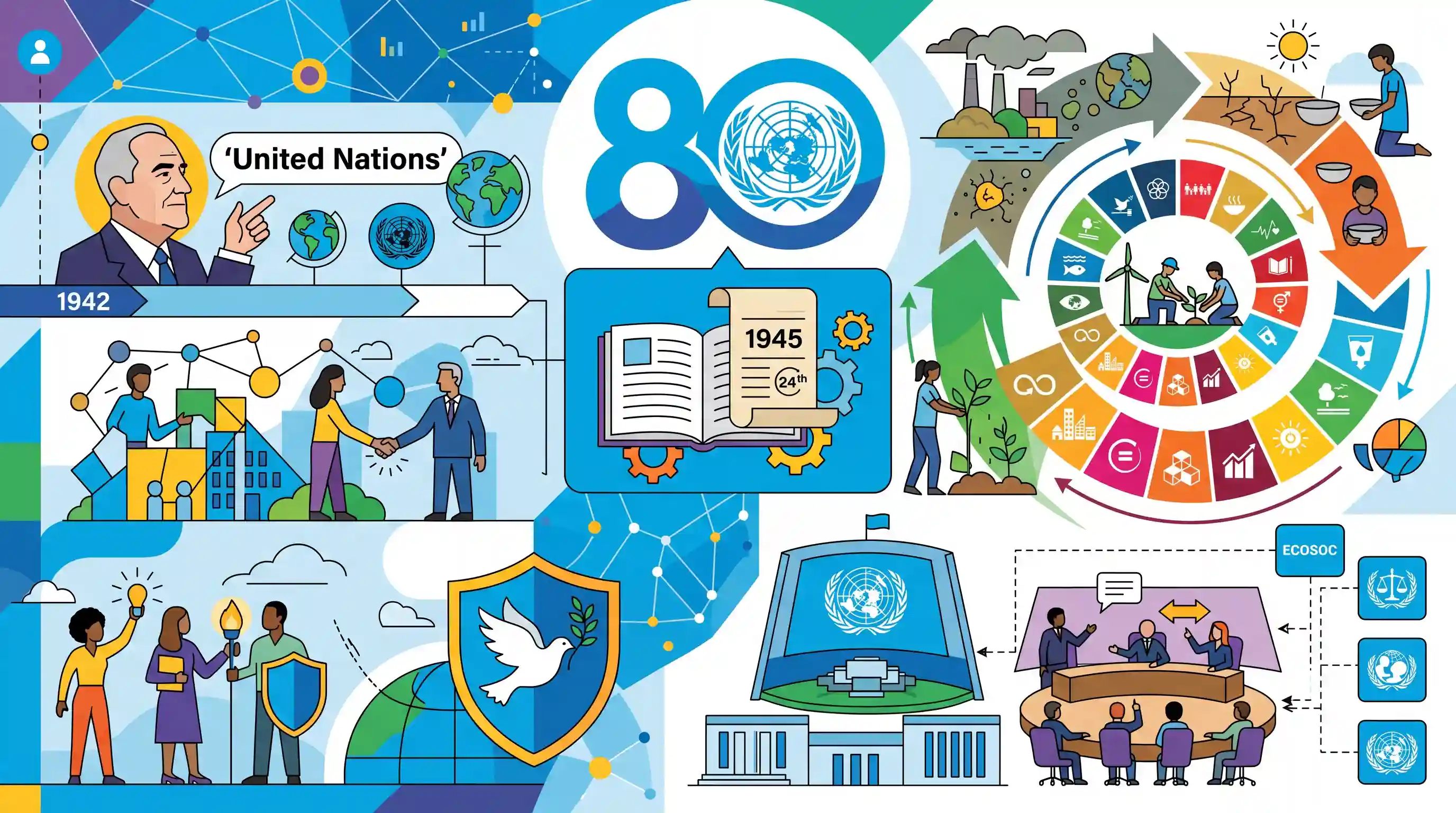
United Nations Day is celebrated annually on October 24, commemorating the day in 1945 when the UN Charter officially came into force, establishing the organization. The year 2025 is particularly historic as it marks the 80th anniversary of the United Nations. The article delves into the history of the UN, noting that the term was first coined by US President Franklin D. Roosevelt in 1942. The celebrations and themes revolve around reaffirming the core principles of the UN Charter: maintaining international peace, protecting human rights, and advancing global cooperation. Furthermore, it highlights the importance of the Sustainable Development Goals (Agenda 2030) in tackling modern crises like poverty, hunger, and climate change, while implicitly pointing to the growing debate around reforming UN institutions like the Security Council to reflect 21st-century realities.
Key Points
- United Nations Day is observed globally on October 24 to commemorate the anniversary of the UN Charter's entry into force in 1945.
- The year 2025 marks the significant 80th anniversary of the establishment of the United Nations, reflecting on eight decades of international cooperation and multilateralism.
- The term 'United Nations' was originally coined by US President Franklin D. Roosevelt during the 1942 Declaration by United Nations.
- The day emphasizes the UN's ongoing mission to maintain global peace and security, protect human rights, and promote sustainable development through Agenda 2030.
- Amid changing global dynamics, the occasion also serves as a reminder of the urgent need for UN and UNSC reforms to address contemporary geopolitical challenges and conflicts effectively.
Important Terms
United Nations (UN)

The world's most universal international organization, founded in 1945 to maintain global peace, security, and cooperation among its currently 193 member states.
UPSC context
GS Paper II: International institutions; focuses on India's historical role as a founding member and its current peacekeeping contributions.
UN Charter
The UN's founding treaty, signed in June 1945, which codifies international law principles like sovereign equality and the peaceful settlement of disputes.
UPSC context
GS Paper II: Global governance; tested via articles like 2(4) on force and 51 on self-defense in contemporary conflict analysis.
United Nations Security Council (UNSC)
The 15-member UN body (5 permanent, 10 non-permanent) primarily responsible for global peace and security, with the authority to issue binding resolutions.
UPSC context
GS Paper II: International relations; specifically India's bid for a permanent seat and the demand for democratizing global institutions.
United Nations General Assembly (UNGA)
The UN's main deliberative and representative organ where all member states have an equal vote to discuss budget, membership, and global policy recommendations.
UPSC context
GS Paper II: International forums; tests the distinction between non-binding resolutions and the sovereign equality of nations.
Sustainable Development Goals (SDGs)
A collection of 17 interconnected global goals adopted in 2015 to end poverty, protect the environment, and ensure prosperity for all by 2030.
UPSC context
GS Paper III: Environment and Development; critical for topics on climate justice, poverty alleviation, and NITI Aayog's SDG India Index.
Agenda 2030
The comprehensive global plan for action adopted by the UN in 2015, prioritizing the 17 SDGs as a blueprint for human and planetary well-being.
UPSC context
GS Paper III: Economic development; focuses on the transition from Millennium Development Goals (MDGs) to universal sustainability targets.
Declaration by United Nations
A 1942 document signed by 26 nations pledging to fight the Axis Powers, marking the first official use of the term 'United Nations.'
UPSC context
GS Paper I: World History; covers the transition from the failed League of Nations to the modern post-WWII international order.
Prelims Trap
"The UN Charter was signed by member states on October 24, 1945."
October 24, 1945 is when the Charter came into FORCE. It was actually signed months earlier on June 26, 1945, in San Francisco.
Static Concepts Connected
What are the main groupings involved in UNSC reform debates?
- G4 Nations: India, Brazil, Germany, and Japan, who actively support each other's bids for permanent seats in a reformed UNSC.
- Uniting for Consensus: Also known as the Coffee Club (led by Italy, Pakistan, etc.), which strongly opposes adding new permanent members, advocating instead for more non-permanent seats.
- Ezulwini Consensus: A position held by the African Union demanding at least two permanent and five non-permanent UNSC seats for the African continent.
What are the core origins and founding milestones of the UN?
- Term Origin: The name 'United Nations' was coined by US President Franklin D. Roosevelt, first officially used in the 1942 Declaration by United Nations.
- UN Charter: The foundational treaty of the UN, drafted and signed by 50 nations in June 1945 in San Francisco, which formally established the six principal organs.
Cross-Topic Patterns
UNSC Reform & The Global South
India's push for UNSC reform during the UN's 80th anniversary ties directly into its broader diplomatic strategy of positioning itself as the leader and 'Voice of the Global South'.
Agenda 2030 & Climate Finance Deficits
The critical funding gap for achieving Agenda 2030 (SDGs) closely mirrors the ongoing GS3 debates regarding the New Collective Quantified Goal (NCQG) and broken climate finance promises at UNFCCC COPs.

The UN's 80th anniversary in 2025 makes a 2026 question on the IGN process, Ezulwini consensus, or exact UN Charter origins highly likely.
Linked PYQs · 4
Linked PYQs · 4
- 2025MainsGS2
"The reform process in the United Nations remains unresolved, because of the delicate imbalance of East and West and entanglement of the USA vs. Russo-Chinese alliance.” Examine and critically evaluate the East-West policy confrontations in this regard.
- 2024MainsGS2
‘Terrorism has become a significant threat to global peace and security.’ Evaluate the effectiveness of the United Nations Security Council's Counter Terrorism Committee (CTC) and its associated bodies in addressing and mitigating this threat at the international level.
- 2009PrelimsGS1
The Security Council of UN consists of 5 permanent members, and the remaining 10 members are elected by the General Assembly for a term of
- 2022PrelimsGS1
With reference to the United Nations General Assembly, consider the following statements: 1. The UN General Assembly can grant observer status to the non-member States. 2. Inter-governmental organisations can seek observer status in the UN General Assembly. 3. Permanent Observers in the UN General Assembly can maintain missions at the UN headquarters. Which of the statements given above are correct?
