United Nations Chief Warns Against Global Violations of Law
Source:The Hindu ↗
Why It Matters
The remarks by the UN Secretary-General highlight the growing systemic challenges facing international institutions today. For UPSC aspirants, this illustrates the 'crisis of multilateralism', demonstrating how geopolitical polarization, flouting of the UN Charter by veto-wielding powers, and financial starvation threaten the UN's viability. This forms critical fodder for GS2 questions on UN reforms, global governance, and the East-West divide.
Summary
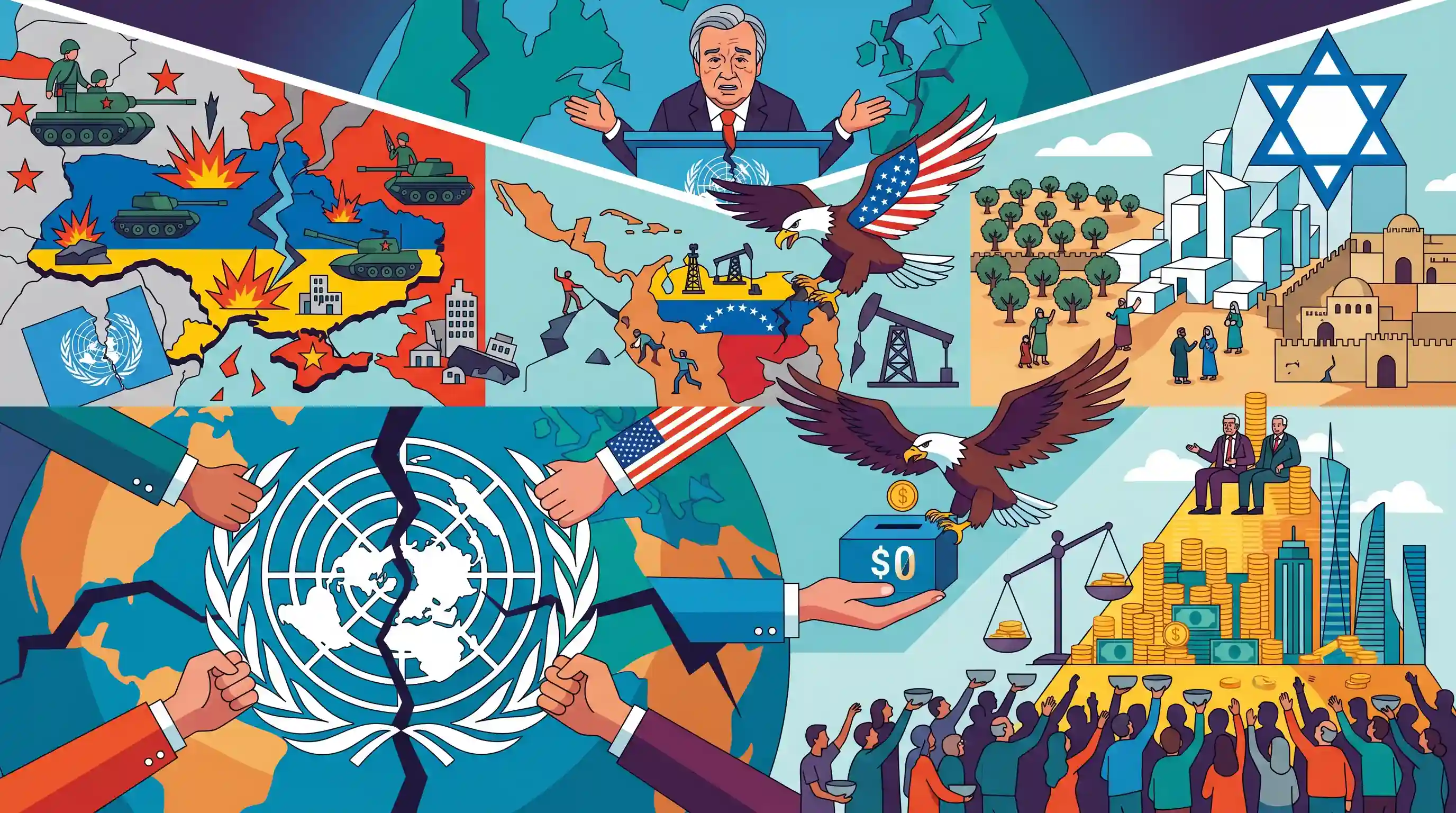
United Nations Secretary-General António Guterres sharply criticized several member states, including Russia, the United States, and Israel, for undermining global order through violations of international law and the UN Charter. He highlighted Russia's invasion of Ukraine, US military interventions in Venezuela, and Israel's actions in the West Bank as prime examples of major powers flouting multilateral norms. In addition to geopolitical conflicts, Guterres raised urgent concerns regarding extreme global wealth inequality and the financial crisis within the UN itself, driven by the non-payment of obligatory dues by key nations, notably the United States.
Key Points
- UN Secretary-General António Guterres condemned major global powers for violating international law and the UN Charter, citing a breakdown in multilateralism.
- Russia was criticized for its invasion of Ukraine, while the US was called out for interventions in Venezuela aimed at capturing President Nicolás Maduro.
- Guterres described Israel's policies in the occupied West Bank as a form of 'apartheid'.
- He highlighted stark global economic disparities, noting that the world's richest 1% holds 43% of global financial assets while billions remain in poverty.
- The functioning of the UN is being severely hampered by financial constraints, largely due to member nations—most notably the US under the Trump administration—withholding their dues.
Important Terms
UN Charter

Foundational treaty (1945) establishing the United Nations’ purposes, principles, and organs. It mandates sovereign equality, peaceful dispute settlement, and non-intervention, serving as the legal bedrock for the modern international rules-based order.
UPSC context
GS II: Important International institutions; tests understanding of global governance frameworks and the legal basis of the international order.
UN Security Council (UNSC)
The UN’s primary organ for maintaining international peace and security. It consists of 15 members (5 permanent with veto power) and is the only UN body capable of issuing legally binding resolutions to member states.
UPSC context
GS II: Reforms of international bodies; tests knowledge of UN structure and India’s long-standing bid for permanent membership.
Multilateralism
An international relations framework where three or more countries collaborate to address global challenges. It relies on shared norms and institutions (like the UN or WTO) to prevent unilateralism and balance power.
UPSC context
GS II: Global groupings and agreements; critical for India’s "reformed multilateralism" policy and its role in a multipolar world.
International Law
A body of rules, norms, and standards generally accepted in relations between sovereign states and international organizations. It covers areas such as human rights, war, and trade, functioning through treaties and customs.
UPSC context
GS II: International Relations; examines the efficacy of global rules in managing conflict and protecting the sovereignty of smaller nations.
Sovereignty
The supreme and independent authority of a state to govern its territory and people without external interference. It implies the legal equality of states and their right to exercise exclusive domestic jurisdiction.
UPSC context
GS II: India and its neighborhood; relevant for understanding territorial integrity and non-interference as cornerstones of Indian foreign policy.
Assessed Contributions
Mandatory payments required from UN member states to fund the organization's regular and peacekeeping budgets. These amounts are determined based on a country's economic capacity, such as Gross National Income.
UPSC context
GS II: Challenges in global governance; tests understanding of financial vulnerabilities and structural dependencies within international organizations.
Prelims Trap
"The United Nations' regular budget is entirely reliant on voluntary contributions from member states."
The UN's core budget and peacekeeping are funded by mandatory "assessed" contributions based on economic capacity. Voluntary funding is primarily for specialized agencies like UNICEF.
Static Concepts Connected
How is the United Nations funded?
- Assessed contributions: Mandatory payments calculated based on a member state's Gross National Income (GNI), population, and debt burden to fund the core budget and peacekeeping operations.
- Voluntary contributions: Discretionary funds provided by member states to finance specialized UN agencies, funds, and programs like UNICEF, WFP, and UNDP.
- Article 19 penalty: Under the UN Charter, a member state in arrears can lose its General Assembly vote if unpaid dues equal or exceed the previous two years' assessments.
Under what conditions does the UN Charter legally permit military force?
- Article 51 (Self-Defense): Allows member states to use force in individual or collective self-defense if an armed attack occurs against them.
- Chapter VII Authorization: The UN Security Council can authorize military action or sanctions to maintain or restore international peace and security.
- Article 2(4) Prohibition: States are generally prohibited from the threat or use of force against the territorial integrity or political independence of any state, making unauthorized invasions illegal.
Cross-Topic Patterns
Institutional weaponization via funding blockades
The US withholding UN dues mirrors its strategy of blocking WTO Appellate Body appointments, highlighting a broader pattern of great powers weaponizing administrative and funding mechanisms to paralyze multilateral institutions.
Global South solidarity amid UN paralysis
As P5 nations (US, Russia) repeatedly flout the UN Charter, platforms like BRICS and the Voice of Global South Summit are gaining legitimacy as parallel forums demanding structural UNSC reforms.

Expect a multi-statement Prelims question comparing assessed vs. voluntary UN contributions and the penalty mechanisms under Article 19.
Linked PYQs · 2
Linked PYQs · 2
- 2025MainsGS2
"The reform process in the United Nations remains unresolved, because of the delicate imbalance of East and West and entanglement of the USA vs. Russo-Chinese alliance.” Examine and critically evaluate the East-West policy confrontations in this regard.
- 2020MainsGS3
Explain intra-generational and inter-generational issues of equity from the perspective of inclusive growth and sustainable development.
